
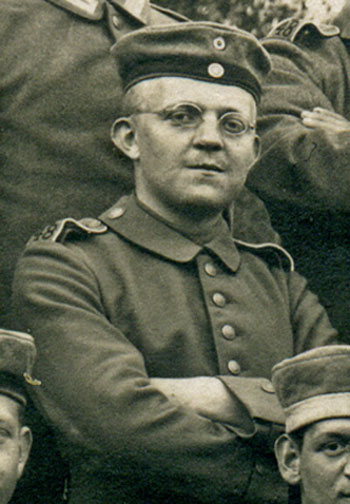
Thus far we have seen Arno in his battery's fire positions on the Juvincourt-Corbeny road and in the infantry positions at La-Ville-aux-Bois, where I now believe he spent some time with the crew of a forward-deployed 5.7cm fortress gun of captured Belgian origin. His final group of photos from 1915 takes us up to June and further north into the divisional rear area.
While holding La-Ville-aux-Bois, the main billeting area of Kgl. Sächs. Schützen (Füsilier)-Regiment Prinz Georg Nr.108 (SR 108) was the village of Berrieux, though they were also present in its smaller near-neighbour Goudelancourt-lès-Berrieux. This tiny settlement was chiefly notable for a substantial private estate on its western edge, the Château de Belval - invariably referred to by the Germans as Schloss Belval or simply 'Belval'. Although it would have made a fine headquarters, the chateau was surplus to requirements for that purpose and instead became the Erholungsheim (rest and recreation home) of the 23. Infanterie-Division. So far as we can determine, ordinary soldiers of the division's fighting units were sent here in batches for short periods to recuperate from the stresses of trench warfare.
So why was Arno here in early June 1915? I believe that the explanation lies in the fact that his photos from Schloss Belval all include infantrymen from Kgl. Sächs. 2. Grenadier-Regiment Kaiser Wilhelm, König von Preußen Nr.101 (GR 101, usually known among Saxons as the Kaisergrenadiere as opposed to the Königsgrenadiere of their sister regiment LGR 100). This regiment held the sector immediately to the left / east of SR 108, extending from the Pappelallee to just beyond the Miettebach (a small tributary of the Aisne which ran through the German lines); their main strongpoint was a farmhouse known as Le Cholera Ferme.
Due to a French mine detonation and incessant trench mortar attacks in April, the regiment launched a local attack on 10th May 1915 by three companies, accompanied by Pioniere and by two machine-guns from SR 108. This operation succeeded in taking 400 metres of the French front line as well as 42 prisoners and a large quantity of materiel. However it also clearly agitated the enemy, resulting in a period of intense and prolonged artillery exchanges. As a result, from 10th to 13th May alone the Kaisergrenadiere lost 86 dead, 278 wounded and three missing. As for the Saxon artillery, the entirety of FAR 48 had supported the original operation, and the regiment was subsequently heavily engaged in counter-battery fire missions in conjunction with the corps heavy artillery. The published history of FAR 48 reckons that this period of intense activity subsided around 20th May, while that of GR 101 records severe French bombardments as late as the 26th - as well as severe damage inflicted on their new line on 1st June by trench mortars and aerial bombing. After a deceptive period of calm, on 11th June the French launched a concerted attempt to retake their lost position using dedicated bombing parties. This was beaten off without breaching the Saxon line, and the GR 101 sector then remained relatively quiet for the rest of the summer.
My supposition is that elements of GR 101 and FAR 48 were sent to the Erholungsheim around the end of May to recuperate from this period of enhanced activity. While Arno is surmised to have been serving on the 5.7cm gun at La-Ville-aux-Bois in April, photographic evidence suggests that in May he belonged to the crew of 4. Geschütz of his regiment's 3. Batterie, deployed on the Juvincourt-Corbeny road - where they were well-placed to support any of the division's infantry regiments. A couple of other faces from this crew (including the Unteroffizier) reappear in his photos from Schloss Belval.
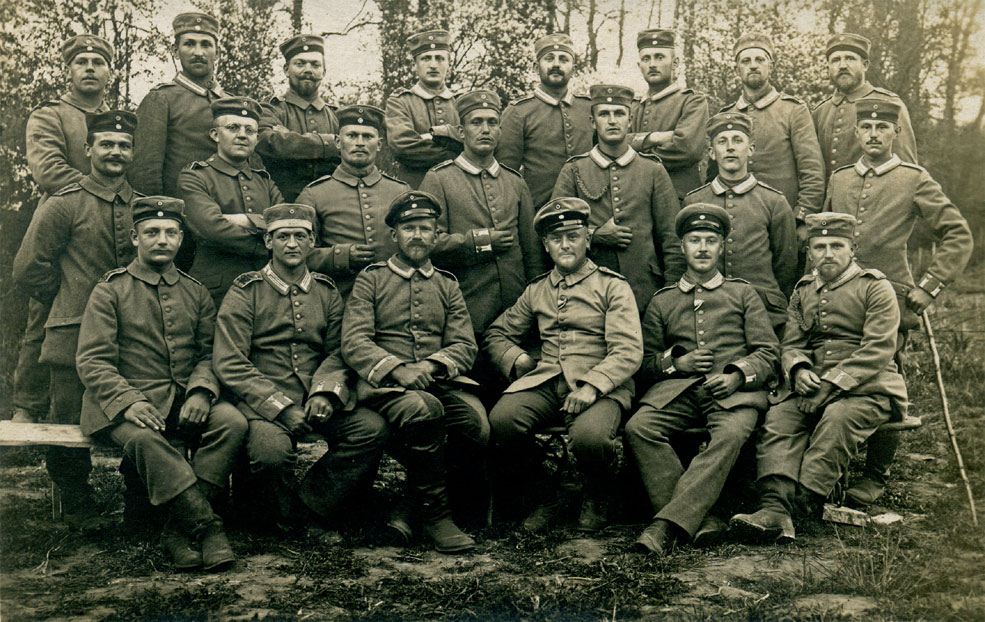
Above: Arno and comrades from FAR 48 photographed in the grounds of the chateau in a mixed group with Kaisergrenadiere (GR 101) and a senior NCO of SR 108. I think that I recognise a couple of members of Arno's gun crew from the 4. Geschütz of 3./48, including the Unteroffizier. This is the only surviving wartime photo of Arno to have been demonstrably sent through the mail, with Feldpost stamps and an actual 'letter home' on the back. Hence we know that it was taken around the first week of June (or maybe in late May?) at the Erholungsheim.
Like Arno's one surviving letter from Africa in 1912, this card is addressed to his uncle (Max Leonhardi) and aunt at Feldherrnstraße (a street which sadly no longer exists since 1945) in Dresden. The text is quite enigmatic, with a mysterious deletion or deliberate blank - the meaning of which can only be guessed at. It was postally stamped on 8th June by the I. Abteilung (1st battalion) of FAR 48 and seemingly received by the Leonhardis in Dresden on the 10th.
d. 7./6. 15
Lieber Onkel + Tante -
Vom Erholungsheim umstehend eine kl[eine] Erinnerung. Ich war heute in Belval zum mit.... Fatale Situation aber im Kriege manchmal unvermeidlich. Unser ganzer Geschütz war hier. Laune + Gesundheit gut.
Herzl[icher] Gruß euer Arno
7th June 1915
Dear uncle and aunt -
Overleaf [is] a small memento from the Erholungsheim. Today I was in Belval to… [partially erased] Fatal situation but often unavoidable in war. Our whole gun [crew] was here. [Am in] good health and spirits.
Best wishes [from] your Arno
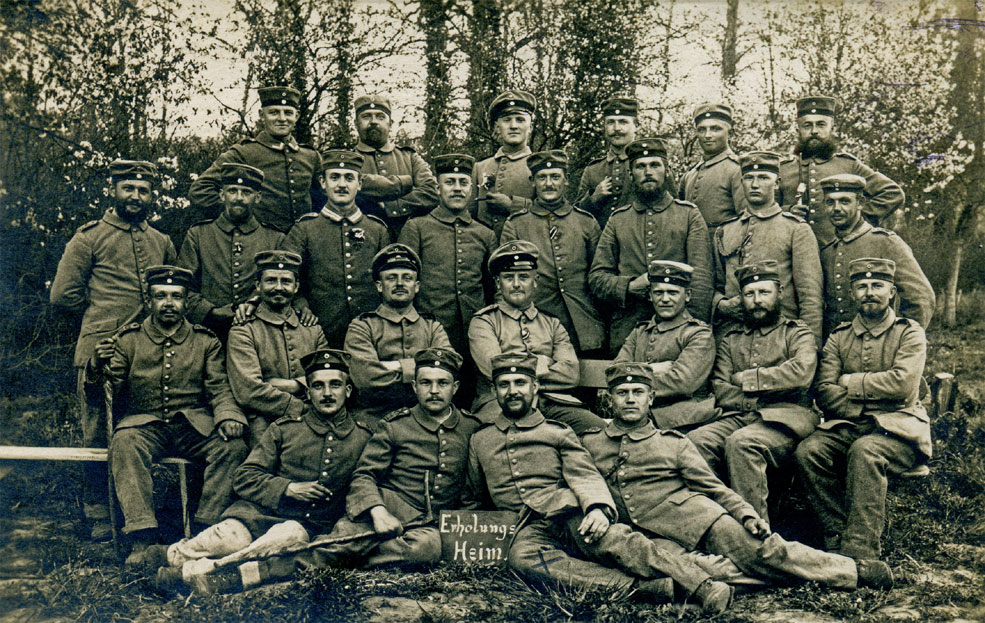
Above: another group of temporary residents of the Erholungsheim photographed at exactly the same spot as Arno and his comrades. This undated photo, discovered a few years ago at auction, even features the same senior NCO - now revealed by his shoulderstraps as an Offiziersstellvertreter (officer's deputy, i.e. NCO platoon commander) of SR 108. We can therefore surmise that he held some sort of supervisory position among the residents of Schloss Belval at this time.
Although mostly drawn from the Schützen-Regiment, this group also includes a few Grenadiere and at least one man each from Pionier-Bataillon 12 (front row, second from left) and from the divisional or corps telephone detachment (front row, furthest left).
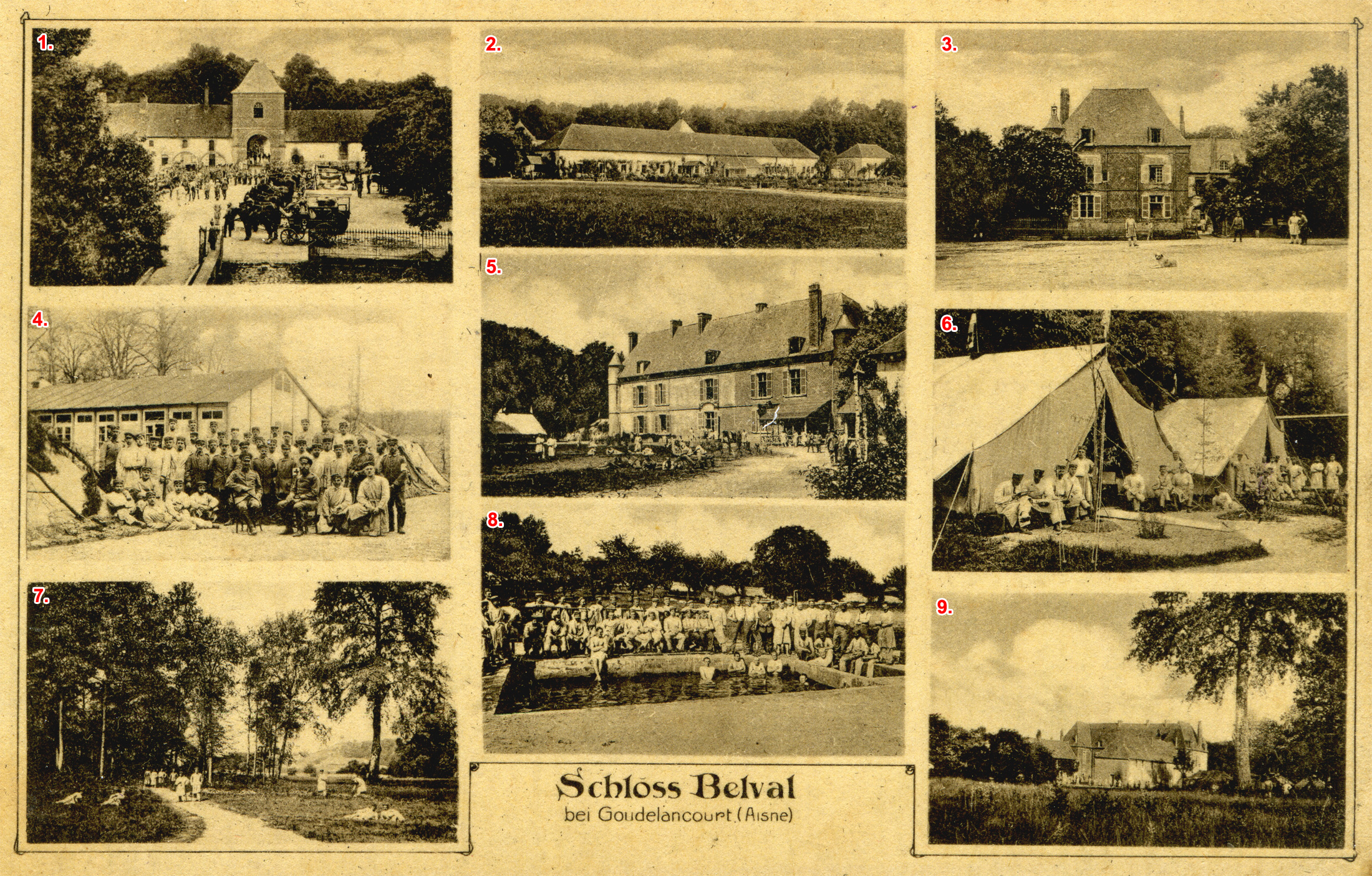
Above: (click to open at full size in a new window) "SCHLOSS-BELVAL 1914/15 als Lazarett und Erholungsheim", a commercial card published by Karl Messer of Rabenau (near Dresden). I have numbered the individual pictures for ease of reference:
- Departure of Feldlazarett XII.6 from the chateau in July 1915; see the commentary (later in this article) on Berthelen's photo of this event. This is the gatehouse seen from inside the grounds.
- The principal building which housed the Erholungsheim, as seen from the park; the chateau itself is out of shot to the left.
- The main hospital building (the actual Château de Belval) seen from the side, with the photographer's back to the Erholungsheim; see the commentary (later in this article) on the colour postcard.
- Patients and medical personnel of the Feldlazarett among the outbuildings.
- The chateau seen from the park, during its use by Feldlazarett XII.6. The corner of the Erholungsheim is visible at the right-hand edge of the picture.
- Despite the numerous buildings available on the estate, it was evidently still necessary to use at least some of the large tents with which the Feldlazarett was equipped.
- Patients relaxing in the park, with the Römerschanze visible through the trees on the right; see the commentary (later in this article) on Berthelen's photo from the same viewpoint.
- Swimming pool in the grounds, as described by Hottenroth. Most of the men here seem to be in (or partially out of) fatigue uniform rather than hospital pyjamas, suggesting that they are residents of the Erholungsheim rather than patients.
- Possibly the chateau seen from a different angle?
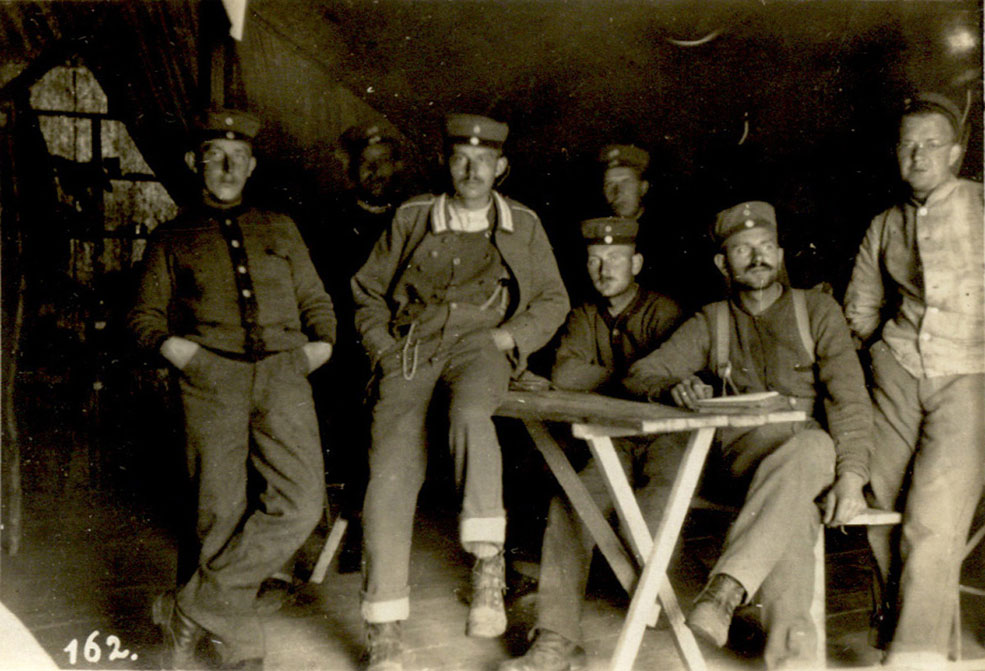
Above: Arno and some of the men from his group photo, pictured inside what I believe to be one of the large tents in the chateau grounds - evidently used by the Erholungsheim as well as the Feldlazarett. Since it was evidently intended to remain pitched for an extended period, the tent has been fitted out with wooden floorboards as well as basic furniture. While most of the men have shed their tunics, and all wear the side-laced ankle boots issued for light duty, Arno sports the jacket from the Drillich fatigue dress. Designed for dirty jobs, this consisted of a hard-wearing white jacket and trousers which began to be dyed a darker colour (as camouflage against e.g. aerial observation) during 1915. In this case, I believe it is simply dirty rather than dyed!
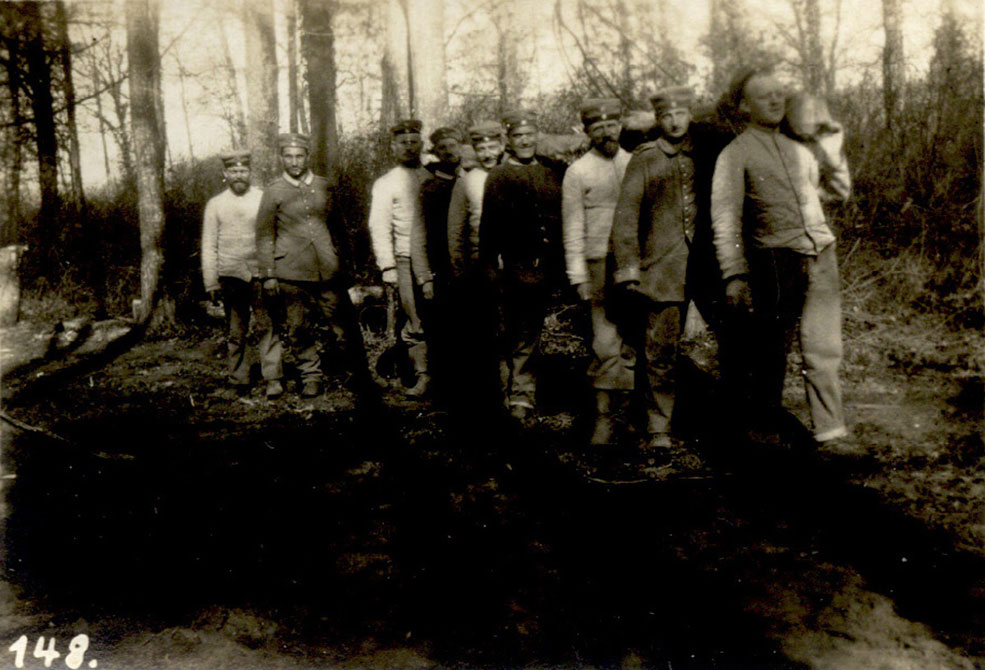
Above: Arno and comrades from the group photo, transporting a log somewhere in the chateau grounds. As usual, the army's idea of 'rest' did not preclude a certain amount of physical labour. All of the artillerymen (including Arno) are wearing their white fatigue jackets, while most of the Kaisergrenadiere are in full Feldgrau uniform.
Either during his stay there or immediately after his return to active duty, we also know from archival documents that Arno was once again assessed for his suitability for promotion. This time the verdict was negative, though regrettably the reasons for this decision are not cited.
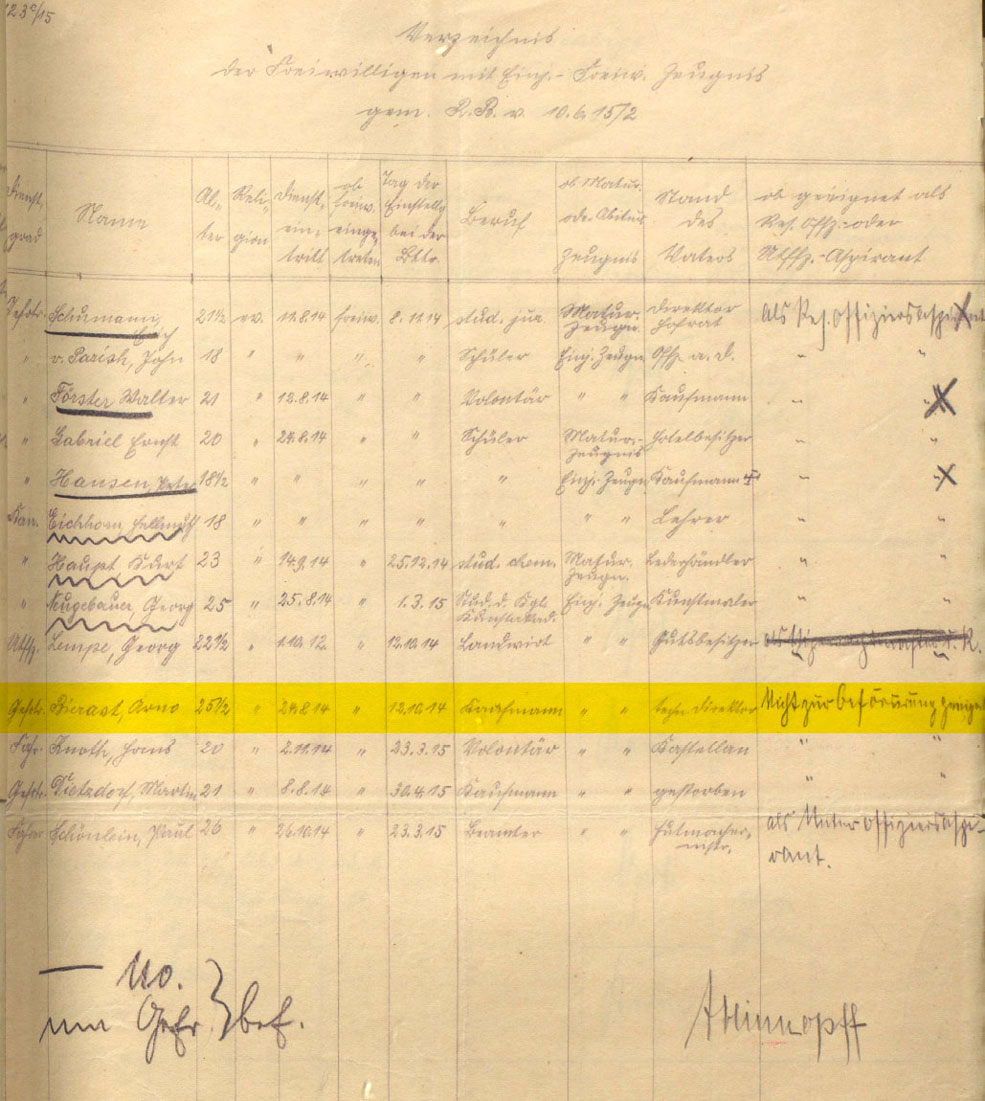
Above: assessment dated 10th June 1915 of volunteers with the Einjährig-Freiwilligen-Zeugnis (one-year-volunteer's certificate), indicating that they had met the educational qualification to be an Einjährig-Freiwilliger (whether or not they had taken up that expensive option). These men are being assessed for potential suitability as Reserve-Offiziers- oder Unteroffiziers-Aspiranten (reserve officer or NCO aspirants), and significantly more personal information is cited. Arno is among those judged unsuitable, despite the earlier favourable assessment which appeared in part one of this article series.
Arno is one of the oldest (at 25 ½). His profession is given as Kaufmann (very generically 'businessman', 'merchant' or 'trader') and that of his father Friedrich Wilhelm Emil Bierast as what looks like Betr[iebs] Direktor (plant manager / chief operating officer). According to a family tree from the 1930s the elder Bierast (who died on 4th August 1916) was a Seiler (ropemaker), which had been the family trade in Rosswein. Arno's father had moved to Zwickau and evidently gone up in the world, enough to give Arno a professional education. The fact that the father's profession (or rather position in society- the word Stand is used) is a factor meriting inclusion on this document suggests that social class openly played a part in the selection of potential reserve officers. In any case, the assessment given for Arno here is that he is "not suitable for promotion".
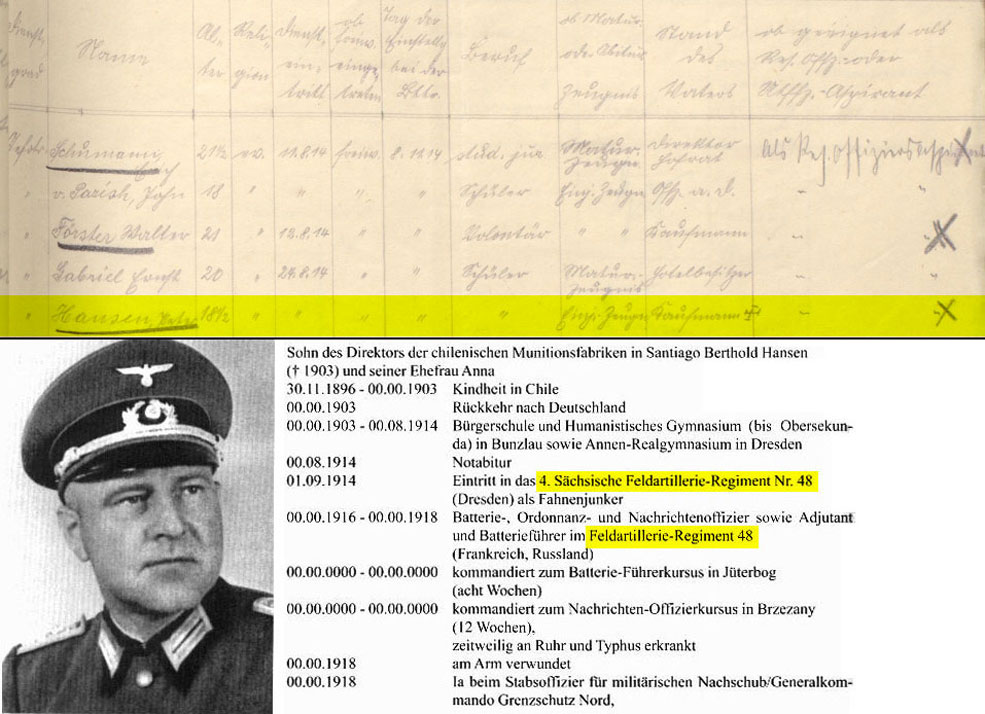
Above: looking among the candidates who were considered suitable Reserve-Offiziers-Aspiranten one name jumps out for those more familiar with the regiment. I believe that Gefreiter Peter Hansen (fifth from top), aged 18 1/2 at this time and a student at the outbreak of war, is the future SS-Brigadeführer und Generalmajor der Waffen-SS of the same name. Born at Santiago in Chile as the son of German parents (his father then being director of a munitions factory there), Peter Adolf Caesar Hansen grew up in Germany from 1903 onwards and studied at Bunzlau and Dresden. He served with FAR 48 for the duration, having volunteered (according to this document) on the same day as Arno, 24th August 1914.
The information in the bottom half of the image is taken from Schulz, Wegmann and Zinke Die Generale der Waffen-SS und der Polizei and (being a post-1945 work, written without access to the relevant WW1 personnel records) shows understandable uncertainty about the exact details of Hansen's early career. It also reveals some unfamiliarity with the workings of the German military under the Kaiserreich. He cannot have been a Fahnenjunker or Fähnrich (ensign) in 1914 as he did not come via the Kadettenkorps as a prospective career officer. Rather, as a war volunteer he was gradually promoted to Gefreiter and (following the approval indicated in this document) Unteroffizier. Hansen evidently gained his (presumably reserve?) officer's commission in 1916, eventually serving as a battery commander. Despite bouts with typhus and dysentery and a wound in the arm, he survived the war and served on the staff of the post-war Grenzschutz Nord of the Reichswehr.
Retired in 1920, Hansen was reactivated as a Wehrmacht officer in 1935 with the rank of Hauptmann; the photo here dates from this period. Subsequently promoted to Major, he was transferred to the SS-VT (later to become the Das Reich division of the Waffen-SS) in 1939 to command its artillery element. This would surely have made him a highly influential figure in the development of Waffen-SS artillery doctrine, but (so far as I could determine) no author seems to have picked up on this or made more than passing mention of him. In 1943 and spring 1944 he served for short periods as a divisional commander of Latvian and Italian volunteer units of the Waffen-SS during their formation periods. From July 1944 he was a corps artillery commander, and for the last three months of the war a corps chief of staff. So far as I can determine, no atrocity allegations of any kind have ever been made against him (despite his senior role in what would, after its dissolution, become surely the most intensely judicially scrutinised military force in history). Hansen survived the war and died in Viersen (West Germany) in 1967.
The sizeable Château de Belval, its numerous outbuildings and extensive grounds were not solely occupied by the Erholungsheim visited by Arno and his comrades. For long periods (evidently with some gaps) a field hospital also operated on the premises, allowing convalescent patients to enjoy the pleasant environment of the grounds and extensive leisure facilities.
The XII. Armeekorps was mobilised in August 1914 with as many as fourteen Feldlazarette (mobile field hospitals), fully equipped to set up in tents on open ground if necessary - though suitable buildings were always preferred. Its three Sanitäts-Kompagnien (medical / bearer companies) operated casualty clearing stations, providing the link between regimental medical services and the hospitals. Finally a single Kriegslazarettabteilung (war hospital detachment) was responsible for commandeering existing civilian facilities in the corps rear area and converting them into Kriegslazarette (war hospitals) with a mixture of German and existing local staff.
Thanks to the survival in Russia of some volumes of the war diary for the Kommandeur der Trains des XII. Armeekorps (the command staff for the corps supply formations) we know that on 20th February 1915 three of its field hospitals were redeployed as follows: Feldlazarett XII.2 to Brienne-sur-Aisne, Feldlazarett XII.6 to 'Belval' and Feldlazarett XII.8 to Le Haute Chemin. Although the war diary volume for June to September 1915 is missing, we know thanks to Hans Berthelen of SR 108 that Feldlazarett XII.6 left again in July, presumably because the corps sector was now considered 'quiet' and its medical assets were needed elsewhere. By 9th September the chateau once again housed a hospital (perhaps in anticipation of the Entente's autumn offensive), but as yet we do not know which one.
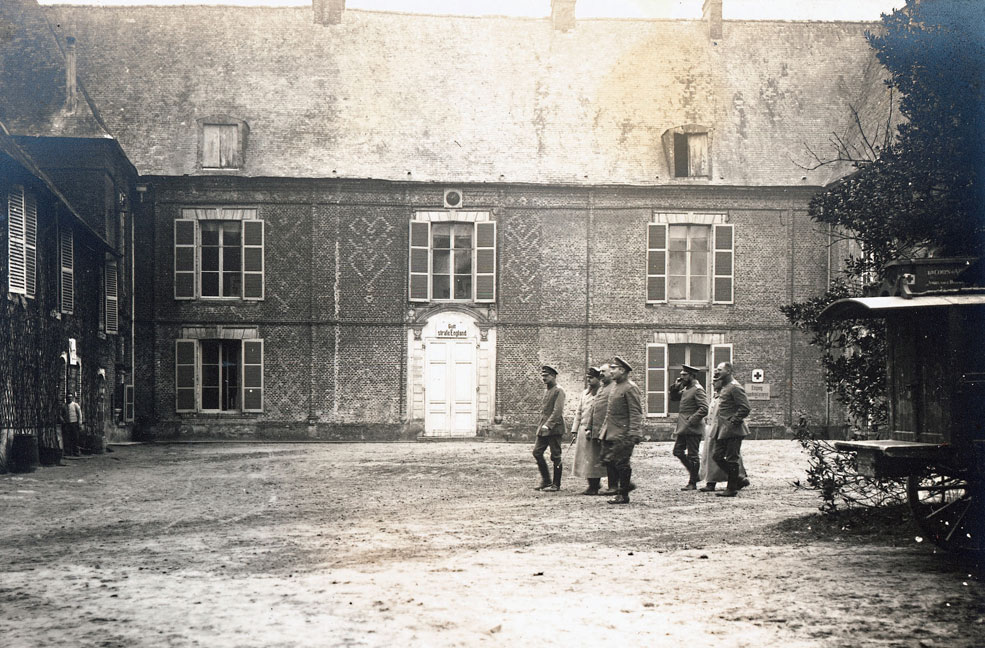
Above: photo from the album of Hans Berthelen (SR 108) showing the visit of HRH Prince Friedrich Christian (in greatcoat with cane, second from left) to Feldlazarett XII.6 in March 1915.
Like his brothers, the second of the King of Saxony's three sons was an officer of LGR 100. At the outbreak of war he held the rank of Oberleutnant, and was given a post on the staff of XII. Armeekorps. According to the caption, he is being guided by 'Dr. Nahmmacher' - revealed by other photos in this album to be the portly bare-headed gentlemen in the middle. This is undoubtedly Stabsarzt der Reserve Dr. Felix Nahmmacher of the hospital staff (awarded the Saxon Ritterkreuz des Albrechts-Ordens with swords as Oberstabsarzt der Reserve in October 1915). He could of course also be the Stabsarzt described by Hottenroth (see below), assuming that he remained at the chateau when Feldlazarett XII.6 departed.
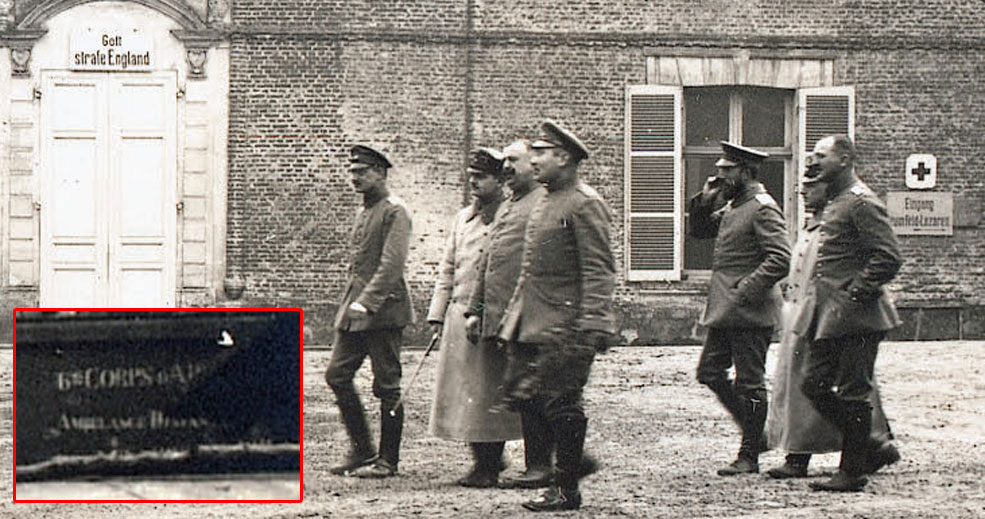
Above: closer examination reveals interesting details including a sign with the popular German slogan Gott strafe England (God punish England) and French Army markings on a captured horse-drawn ambulance near the right-hand edge of the photo.
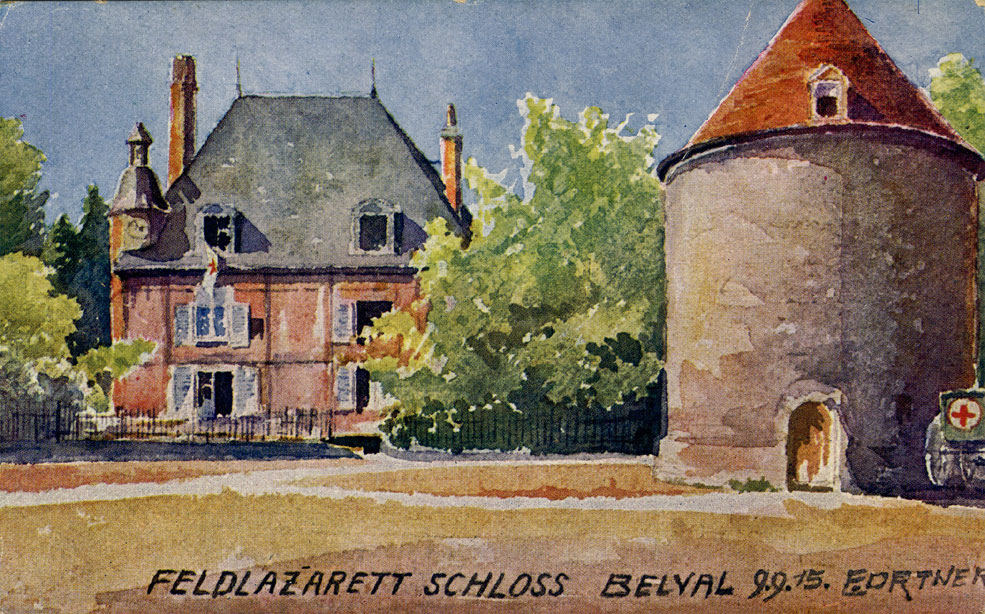
Above: watercolour showing the chateau from the side, plus an adjacent round tower. Note the horse-drawn ambulance at far right, and especially the fact that despite the departure of Feldlazarett XII.6 in July, the chateau evidently housed a hospital again by 9th September 1915. This card was commercially distributed by the highly prolific firm of Heinrich Knobloch (based on the Tolkewitzer Straße in Dresden-Blasewitz).
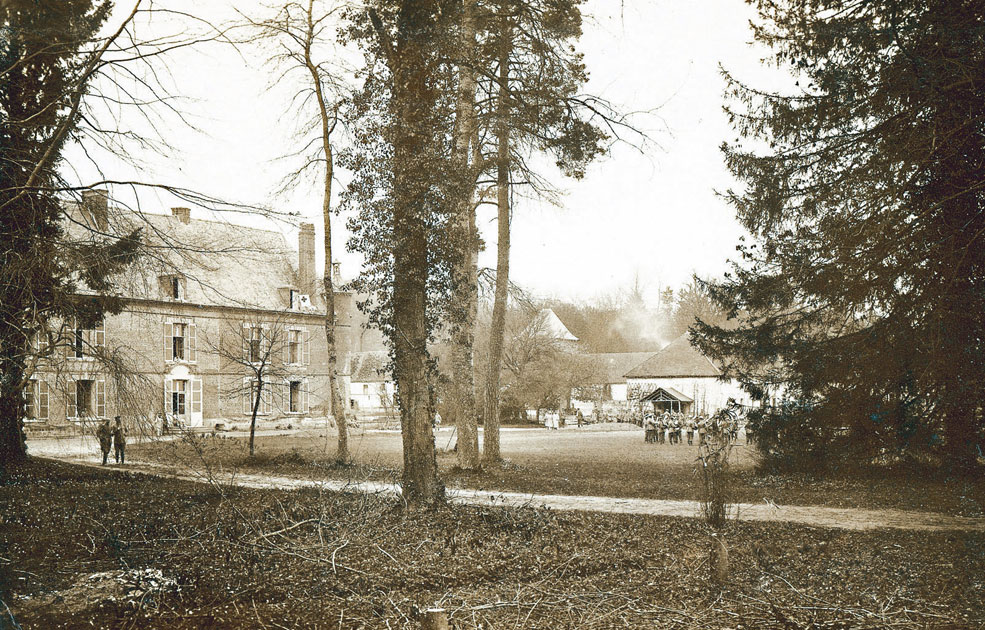
Above: view from Berthelen's album dated 29th April 1915, looking across the front of the chateau (left) towards the courtyard and gatehouse (obscured by trees). The end of the Erholungsheim is visible behind the band on the right, which is most probably the Regimentsmusik of SR 108. More commonly seen in Berrieux, this was a pure brass band in accordance with Jäger tradition. Credit: Jürgen Schmieschek collection.
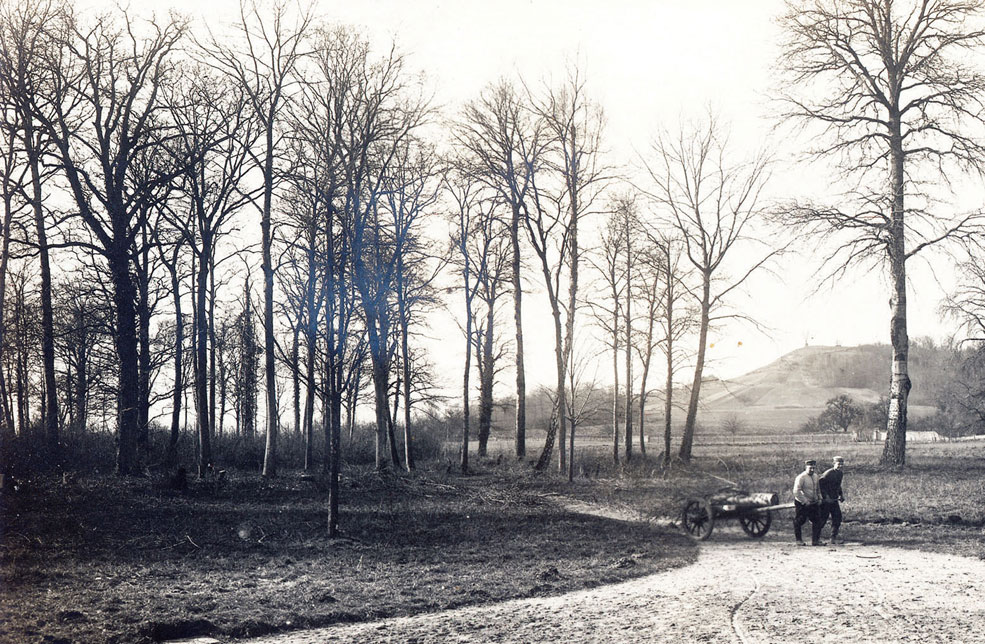
Above: another photo from Berthelen's album which was taken from the same spot as one of the pictures on the multi-photo card, albeit later (or maybe earlier?) in the year going by the trees. Tree trunks are evidently still in demand, but a less labour-intensive method of transporting them is now being employed.
According to Berthelen, the high ground in the background is the Römerschanze (Roman redoubt), a local landmark "from which the battles of 1814 were directed". This presumably refers to the Battle of Craonne, fought by the allied Prussian and Russian armies against that of Napoleon on 7th March 1814. Credit: Jürgen Schmieschek collection.
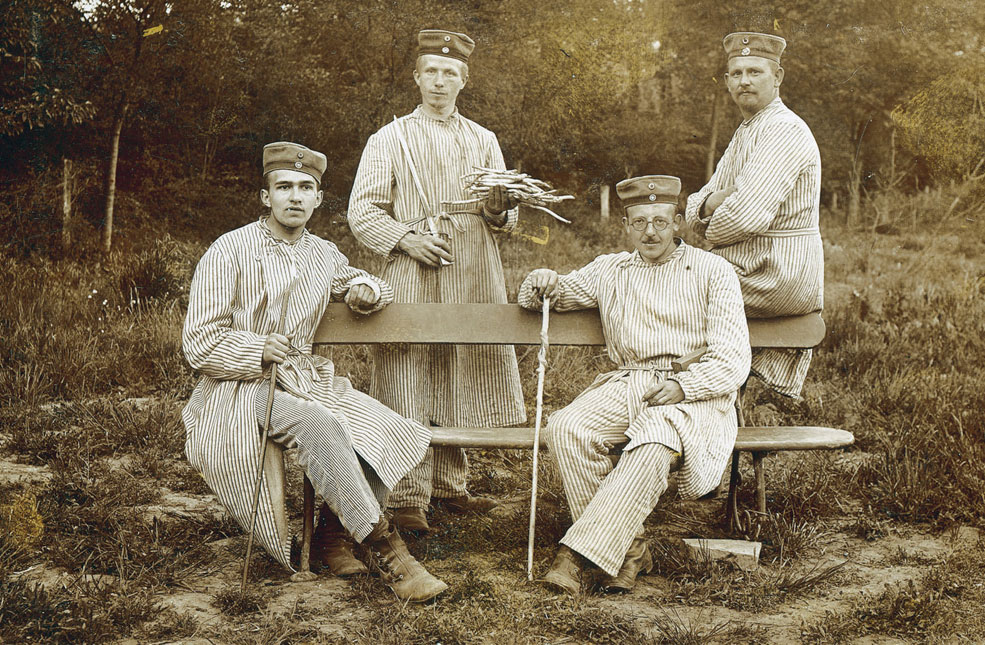
Above: Hans Berthelen of SR 108 (seated, with spectacles) and comrades in the chateau grounds, all wearing striped hospital pyjamas. We do not know what rank he held at this time, but he was an Einjährig-Freiwilliger in September 1914 and received a (reserve?) officer's commission in 1917. Confusingly there is no record in the published Verlustlisten of him ever being wounded or taken ill.
This photo is whimsically entitled Spargeltruppe von Belval, 1915 ('Belval asparagus troop 1915'). As my wife Diana (a connoisseur of this noble vegetable) points out, the seasonal white asparagus seen here dates the picture to between late April and June. Credit: Jürgen Schmieschek collection.
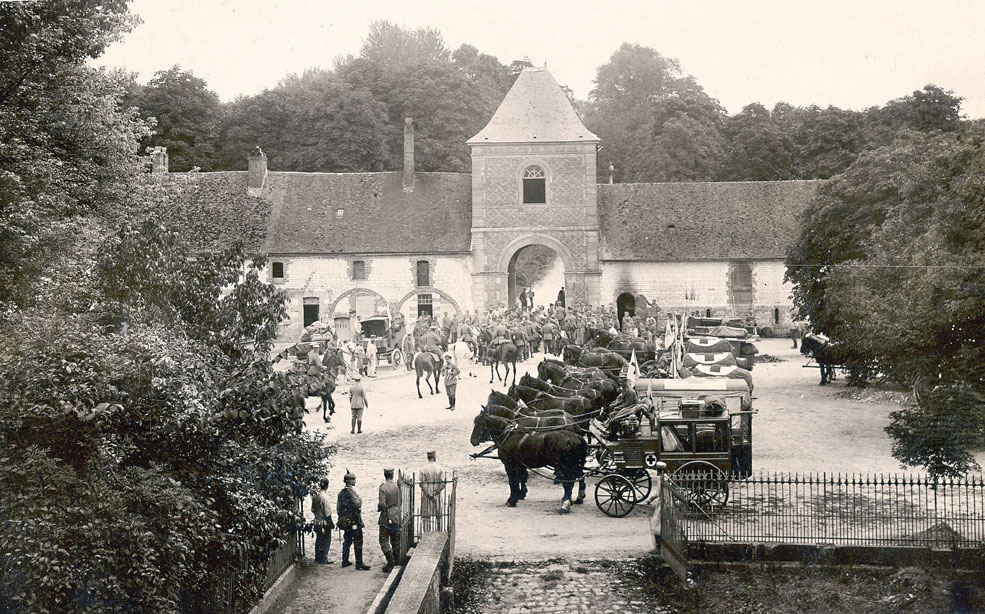
Above: from Berthelen's album, another view of the departure of Feldlazarett XII.6 from the chateau in July 1915. The scene is the courtyard immediately behind the gatehouse, undoubtedly shot by the same photographer as part of the same sequence as the similar photo on the multi-picture postcard.
According to the British War Office's Handbook of the German Army 1914, the personnel and transport of a mobile Feldlazarett consisted of nine medical officers and officials, 52 other ranks, 29 horses and nine horse-drawn vehicles. The latter were all two-horse wagons, comprising a single ambulance, two medical and surgical store wagons, one baggage wagon, four hospital equipment wagons and one office wagon. Most of these vehicles can be identified here.
Notable details include the chaplain (recognisable by his white-edged purple armband), standing beside the horses in the middle of the courtyard with his back to us. In addition to the Divisionspfarrer for each of the two main Christian denominations (often aided by voluntary Hilfspfarrer), additional chaplains were routinely attached to field hospitals. The officer facing him is holding what is either a small dog or possibly a large cat. Credit: Jürgen Schmieschek collection.
In August 1915, Oberstleutnant a.D. Johann Edmund Hottenroth of the Kgl. Sächs. Kriegsarchiv (later the author of the first volume of Sachsen in Grosser Zeit) made an official tour of the rear areas of the XII. and XIX. Armeekorps. His account of this tour was published in 1916 as a pamphlet entitled Friedensarbeit der Sachsen hinter der Front ('The peace work of the Saxons behind the front'). Not surprisingly it is overwhelmingly positive in tone, and censors most of the names of places and individuals in the interests of military security. With a little knowledge of the situation of XII. Armeekorps it is nevertheless quite easy to fill in most of the blanks. Naturally Hottenroth included the Château de Belval in his itinerary, and left us the only known written account of the Erholungsheim:
Through a beautifully wooded gorge, in which a Landser was looking for mushrooms, we descended to visit Schloss B[elval]. Used at the beginning of the war as a field hospital, today it is an Erholungsheim for officers and men in need of rest. The chief physician acted as an amiable guide.
In a wide corridor through which we walked, magnificent old tapestries hung on the wall. So, not stolen by German barbarians! In the room of the Stabsarzt it looked thoroughly homely. On the mantelpiece there ticked a beautiful old clock, vases and other objets d'art stood around free of dust, and through the windows which reached to the floor one could see the flower garden and the avenues of the park. Bismarck had lived in this room for a time in 1870.
The working spaces have been prepared for habitation with an amazing love of order and cleanliness. Soldiers have converted the little stable windows into large ones fitted with plain glass panes. Here too [there are] gauze screens against flies. Soldiers have dragged a plank floor [into place] under the barn roof, whitewashed like the walls. Soldiers have scrubbed the stone tiles of the floor clean and covered them with mats. Aligned with a cord stood the iron bedsteads, the covers were snow-white. Next to it, probably once the feedroom, [was] a room with tables and benches, with books, newspapers, writing material, skat cards [and] chess boards. The door stood wide open. It led to a vine-covered arbour equipped with deckchairs.
The Lausoleum [steam delousing oven for clothing] and disinfection rooms were located a little away from the chateau in the park. A cemented swimming pool was built on the open, sunny square in front of the flower garden using running water. In it, ten Teutons happily splashed about, while others dried themselves in the sun on the green lawn.
Music performances are often held in the park for the entertainment of those in need of relaxation, performed by the Regimentsmusik and directed by Musikdirektor H. In addition whoever is off-duty comes streaming out of the surrounding villages [to listen]. Truly a wonderful place for recreation!
Hottenroth subsequently visited the Krug von Nidda Heim at the Château Nicol in Lambersart near Lille. This divisional Erholungsheim of 24. Infanterie-Division / XIX. Armeekorps similarly provided rest and recreation in remarkably luxurious surroundings, accommodating up to twenty NCOs and fifty men at a time (alternative facilities were presumably available for officers). Photos and Feldpost indicate that it was still operational when the XIX.AK left for the Somme front in summer 1916. How widespread the phenomenon of the divisional Erholungsheim may have been beyond these two examples remains unclear. We would welcome any further evidence, most especially with relation to the divisions of the Royal Saxon Army.
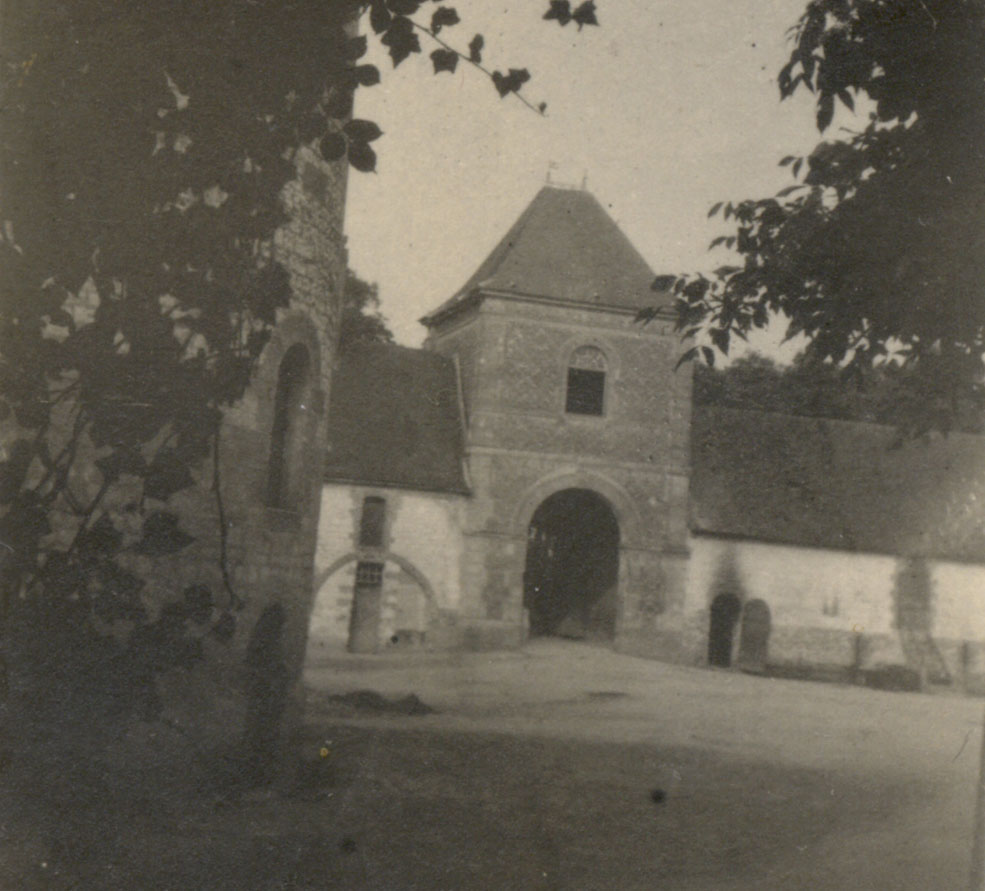
Above: another view of the courtyard and gatehouse, taken from the album of an unknown member of SR 108. The rounded structure in the left foreground might be the round tower, though the window and door visible here don't match the watercolour. If it is the same structure, it reveals the orientation of the chateau to the courtyard and gatehouse.
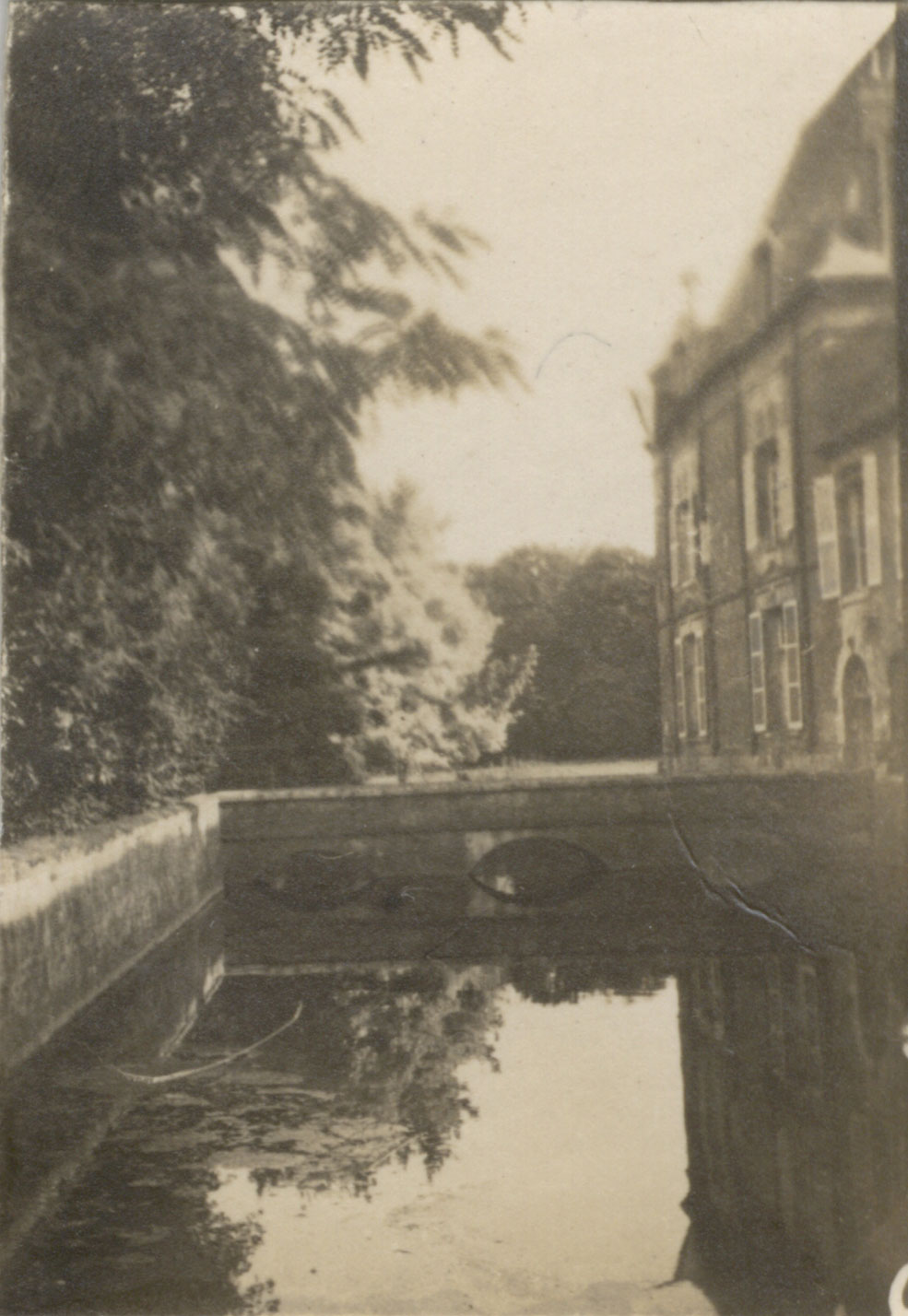
Above: a second photo from the same anonymous album, looking across the side of the chateau from the vicinity of the round tower (or from a window in that structure?). The presence of the moat is not immediately obvious in other images, but it can be made out by its guard railings once one knows that it's there.
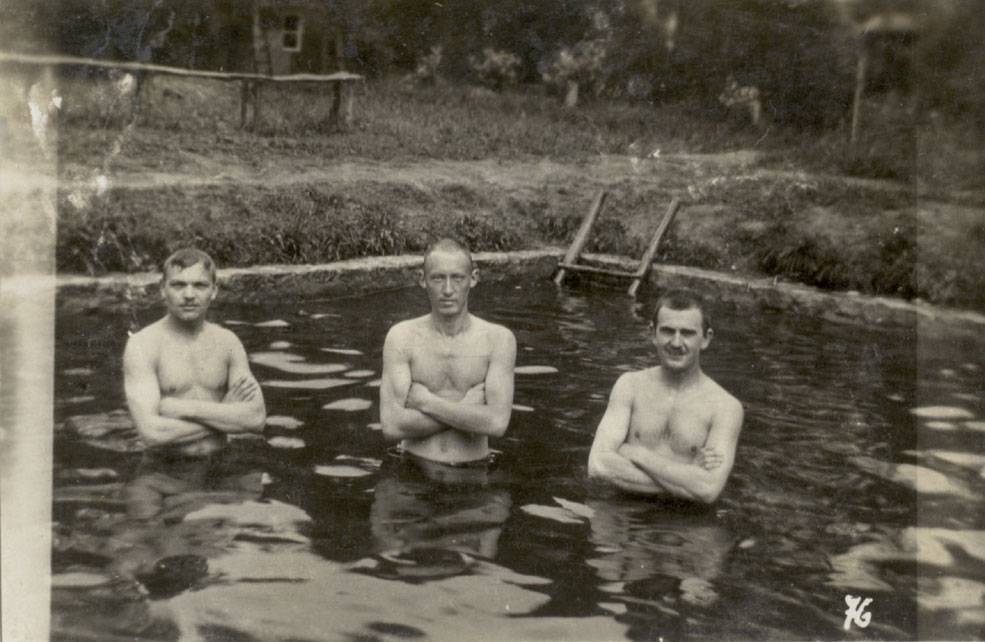
Above: also from the same anonymous album, three friends from (presumably) SR 108 make use of a swimming pool in the grounds.
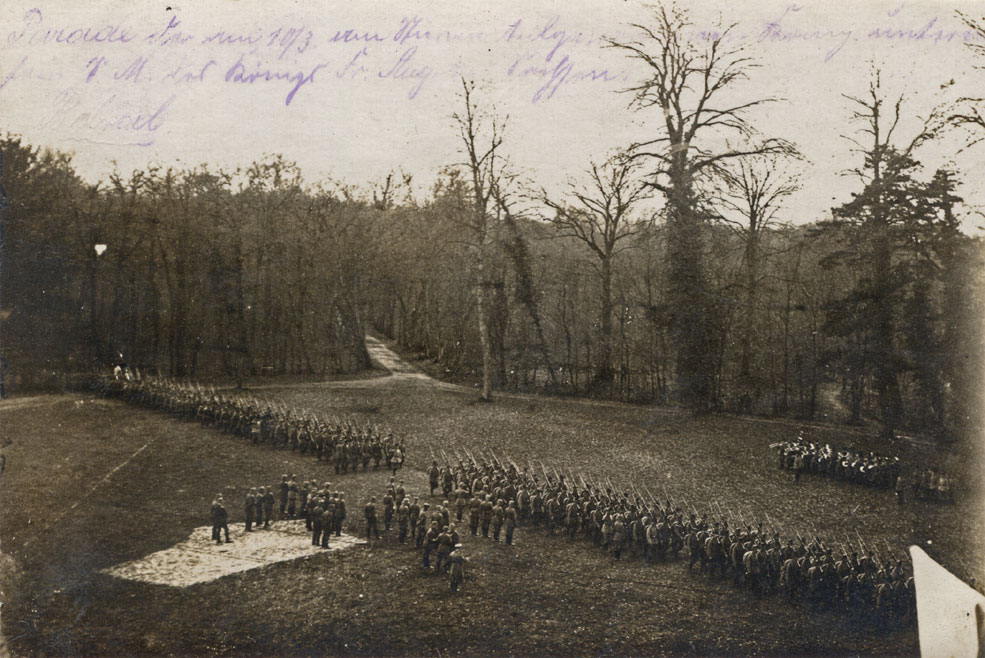
Above: the chateau grounds offered an ideal open space for sporting contests, festivities and parades. Here we see H.M. King Friedrich August III of Saxony reviewing SR 108 on 22nd March 1916, following their successful storming of the Viller Berg in conjunction with GR 101 on 10th March. Once again, their Regimentsmusik is present.
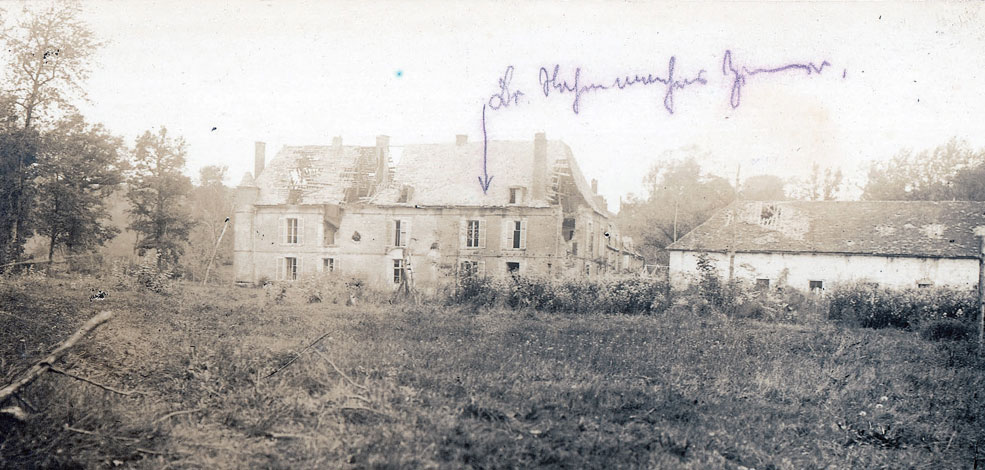
Above: SR 108 would pass through this area once more in April 1917. This photo from Berthelen's album shows the state of the chateau and Erholungsheim by that time. Berrieux now lay in ruins, and the church tower of Goudelancourt had been brought down - according to Berthelen, by French artillery fire. Credit: Jürgen Schmieschek collection.
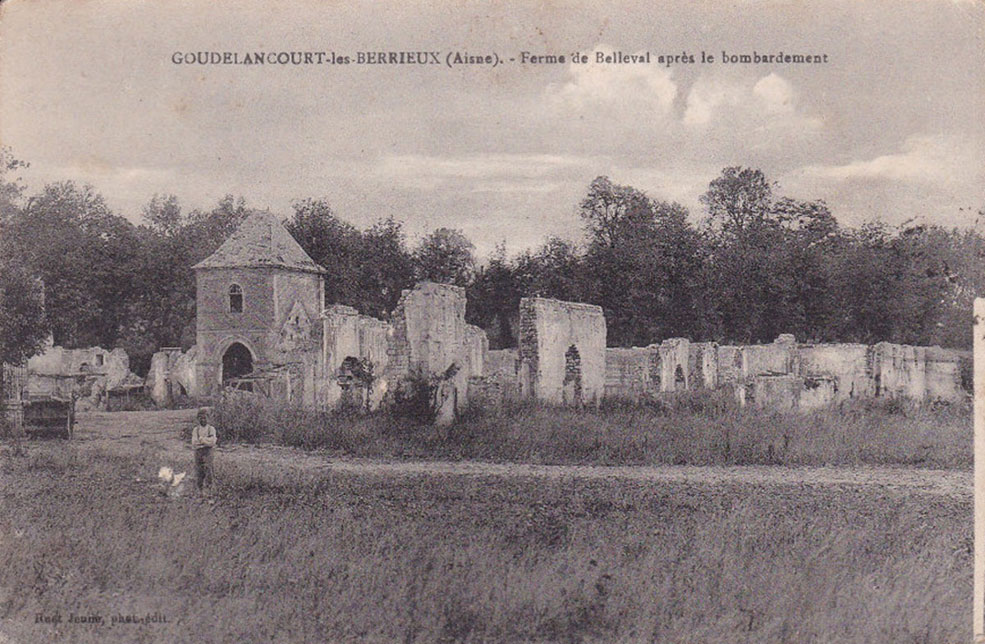
Above: French postcard of the ruined gatehouse building at the end of the war, showing that only its central section survived. Surprisingly the estate is described rather modestly as the Ferme de Belleval (Belleval Farm).
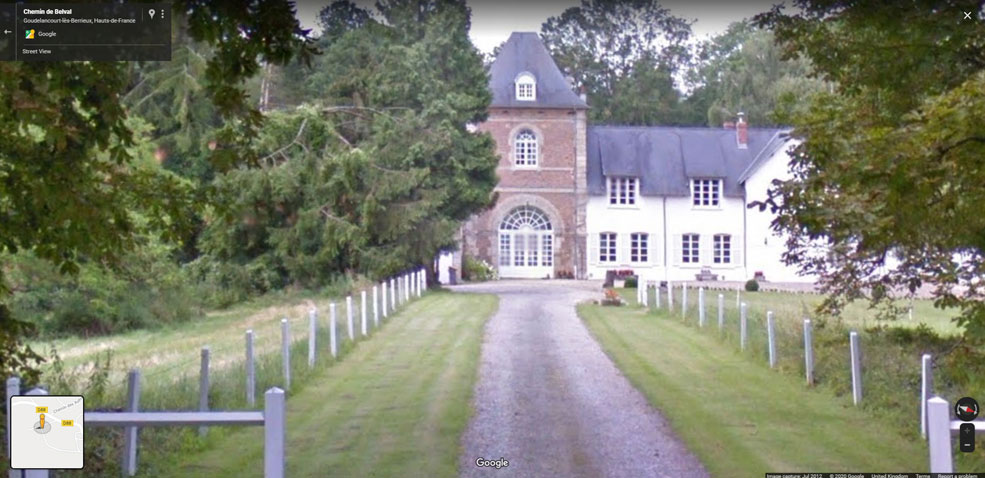
Above: the gatehouse as it looks today, seen from the driveway in Google Streetview.
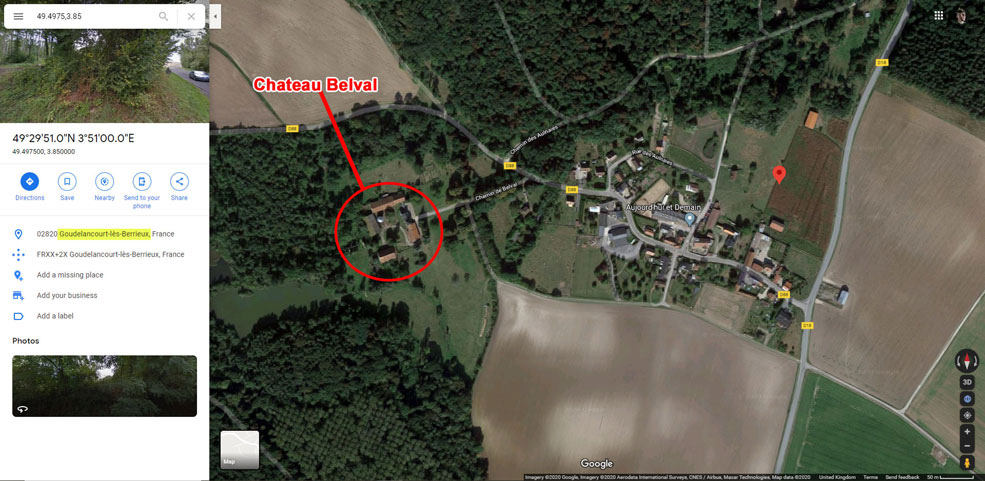
Above: location of the Château de Belval to the west of Goudelancourt-lès-Berrieux.
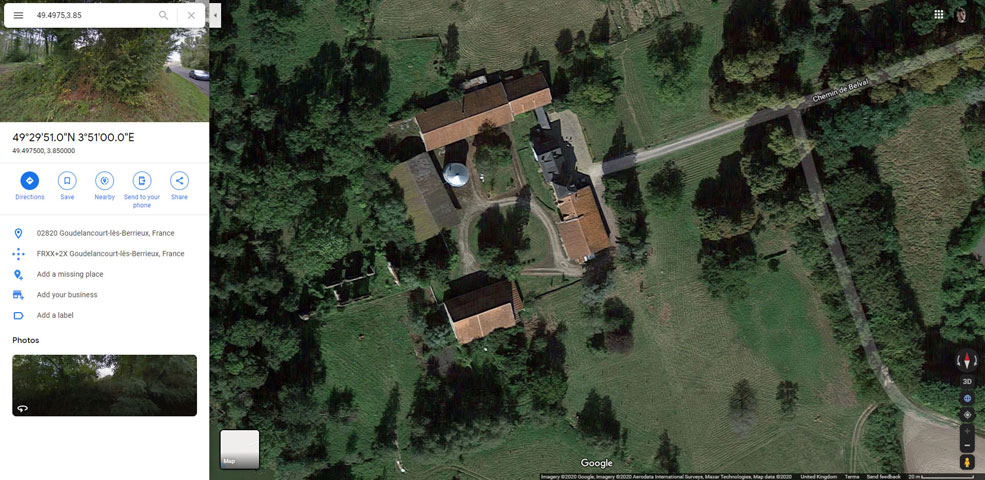
Above: satellite view of the chateau buildings and grounds, seeming to indicate that almost all of the original structures were destroyed and rebuilt post-war.