
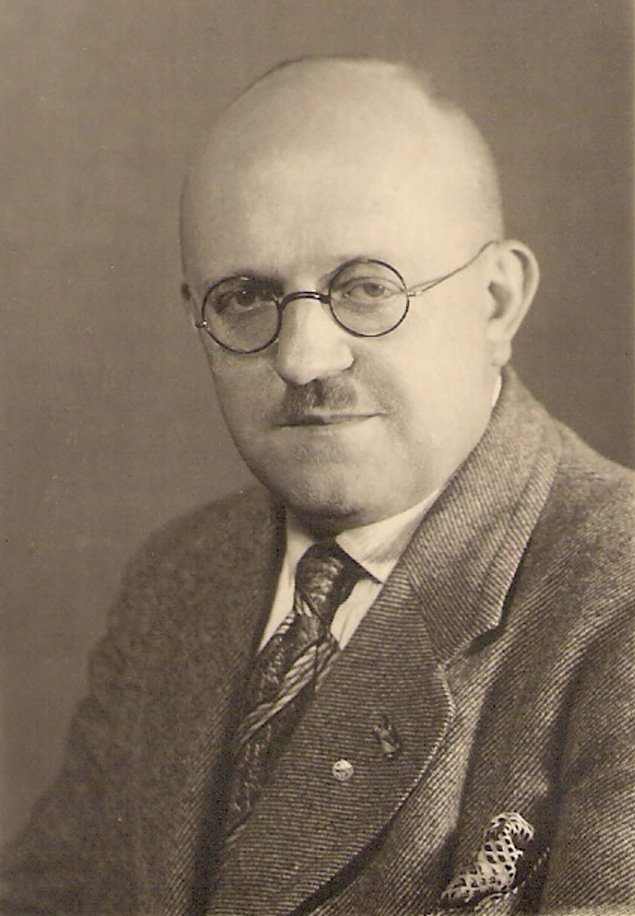
Above: Arno Bierast in later life (probably during the 1930s). My great-grandfather went bald very early in life. Whether this was exacerbated by the war is unclear, but his poor hearing was undoubtedly the result of his four years as an artilleryman. Military service also gave him a life-long taste for small cigars, much favoured by those German soldiers of his generation who did not smoke a pipe.
This part concludes my German great-grandfather's story, covering both the final months of his war service with Kgl. Sächs. 4. Feldartillerie-Regiment Nr.48 (FAR 48) and his subsequent eventful civilian life - including his role in the German conservative resistance to Hitler.
The longest section concerns the momentous fighting at and beyond the 'Hindenburg Line' in October 1918, when the regiment faced the overwhelming armoured might of the British and American armies. Though Arno probably never knew it, they also had the singular honour of facing the final Australian attack on the Western Front.
At this point I should briefly acknowledge the only war story which my great-grandfather ever passed on. According to my late grandmother, during a period when food was very short he was invited by some infantrymen to share a meat stew which they were cooking up in their trench. The main ingredient was later revealed to be their officer's dog, which had been killed by enemy action (presumably artillery). Assuming that he wasn't simply pulling her leg, this most likely happened in 1918. By the last year of the war, German rations on the Western Front were exceptionally grim - 'meatless days' were a regular feature, and captured British 'bully beef' was a much-loved luxury.
By late September 1918, the nominally rebuilt 241. Infanterie-Division was back where FAR 48 had been deployed on the eve of 'Operation Michael' six months of wasted sacrifice earlier. On the 29th the division was hurriedly relieved and rushed to Montbrehain northeast of St. Quentin, with motor lorries laid on for the dismounted troops. There it would face its greatest ordeal yet.
Divisional orders on 29th September 1918 were to relieve the Prussian 2. Infanterie-Division in the second line 'Hindenburg' defences described by the British as the 'Beaurevoir-Fonsomme Line'. British IX Corps had crossed the St. Quentin Canal that morning, and the hastily rebuilt Saxon division was about to find itself thrown piecemeal into a losing battle.
Although II. Abteilung / FAR 48 had shelled the British on the Somme in October 1916 and the whole regiment had bombarded their positions at Vendeuil in March 1918, this would be the first and only time that the 48ers were to encounter this particular enemy up close.
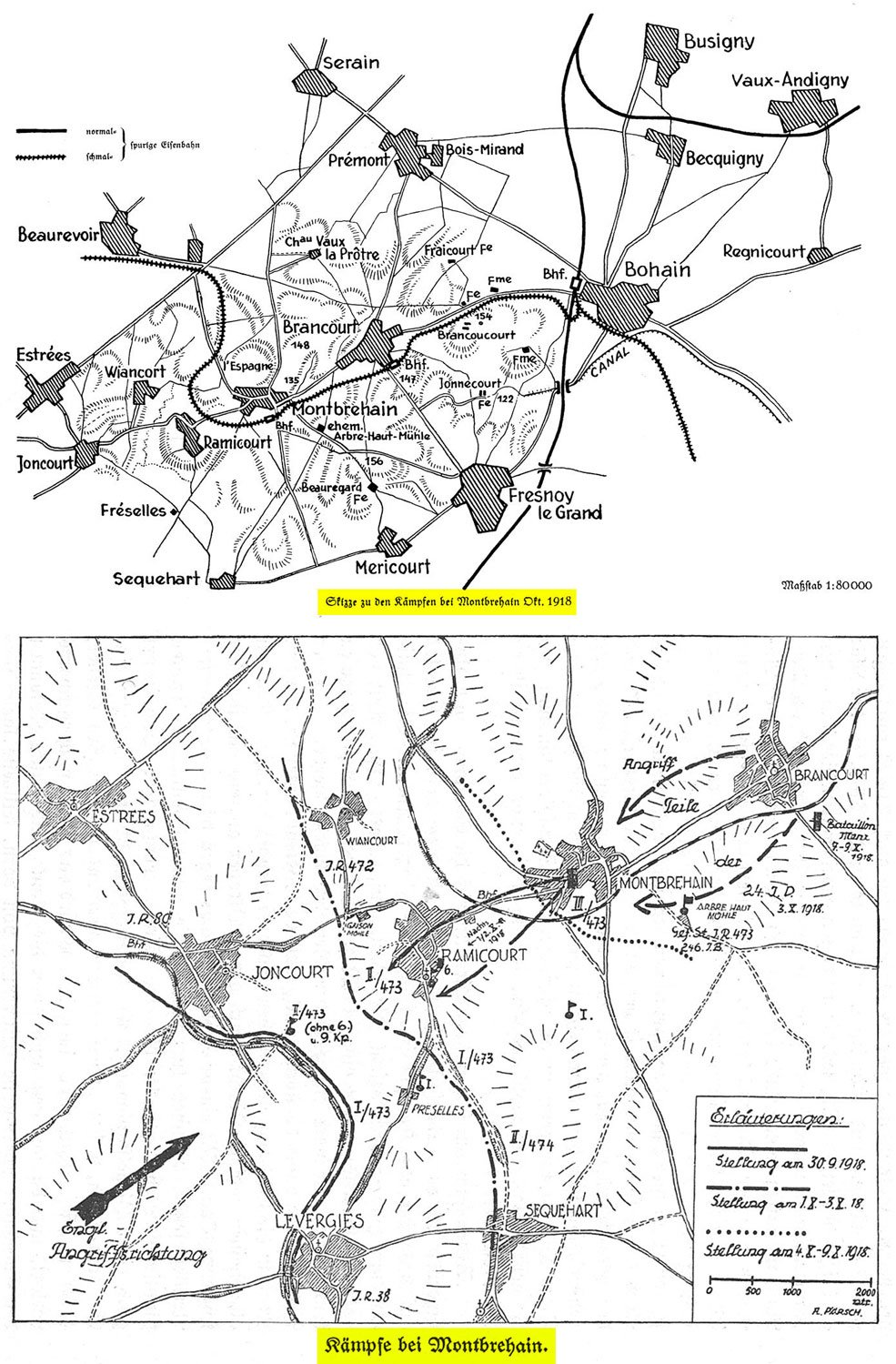
Above: the upper map is from the regimental history of FAR 48 and the lower one from that of IR 473. Although these are the best maps available they are less than ideal. The placement of II./474 directly on the left of IR 473 does not seem to match any of the sources.
First to arrive was the bulk of IR 473 (I. and II . Bataillon, 9. Kompagnie and the regimental staff) soon after midnight on 29th-30th September. The staff set up headquarters at the Arbre-Haut-Mühle (Doon Mill), temporarily co-located with the Divisionskommando of Prussian 2. Infanterie-Division to which they were now subordinated. They were no doubt disturbed to learn that the forward positions of 2.ID at Bellenglise had been completely overrun, with much of their infantry including the brigade staff killed or captured. The front line was now held mainly by the badly mauled Fusilier-Regiment 38 (11.ID) and Fusilier-Regiment 80 (21.ID).
The two (and a bit) battalions of IR 473 advanced at 05:00 on 30th September to the railway embankment between Joncourt and Levergies, evicting a British unit identified only as "Scots with bare knees" and taking sixteen prisoners. Meanwhile III. Abt. / FAR 48 (temporarily comprising the 5., 7. and 9./48) had deployed northeast of Ramicourt as Untergruppe Grohmann, with Hauptmann Grohmann and his staff based at L'Espagne Farm.
Having established contact with Fusilier-Regiment 80 on the right and Fusilier-Regiment 38 on the left, IR 473 saw off an attack at 16:30 by 15th Lancashire Fusiliers (32nd Division). This was supported by three 'Whippet' tanks of A Company / 6th Tank Battalion under Captain Farrar, all of which were destroyed by a Bavarian battery armed with what are described as 'light anti-tank guns' ("kleine Tankkanonen") or 'infantry guns' ("Infanteriegeschütze"). The railway embankment and Joncourt village were then abandoned quietly under cover of darkness, with the garrison falling back to the 'Beaurevoir-Fonsomme Line' in front of Ramicourt. This was the last actual defensive line of the Siegfriedstellung, well-wired in places and containing a number of concrete dugouts. The rest of 241.ID arrived that night, and its staff officially took over the sector the following day. IR 472 (with six companies) replaced FR 80 on the right, with IR 474 initially in reserve together with the remaining two thirds of FAR 48.
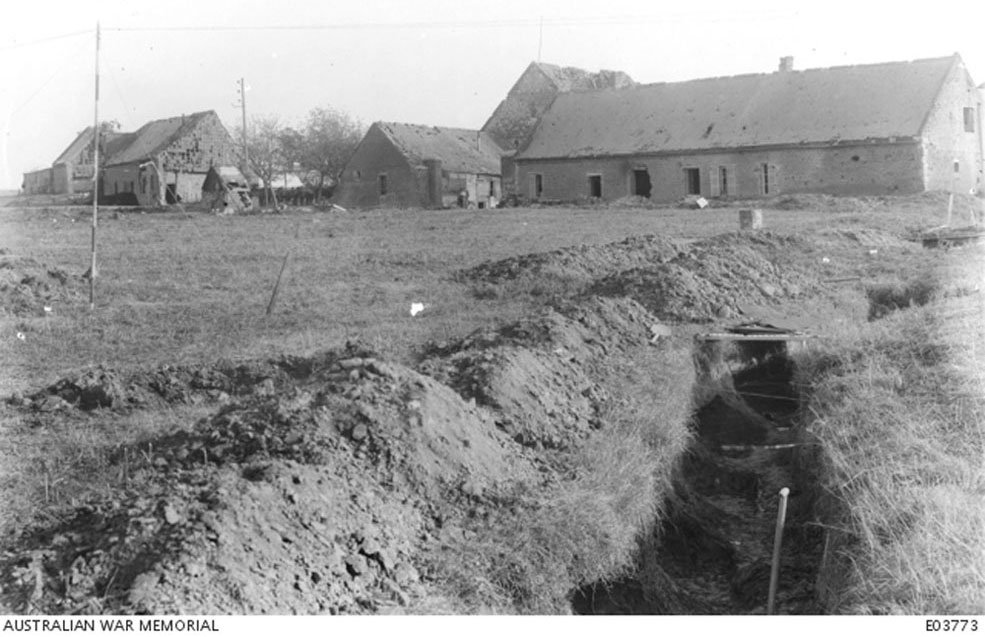
Above: Australian War Memorial archival photo of Grisonmühle (Swiss Cottage) after its eventual capture. Despite its wire obstacles and concrete bunkers, the 'Beaurevoir-Fonsomme Line' was still fundamentally incomplete. Many of the defenders were forced to fight from rudimentary trenches like those seen here.
1st October 1918 was a bright autumn day, exposing the defenders to constant harassment by as many as forty British aircraft at a time. Outnumbering their German counterparts by at least ten to one, they freely bombed, strafed and (aided by observation balloons) directed artillery fire onto the hapless Germans throughout the day. The immediate preparatory barrage for their assault began around 15:00, including copious quantities of gas and smoke. At 16:00 the infantry of 32nd Division strode forward through this toxic miasma, with eight heavy tanks of 9th Battalion flattening the wire in front of them. Three tanks were knocked out by the Bavarian Tankkanonen and concentrated machine-gun fire, Vfw. Münch of 1MGK/473 being credited with two of them. Nevertheless the section of the 'Beaurevoir-Fonsomme Line' held by II./473 was breached and almost all of 7. and 8./473 killed or captured in close quarters fighting; the British took around 200 prisoners from this regiment alone. The left flank of IR 472 near the Grisonmühle (Swiss Cottage) likewise collapsed and 1. and 7./472 were effectively destroyed. Immediate reserves from both regiments could not get far beyond Ramicourt due both to enemy fire and to the intense defensive bombardment. By 19:00 the much depleted infantry were holding a rudimentary line closer to the western edge of Ramicourt. Counterattacks were launched in the night by fresh battalions, bolstered by survivors of those which had been so badly mauled during the day. III./473 cleared the former II./473 section of the line after some serious localised fighting, while III./474 cleared the British from the IR 472 sector and took over its left half. In addition II./474 was deployed near L'Espagne Farm as Nahtbataillon (literally 'stitch battalion') to reinforce the vulnerable inter-divisional boundary with 21.ID on the left.
The British 32nd Division made a fresh attempt to take Ramicourt on 2nd October, again with massive artillery and air support but this time without tanks. This was successfully repulsed by the Saxons without reaching their lines, but the defenders were being steadily ground down by incessant shelling, hunger, thirst and the looming certainty of Germany's imminent defeat. Although its meagre line was reinforced by 1./473 during the following night, it was still weakly held; some of the trench-holding rifle companies had as few as twenty-five rifles and two or three light machine-guns, while the machine-gun companies no longer had enough men to man all of their guns. The front line of 241.ID as a whole was now held by a complex patchwork of companies (and remnants thereof) from all of its own regiments plus several others, grouped under the ad-hoc leadership of the nearest battalion staff.
During the afternoon the regimental staff of FAR 48 (under Hauptmann Hielscher, as Major Wagner was now acting divisional artillery commander) had taken up residence at the Arbre-Haut-Mühle southeast of Montbrehain, which at the time also housed the staffs of IR 473 and 474 as well as that of 246. Infanterie-Brigade. The remaining batteries of FAR 48 went into firing positions during the night of 2nd-3rd October; with the exceptions of 2., 6. and 9./48 in and around Brancourt (plus half of 4./48 in reserve), the bulk of the regiment was concentrated south of Montbrehain. Perhaps significantly for Arno, one two-gun section (Zug) of 3./48 was designated as Tankzug (anti-tank section); this would be the only element of the regiment not to find its new position before the British bombardment opened, as the Tankzug of FAR 1 which they were due to relieve had already disappeared.
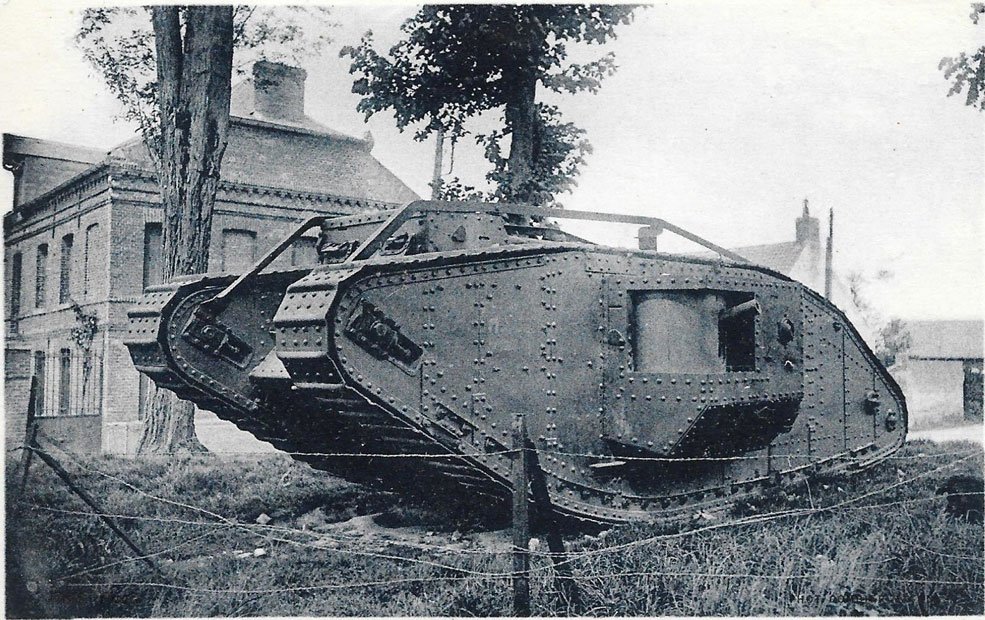
Above: a knocked-out 'male' heavy tank in Montbrehain. I have been unable to identify this exact location, but post-war French picture postcards of this same vehicle (erroneously claimed to be German) clearly confirm that it is somewhere in Montbrehain village.
The barrage preceding the attack on 3rd October opened at 06:05 with overwhelming force, and rapidly began to creep toward Ramicourt and Montbrehain. The entire German line was soon enveloped in gas and thick artificial smoke, under cover of which the infantry of 46th Division and eleven tanks of 5th Battalion closed with the defenders before they could react. The regimental history of IR 473 includes graphic eyewitness accounts, claiming that some of the enemy even seemed to appear from the rear of the Hauptwiderstandslinie (main line of resistance). Once astride the infantry positions, the tanks ruthlessly enfiladed the defenders with their machine-guns and 6-pounder guns. Since many of the hapless Saxons were occupying 'knee-deep' holes and small trench sections with a rudimentary parapet and no side cover, they were butchered in their dozens before coming under close assault by infantry with fixed bayonets. According to IR 472, there were no remaining anti-tank weapons beyond machine-guns; it is unclear what had become of the Bavarian specialist battery, or of the numerous Minenwerfers of the regimental companies. 12./474 and 5./472 launched futile local counterattacks, and were likewise destroyed. By 07:30 the British had secured Ramicourt, and the few survivors of its garrison fell back to Montbrehain. This was the enemy's next objective, and was itself under attack by 08:30.
North of Montbrehain, 7./474 was mostly destroyed in the defense of L'Espagne Farm. The rest of II./474 managed to dig in and hold on "the heights NE of Montbrehain" together with survivors of III./474, RIR 46 and the nearly obliterated IR 472, all under the command of Rittmeister von Bünau of III./474. South of Montbrehain, the assorted stragglers and staff personnel concentrated at the Arbre-Haut-Mühle within the artillery lines were reinforced by 6./473, which had managed to escape from its reserve position south of Ramicourt largely intact. In addition, about half of I./472 under Hauptmann Müller (himself fighting in the front line with his staff) held a line south of Montbrehain, apparently between the village and the Arbre-Haut-Mühle. Meanwhile the Tankzug of 3./48 had been caught by the bombardment while relocating, and its commander Leutnant der Reserve Oertel wounded in the head. Under the provisional command of Leutnant der Reserve Haubenreißer, it had taken up an improvised position next to Montbrehain railway station. Here it became the first element of FAR 48 to observe and fire on the advancing enemy infantry over open sights.
As the smoke cleared and the approaching tanks and infantry became clearly visible around 08:30, FAR 48 redeployed to engage them directly, despite relentless harassment by enemy aircraft. 4., 5. and 7./48 all moved back slightly into open positions, while the other half of 3./48 and half of 1. / FAR 1 went into action northwest of Beauregard Farm. The Tankzug of 3./48 is credited with a tank kill at this point. Of the eleven tanks accompanying 46th Division, five were knocked out over the course of the day - four definitely while approaching the outskirts of Montbrehain. It is sadly impossible to determine how many of these were destroyed specifically by FAR 48.
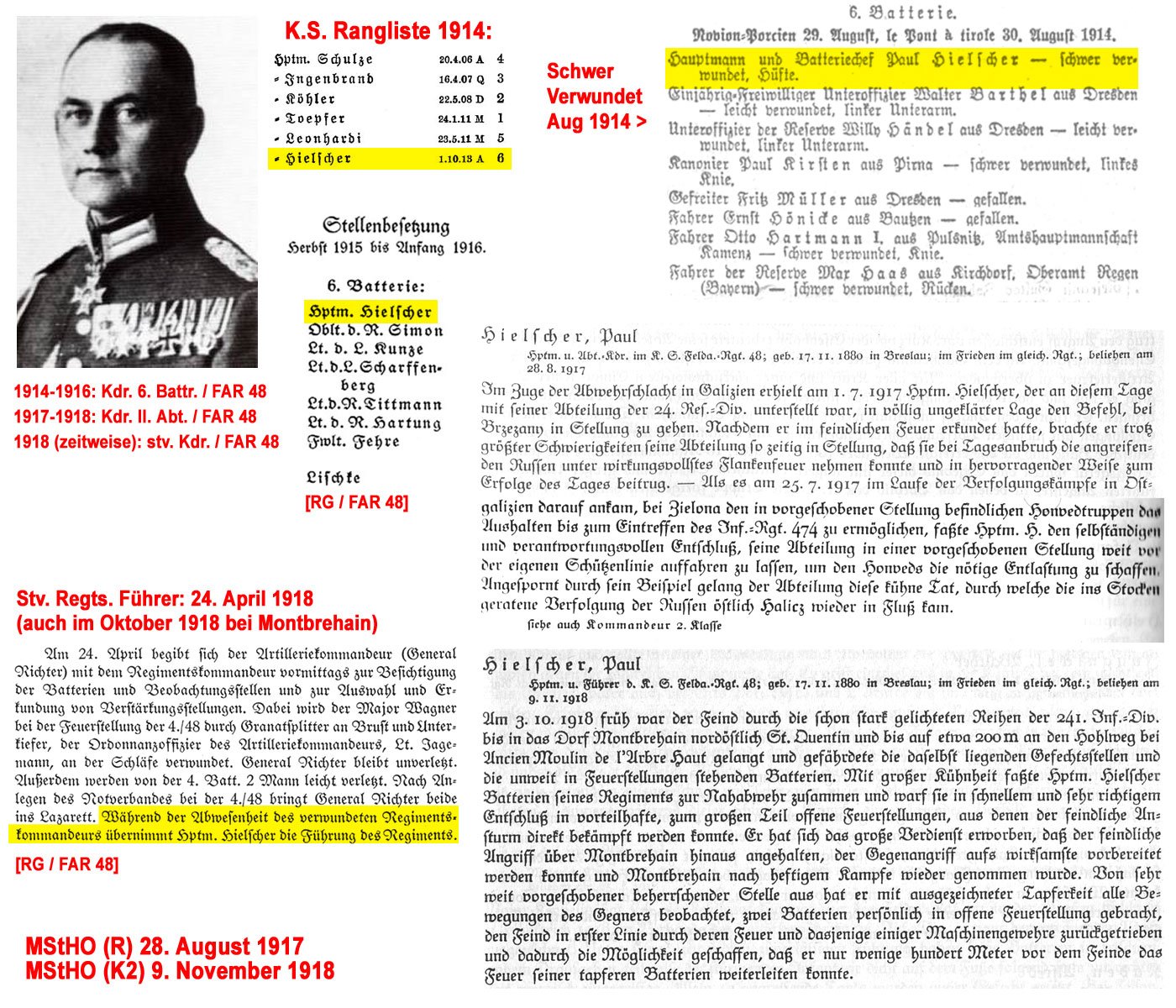
Above (click to enlarge): Hauptmann Paul Hielscher was already commander of the 6. Batterie / FAR 48 in peacetime, and still held that position in 1916 after recovering from the severe hip wound he had received in August 1914. By 1917 he was commander of the II. Abteilung, and was awarded the Ritterkreuz des Militär-St.Heinrichs-Ordens for his performance in that role in Galicia in July. He first deputised for Major Wagner as acting regimental commander after the latter was wounded on 24th April 1918.
With Wagner temporarily required to act as divisional artillery commander, Hielscher held acting command of FAR 48 during the fighting for Ramicourt, Montbrehain and Brancourt. For his defence of the Arbre-Haut-Mühle on 3rd October 1918 he would subsequently be decorated with the Komturkreuz II. Klasse des Militär-St.Heinrichs-Ordens, the highest grade available to field officers. After the war he remained in service with the Reichswehr and Wehrmacht, ultimately reaching the rank of Generalleutnant and acting divisional commander. Paul Hielscher died in Wiesbaden on 21st September 1945.
By 09:00 the British had nevertheless reached Montbrehain, and 9./48 (on the Montbrehain-Brancourt road) was soon forced to change position due to direct machine-gun fire. Hauptmann Müller's group (I./472) was encircled around 09:30 by British infantry attacking through Montbrehain into its right flank and rear. The majority of his force was eventually overwhelmed and killed or captured, including Müller and his staff. With infantry stragglers fleeing past them and its limbers at Brancourt, the Tankzug of 3./48 was obliged to disable its guns and fall back around 10:00 after it had run out of ammunition. Fifteen minutes later enemy infantry began to appear on the high ground west of the Arbre-Haut-Mühle. Hauptmann Hielscher immediately brought two batteries (not identified by number in the regimental history) into action in open ground in direct defence of his regimental headquarters, reinforcing the shattered infantry remnants which now stood between FAR 48 and the enemy. The batteries west of the Arbre-Haut-Mühle engaged the enemy down to ranges as close as 800 metres before limbering up and relocating further east.
Unlike on 18th July, salvation now arrived for the beleaguered artillery regiment. From 12:30 (according to their regimental history; other sources vary) all of its guns which remained operational and in possession of ammunition fired a creeping barrage on the British troops in Montbrehain, in support of a counterattack led by fresh Saxon reinforcements. The Saxon 24.ID was now Eingreifdivision to 241.ID, its first elements having reached Bohain by motor lorry that morning. There they had been formed into the composite Regiment Köhler (under Major Köhler of IR 139), consisting of I./133, I./139 and I./179. Now they joined the surviving infantry of 241.ID in an encircling counterattack both north and south of the village, forcing the British to fall back to Ramicourt or risk being cut off. By 16:00 at the latest Montbrehain was once again in German hands, though the counterattack's original objective (the Hauptwiderstandslinie west of Ramicourt) had to be written off as wholly unobtainable. During this stage of the fighting, 1./48 was credited with a tank kill. To their satisfaction, the gunners of 3./48 were now able to reclaim the abandoned guns of their Tankzug - one of which was soon repaired and back in action by the following morning.
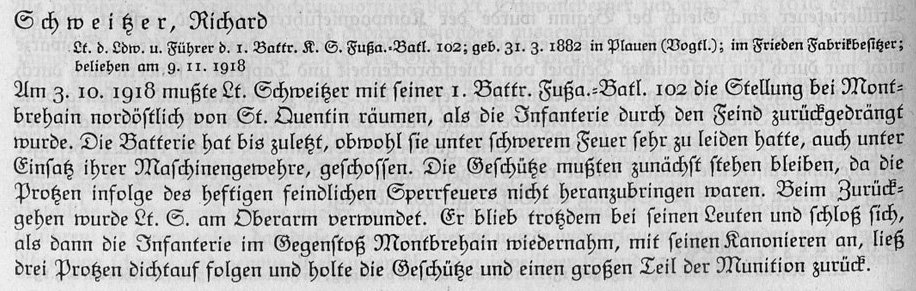
Above: although not mentioned in any other sources, the citations for two awards of the Ritterkreuz des Militär-St.Heinrichs-Ordens to officers of Fußartillerie-Bataillon 102 reveal that the divisional heavy artillery battalion was also hard-pressed on 3rd October; these were two of a total of three awards to this unit during its entire existence. According to the citation for Leutnant der Landwehr Richard Schweitzer, the 1. Batterie was forced to defend itself against enemy infantry with direct fire from its 15cm heavy howitzers as well as its battery machine-guns. Since their limbers could not be brought forward through the intense bombardment, the howitzers finally had to be abandoned. Wounded in the arm during the withdrawal, Schweitzer remained with his men and returned to retrieve the guns and much of their ammunition after the infantry had retaken Montbrehain.
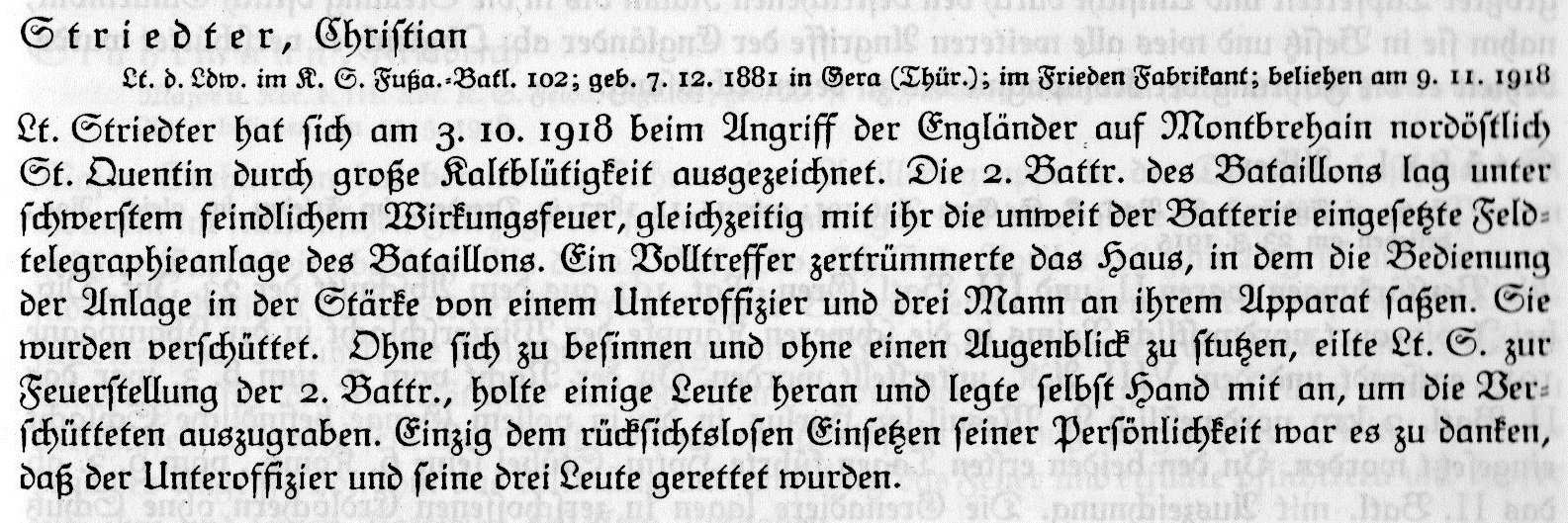
Above: Leutnant der Landwehr Christian Striedter of 2. / Fußa. Batl. 102 received his award for saving the lives of an Unteroffizier and three men of his battalion, who were buried alive when the house containing its field telegraphy station took a direct hit. Although under heavy 'fire for effect' from the enemy artillery, Striedter immediately led a group of gunners to the site and managed to dig all four men out of the rubble before they could suffocate.
The exhausted 46th Division made no attempt to resume its attack on 4th October, though naturally the incessant shelling continued. For the next attempt on Montbrehain it would be replaced by the 2nd Australian Division, in the final battle fought by Australian troops on the Western Front. This would go wholly unremarked by the Germans, to whom this fresh opponent would simply appear as yet more Engländer. During the brief respite provided by this pause in operations, the defenders were reinforced by the arrival of further elements of 24.ID in the vicinity of Brancourt. These included the III. Abteilung (10.5cm howitzers) of FAR 77, a regiment which had fought with distinction against the first ever tank attack at Flers on the Somme on 15th September 1916.
The front line was now held approximately as follows - Abteilung Bünau (mainly survivors of II./474, plus elements of III./474 and IR 472) at L'Espagne Farm on the right, then I./139 and I./133 holding the western edge of Montbrehain. On the left of I./133, IR 30 (34.ID) stood between the enemy and any approach to the Arbre-Haut-Mühle. Although the regimental staff had now relocated to Brancourt, Untergruppe Grohmann (III./48) was still based at the mill, with 7. and 9./48 deployed nearby. Besides these batteries, this headquarters was defended by about forty survivors of IR 473 with three machine-guns, under their regimental commander Major Alexander Graf Vitzthum von Eckstädt. Remnants of I./474 were also still dug in nearby. Having been fighting for days with erratic provisioning, and with all iron rations long consumed, the survivors of the three infantry regiments of 241.ID (all barely rebuilt before the battle after their mauling in July) were now in dire need of relief but could not yet be spared.
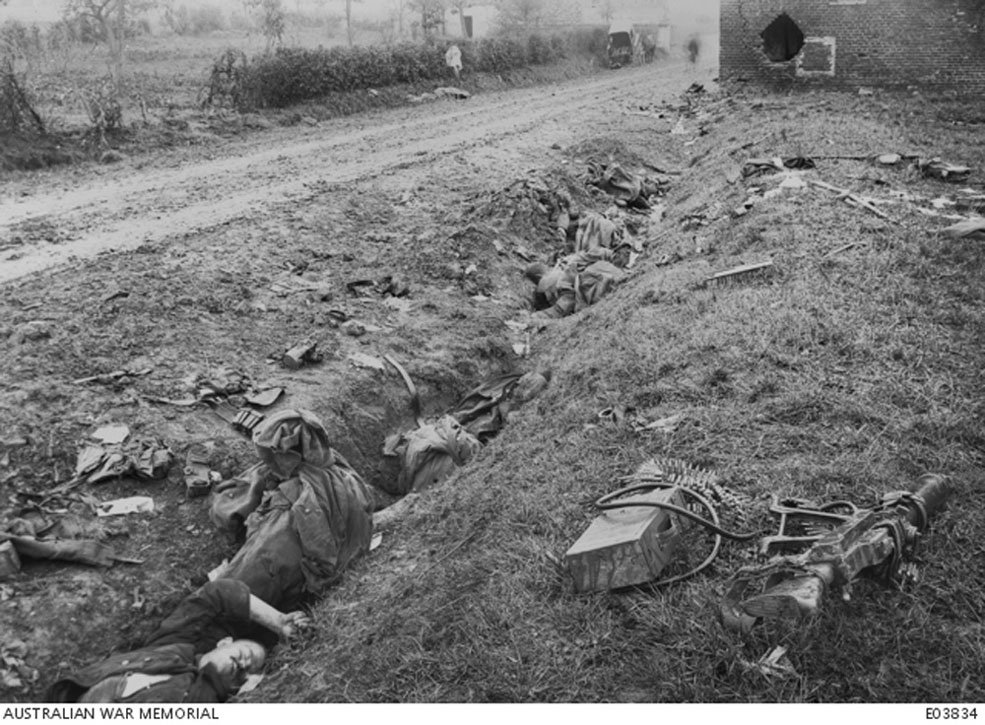
Above: Australian War Memorial archival photo of German dead in a rudimentary roadside trench at Montbrehain. An MG 08/15 light machine-gun lies discarded in a tangle of belted ammunition on the right.
At 06:05 on 5th October eight brigades of Australian field artillery opened up in a coordinated barrage against their attack front, extending some way into the neighbouring divisional sectors to both sides of 241.ID. The barrage crept forward 100 yards every four minutes with the Australian infantry cautiously advancing close behind; despite extensive experience in such advanced methods of combined-arms operation, some were still killed by drop-shorts. A dozen tanks had been allocated, but sources are contradictory on how many actually got into action. Some of them certainly accompanied the Australians into Montbrehain, helping to overcome strongpoints manned by Saxon machine-gunners. About 07:45 the attackers broke into the left flank of Abteilung Bünau at L'Espagne Farm through the village. With breathing space provided by the counterattack of a reserve company from I./179, Rittmeister von Bünau's dwindling force withdrew, subsequently managing to hold onto a new position 600 metres further back on the Montbrehain-Serain road.
Meanwhile the vital high ground at the Arbre-Haut-Mühle was once again under serious threat. Firing their machine-guns and 77mm field guns over open sights, 7. and 9./48 (aided by the forty survivors of IR 473) brought the Australians to a halt about 300 metres north and northwest of the mill. The defenders were further bolstered by support from the batteries of III. / FAR 77, and by 08:30 the first elements of II./179 reached the Arbre-Haut-Mühle. Fortunately for them, the Australians made no further attempt to take the mill, but it nevertheless came under increasingly heavy fire as the morning wore on. Supported by fire from the batteries around Brancourt and south of Montbrehain, the reserve battalions of 24.ID (II and III./139 plus the rest of II./179) subsequently launched an organised counterattack from Brancourt. According to FAR 48, they fired a creeping barrage in support of this attack at 11:40, whereas the Australians claim that the counterattack began as early as 09:00 (from 16 September to 6 October 1918 there was no difference between German and British time; thereafter the Germans were an hour ahead). In any case, the Australians were briefly forced back to the western edge of Montbrehain, before committing their own reserves; this then forced the Saxons back out of the village to avoid encirclement.
By evening FAR 48 and its supporting infantry were still in possession of the Arbre-Haut-Mühle. However every gun of 9./48 and all but one of 7./48 had now been taken out of action by enemy action or mechanical failure. It is unclear when the artillery withdrew from the mill, but it presumably happened during the successive reorganisations on 6th and 7th October, in conjunction with the relief of 241.ID by 24.ID which followed on the evening of the 7th. While nearly all of what remained of 241.ID's infantry was withdrawn, FAR 48 would remain for longer (as was the usual lot of the field artillery). On 8th October, 1-4. and 8./48 would all still be in action.
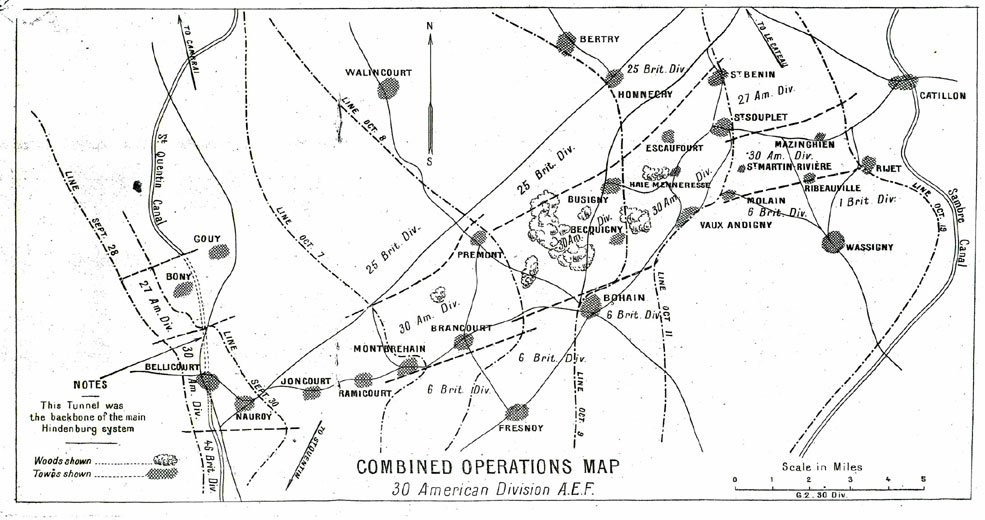
Above: advance of U.S. 30th Division in October 1918.
Meanwhile the Australians had also been relieved by the U.S. 30th Division, which would be tasked with the capture of Brancourt and Prémont (in the neighbouring German divisional sector). For this operation they were allocated twenty Mk V heavy tanks of the U.S. 301st Tank Battalion and ten Whippet tanks of British 6th Tank Battalion. A further six Whippets of the latter battalion were allocated to British 6th Division, attacking immediately to the south of Brancourt.
The bombardment opened at 06:00 on 8th October, again accompanied by artificial smoke. By 06:50 the enemy had reached the south-western exit of Brancourt. South of the village was 2./48, the forwardmost element of the 24.ID artillery. Under heavy enemy shelling and taking casualties, the battery engaged enemy infantry advancing along the railway line. By 07:45 German infantry could be seen falling back past the railway station, as the range narrowed to 800 metres and closing. Having exhausted its ammunition and with no hope of bringing up the limbers to move his battery, its commander (not named in the regimental history) ordered the guns to be disabled. While trying to do so he was shot through the arm, and the battery overrun by enemy infantry. Observing this from further back, Oberleutnant Fischer of 3./48 ordered his gun crews to open fire on the position of 2./48, in the vain hope of giving their fellow gunners a chance to escape in the confusion.
As tanks approached the railway station, Hauptmann Grohmann and the staff of III./48 hurriedly left their position there and retired to the unnamed farm southwest of Bohain. Having been severely hit by the bombardment, 8./48 likewise withdrew with two disabled guns; its third gun, likewise wrecked, had to be abandoned to the enemy as irrecoverable. 9./77, also deployed south of Brancourt, was more fortunate and escaped to join the rest of II. and III./77, which were dispersed in various positions south of the railway line between Brancourt and Bohain. Furthest to the rear of all of its regiment's batteries which were still in the battle, 4./48 went into action in open positions as soon as the smoke had cleared sufficiently to reveal the enemy advancing from Brancourt station. The regimental history claims that they knocked out two tanks and drove back the accompanying infantry, before running out of ammunition and retiring a kilometre further back to restock.
In Brancourt, the sadly depleted defenders were steadily overrun or pushed back by overwhelming numbers of American infantry and tanks. As far as the Americans were concerned the village itself was not secure until 11am (12:00 German time), but long before that the Saxon batteries to the east were already engaging massed infantry and tanks which had bypassed or broken through it. At 09:45, 1./48 was brought out of reserve and deployed in the open near Jonnecourt Farm, adding to the massed firepower of FAR 77. Fifteen minutes later 3./48, having run out of ammunition, limbered up and pulled back to the same position where it took advantage of the stockpiles there. This concentration of Saxon field artillery was unquestionably responsible for many of the tank losses that day, which amounted to ten of the American Mk V heavies and three of the British Whippets supporting U.S. 30th Division.
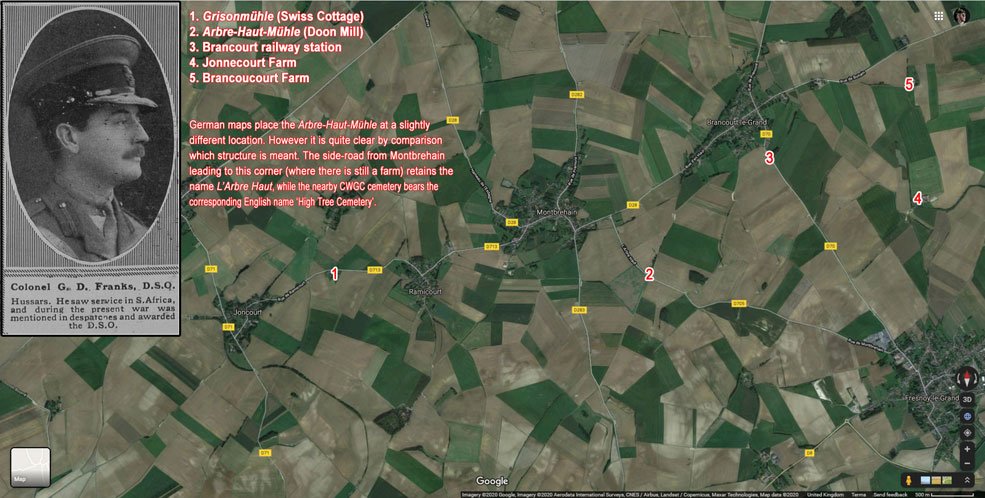
Above: Google Maps view of the area around Montbrehain with relevant locations marked.
- Grisonmühle (Swiss Cottage)
- Arbre-Haut-Mühle (Doon Mill)
- Brancourt railway station
- Jonnecourt Farm
- Brancoucourt Farm
Inset: Colonel G.D. Franks of the 19th Hussars.
Early that afternoon the artillerymen came under a form of attack which FAR 48 had not faced on the Western Front since 1914. Advancing southward from the vicinity of Prémont, the British 19th Hussars attacked and captured Brancoucourt Farm with one mounted squadron at 12:00 British time. While several of the Saxon batteries had already briefly spotted and engaged mounted elements of this regiment and inflicted some casualties, 1.and 3./48 were warned just in time by retreating infantry that British cavalry had taken Brancoucourt Farm (the regimental history of FAR 48 says 'Beauregard Farm', but this makes little sense in context). 1./48 limbered up and relocated further left (south?) from its vulnerable position near Jonnecourt Farm, while 3./48 moved to join a forward-deployed gun of 5./77 in engaging the occupied farm. Arno's battery had only travelled 100 metres when 'A' Squadron of the 19th Hussars charged right through the position they had just abandoned. Personally led by their regimental commander Lieutenant-Colonel Franks, the hussars overran the forward gun of 5./77. The acting battery commander Leutnant der Reserve Schlieder was later found dead with his pistol in his hand under five dead horses. Unfortunately for the hussars, Schlieder's gun was supported by a machine-gun team from an unidentified Jäger-Bataillon. Keeping their nerve, the Jägers emptied their last 300 rounds into the cavalrymen at a range of 200 metres, killing both Lieutenant-Colonel Franks and his horse amongst others. As 1./48, the rest of 5./77 and 6./77 all opened fire on them, the surviving hussars retired to the valley southwest of Prémont. Although it looked like a massacre to the excited artillerymen, the war diary for 19th Hussars reveals that their losses for the day were twenty-one dead (including three officers), five missing (including two officers) and forty-two wounded (including six officers). They lost a total of 113 horses.
After beating off the cavalry attack, the batteries of FAR 48 and 77 continued to engage the numerous targets to their front for the rest of the day, changing position when necessary. FAR 48 was finally withdrawn from the sector that night. According to their regimental history, during the repulse of the cavalry Generalmajor Abeken of 89. Infanterie-Brigade (24.ID) was rallying his men east of Brancoucourt Farm with the words "wieder vor in Stellung; Ihr seht, dass dort vorne unsere Artillerie steht und feuert!" ("back into position; you can see that out there in front our artillery still stands and fires!"). The regimental historian Leutnant a.D. Heinz Wagner also cites a conference on 8th October 1918 where his late father Major Kurt Wagner was present in his role as acting divisional artillery commander. Purportedly the corps commander (Generalleutnant Hans von Below of Generalkommando z.b.V. 51) stated to the commanders of 24.ID and 241.ID that "wenn heute die Linie gehalten wurde, so war es allein das Verdienst der Artillerie!" ("if the line was held today, it was solely thanks to the artillery!") Although the enemy had in fact taken all of their set objectives for the day, the artillery had certainly fought with great distinction and discipline under exceptionally stressful circumstances - and was unquestionably responsible for a major proportion of the enemy's losses.
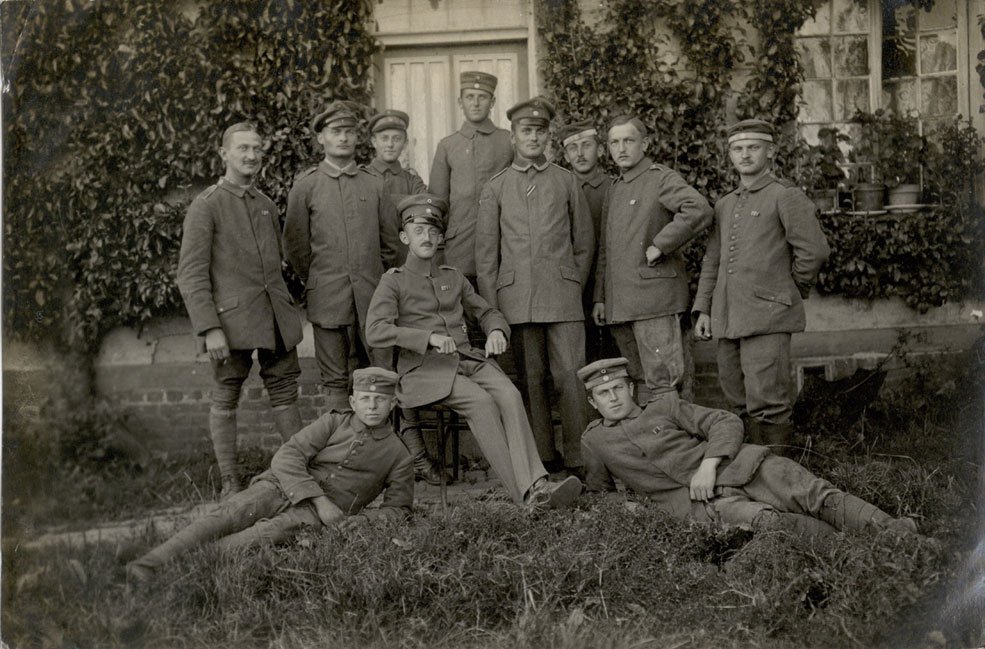
Above: Saxon infantrymen in autumn 1918, just about identifiable as members of the 241.ID by the first two digits '47-' on their shoulderstraps. It is unclear exactly where and when this photo was taken.
Initially FAR 48 was only withdrawn as far as Wassigny, with long-range fire missions (mainly for the howitzer batteries of II./48) for several further days. It was then gradually withdrawn to the vicinity of Maubeuge, joining the other units of the division. There it successively received a series of contradictory orders, as OHL was seemingly unable to decide whether or not to withdraw the near-destroyed 241.ID for rebuilding. The transportation of its surviving units to the rear of Armeeabteilung C (west of Diedenhofen) finally began on 18th October.
The situation now was immeasurably worse than after the disaster on 18th July, although in terms of raw numbers the losses for the division as a whole were comparable. Sachsen in Grosser Zeit estimates that from 1st to 7th October alone the division had lost around ninety officers and 3000 men. According to the roll of honour in the regimental history of FAR 48, the fighting in and east of the 'Hindenburg Line' had cost it thirty-two killed, mortally wounded or missing and later legally declared dead. To make matters even worse, the 'Spanish Flu' was ravaging the army, further reducing the effective strength of all units and causing further deaths.
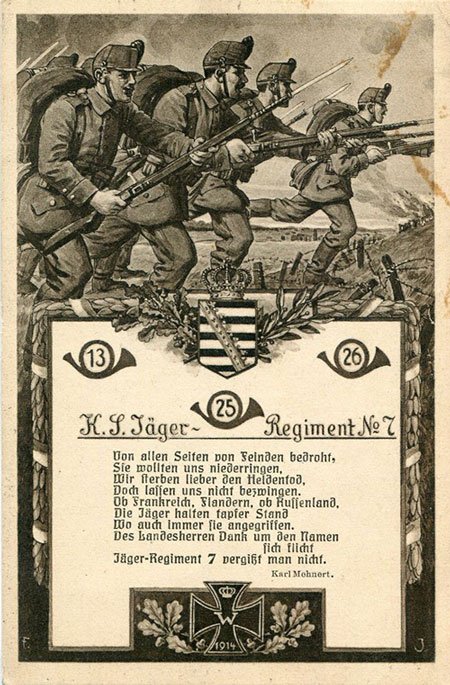
Above: commemorative postcard for Saxon Jäger-Regiment 7 and its three component battalions.
With its recent losses far exceeding its available replacements, the Saxon war ministry had been forced to sacrifice one of its shattered divisions to help rebuild the others. Thus on 26th September the 53.RD, formed with such high hopes in the first weeks of the war with a high proportion of volunteers, was ordered to be dissolved together with all of its infantry regiments. These were then parceled out among the remaining Saxon divisions, with 241.ID receiving what was left of I. Bataillon / RIR 241 during the days of uncertainty at Maubeuge. This nominal battalion became the new I./472. Upon arrival in the billeting area west of Diedenhofen IR 472 was also dissolved in turn, and its remaining personnel used to help rebuild IR 473 and 474. FAR 48 received 141 horses from the defunct regiment, bringing it up to 86.3% of its authorised horse strength.
As its new third regiment the division received Saxon Jäger-Regiment 7 from the otherwise Prussian 197.ID, another of the divisions now dissolved due to irreplaceable losses. This regiment had been formed in August 1916 on the Eastern Front by grouping together the existing Jäger-Bataillon 13, Reserve-Jäger-Bataillon 25 and Reserve-Jäger-Bataillon 26. Its subsequent experiences had been quite similar to those of 241.ID, including the Kerensky Offensive in Galicia, the German offensives in the west in 1918 and the final desperate defence of the 'Hindenburg Line' - during which it had been fighting a few miles to the south of the 241.ID. Though less mauled than the existing regiments of its new division, Jäger-Regiment 7 was still depleted - JB 13 for instance had been obliged to dissolve one of its four rifle companies.
There were a few other sources of replacements for the shattered regiments. In October 1918 Werner Mühle (a featured diarist in Fighting the Kaiser's War for his earlier experiences in Flanders with IR 102) was in Zittau, officially taking an increasingly redundant training course for prospective officers. Hoping to see out the war in Saxony, he was greatly disappointed to hear that the participants of his course were now to be sent to the front as replacements. On 14th October he arrived in Maubeuge, joining 11./474 four days later. When he arrived, the 'company' was only about thirty strong, and the parent III./474 composed of three such companies.
By 30th October the division was considered sufficiently rebuilt for further action. Its regiments each had three battalions, albeit with only three weak rifle companies each - though in these last desperate days this had become the norm. Thus it was now allocated to 5. Armee as an Eingreifdivision and transported (by lorry, in the case of the infantry) to Conflans-en-Jarnisy west of Metz.
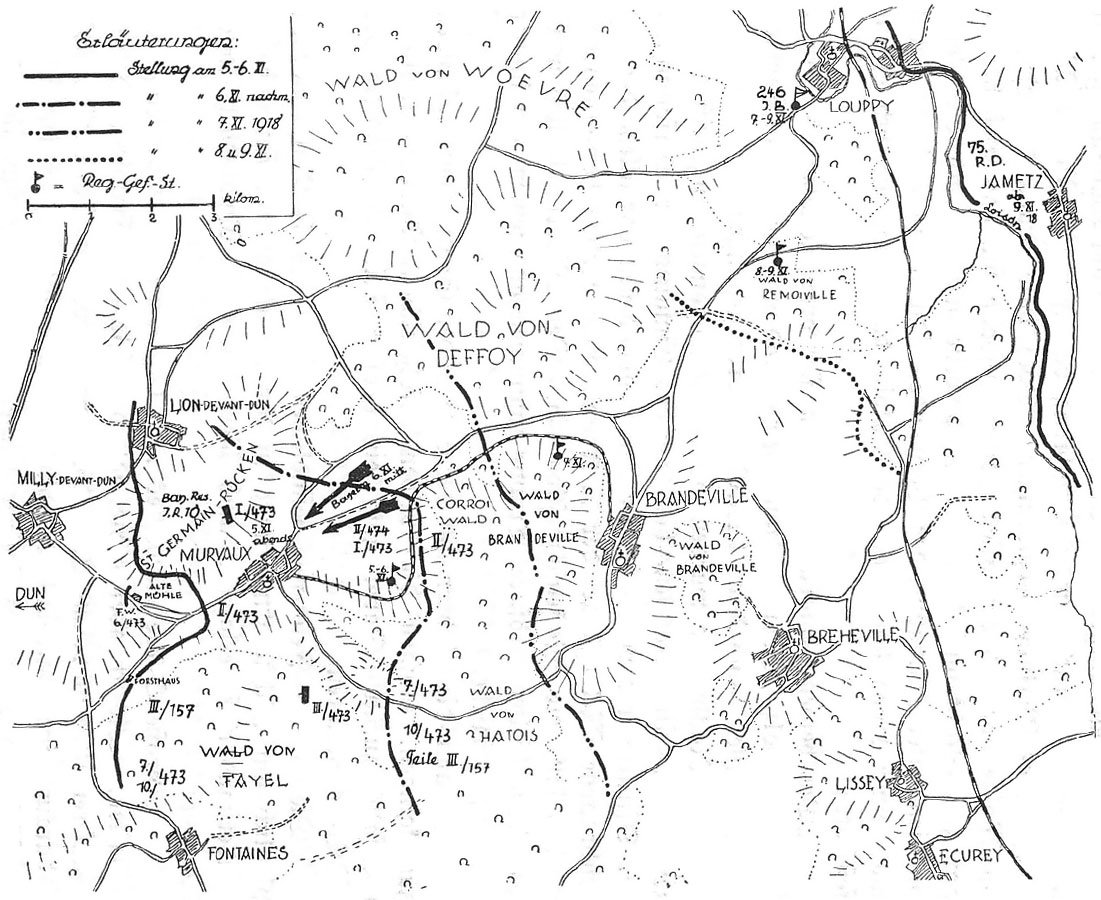
Above: map of the final action fought by 241.ID, taken from the regimental history of IR 473.
In the first days of November the elements of the 241.ID were repeatedly moved back and forth behind the front, earning it the sarcastic name 'Wanderzirkus Fortmüller' ('Fortmüller's travelling circus', after its commander) according to the published history of IR 473. On 5th November the division was committed to a hopeless effort to throw the Americans back across the Maas / Meuse between Dun and Vilosnes. On arrival, FAR 48 found itself initially taking over positions that had been used by Austro-Hungarian artillery. The 241.ID now fought a series of desperate rearguard actions, with the guns of FAR 48 often too close for comfort to the enemy infantry. This time however they would not be overrun, despite the inevitable disintegration of the terminally depleted and demoralised infantry.
The sector was handed over to the 75.RD on 8th November, but as ever the artillery fought on. The last fire position of 3./48 was Hill 279 southwest of Marville, which it occupied on the morning of 9th November. FAR 48 fired for the final time that night, laying down "disruption and annihilation fire" on the Bois de Jametz. The following morning the regiment was withdrawn and billeted in Marville, where it was informed of the armistice on 11th November.
Tragically, the futile November battles had cost FAR 48 a further nine killed, mortally wounded or captured and subsequently dead in captivity.
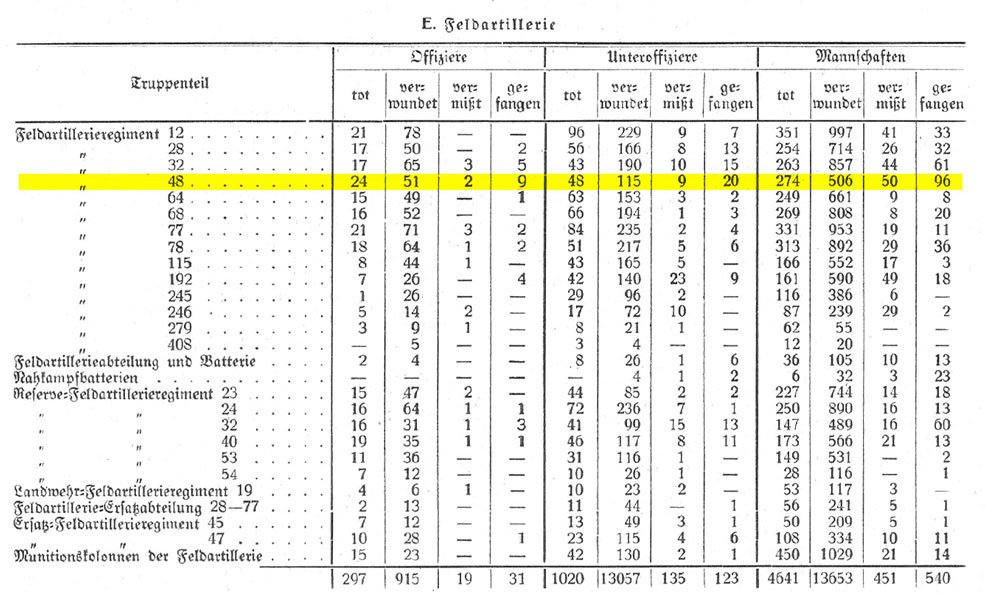
Above: table from Sachsen in Grosser Zeit (volume III, p.239) showing the losses of the Saxon field artillery for the entire war. Despite enjoying a relatively quiet war on the Aisne in 1915-1916 and spending 1917 on the Eastern Front, FAR 48 can be seen to have been one of the worst hit - especially in the numbers of captured and missing.
Note that FAR 12 uniquely possessed an independent Reitende Abteilung (horse artillery battalion) assigned to 8. Kavallerie-Division; its figures are presumably included in those for the parent regiment.
The complete 241. Infanterie-Division marched back from the Western Front as far as Schweinfurt, encountering chaos and rampant indiscipline among the 'Etappenschwein' (the German equivalent of 'REMFs') in the rear areas. The German civilians were often delighted to see them and highly sympathetic, though in a few places they were in a hostile revolutionary mood. FAR 48 parted company from the infantry (for whom trains were provided) at Schweinfurt on 12th December. Six days later the regiment reached Herbesgrün and Plauen in Saxony, where it was finally loaded onto freight trains. It reached Dresden on the 19th and 20th December, marching back to its barracks in good order complete with all of its guns and horse-drawn vehicles. According to his CV, Arno's own service with the regiment had already concluded on 30th November. Perhaps he had been lucky enough to be on leave when the war ended?
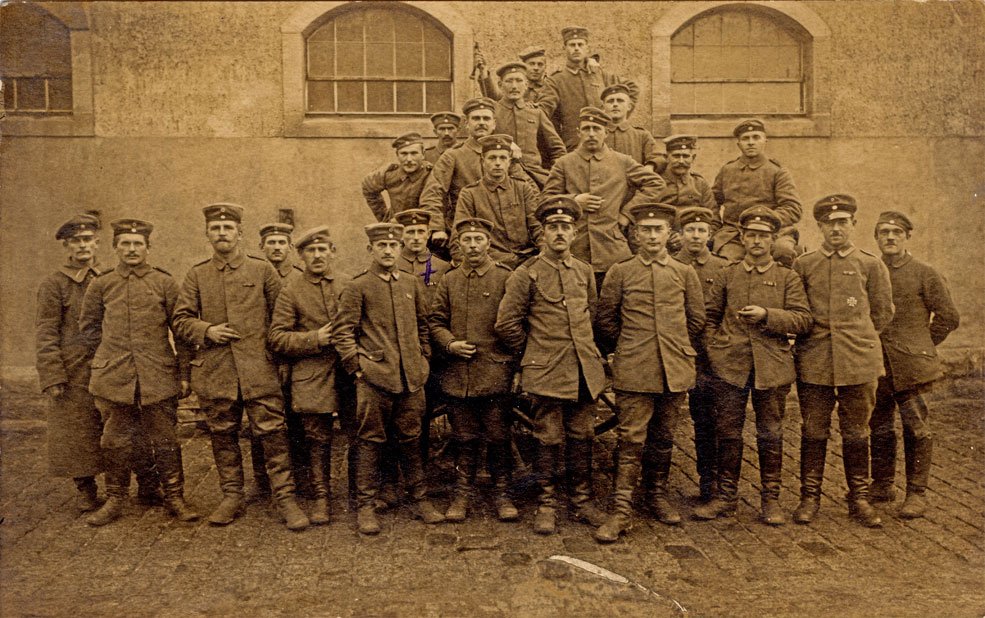
Above: sombre NCOs and men of FAR 48 pose for a last souvenir photo at the König-Georg-Kaserne in Dresden during demobilisation in December 1918.
After months of heavy fighting on the Western Front in a period when mustard gas was routinely used by both sides for counter-battery fire, the wartime economy Feldbluse has completely replaced older tunic patterns. The need to replace contaminated clothing alone had begun to pose an insurmountable logistical challenge to Germany's overstretched supply system. Many of the men and all of the NCOs proudly wear their medal bars; as was typical for non-commissioned veterans of major battles with the Royal Saxon Army, Arno is known to have been awarded the Iron Cross 2nd Class and the Saxon Friedrich-August-Medaille in bronze.
Despite the abdications of both the King of Saxony and the Kaiser (and the subsequent proclamation of a republican Freistaat Sachsen in Dresden) virtually all of these men are still visibly wearing the red-white-black upper cockade (Reichskokarde) on their headgear.
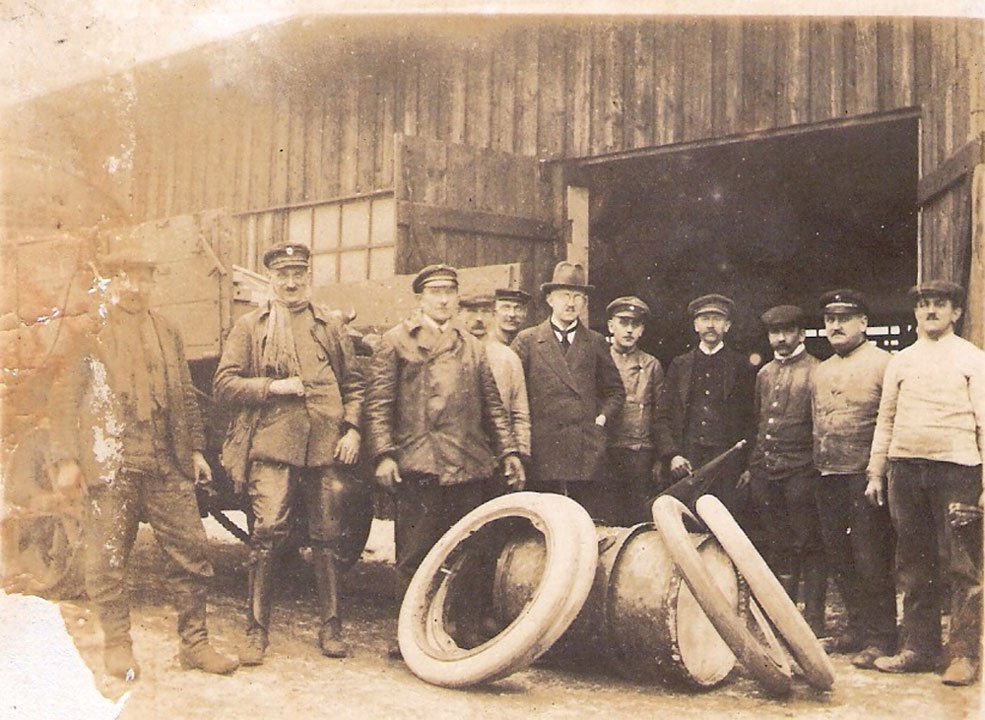
Above: Arno (in the middle, now in smart civilian dress) as Abteilungsleiter für Einkauf und Magazin (departmental head for purchasing and inventory) at the Autopark Zwickau in December 1919. According to his CV, he was initially employed there as a clerk from 1st February 1919 and promoted to Abteilungsleiter at the beginning of August. He sent this photo as a postcard to his future wife Gertrud Reinhold in Altenburg at Christmas 1919.
The Autopark was a local subsidiary of the Reichsverwertungsamt, a governmental body responsible for selling off surplus war material. The wartime Kraftfahr-Ersatz-Abteilung 9 in Zwickau (established in 1915) had been responsible for the training of drivers and for the stockpiling, maintenance and issue of motor vehicles - not only for Saxony, but also for adjacent Prussian corps districts. At the end of the war, a huge quantity of vehicles and components remained at the former facilities of KEA 9. The modifications required to former army lorries for sale on the civilian market included the refitting of rubber tyres, as seen here. Due to the British blockade, rubber had been in critically short supply during the war. As a result, motor vehicles and even bicycles had been fitted with wooden and metal tyre substitutes cushioned with springs. Similarly, the 1915 rubberised fabric gasmask had to be replaced with a new design made of chemically treated leather in 1917.
Having completed its appointed task, the Autopark Zwickau was abolished in February 1920. Arno immediately moved on to a full-time career with his trade union, the Deutschnationaler Handlungsgehilfen-Verband (DHV).
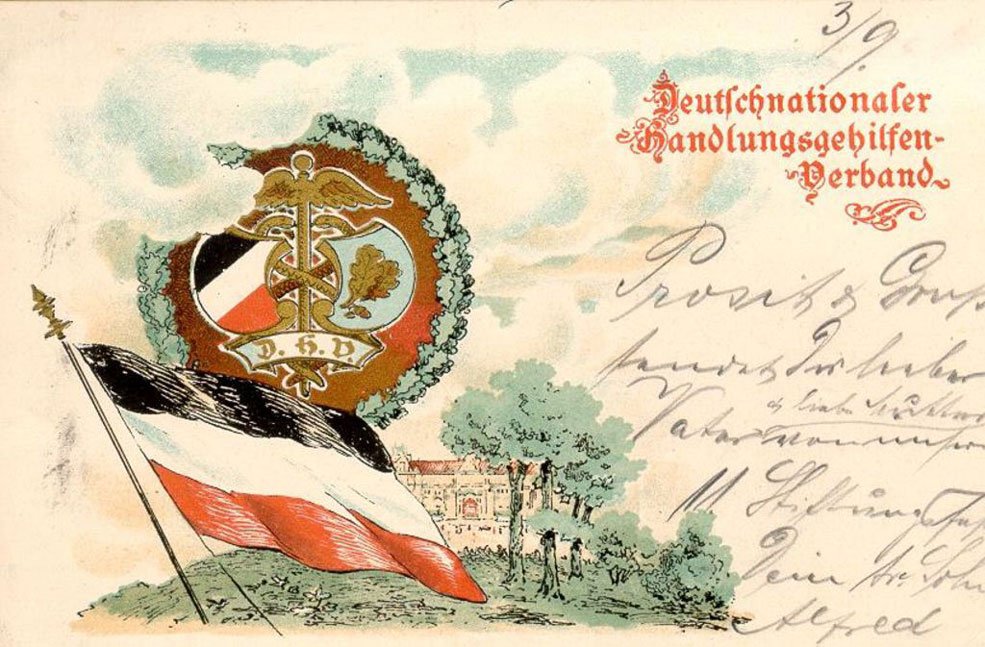
Above: founded in Hamburg in 1893, the DHV was a trade union for white collar workers based on 'Christian socialist' principles. Conservative and nationalist in orientation, it refused to accept Jews and women as members. From 1911 under the leadership of Hans Bechly (who would write Arno's job reference in 1934) it took an increasingly moderate direction, withdrawing from various 'volkisch' political umbrella organisations and realigning itself with the mainstream centre-right.
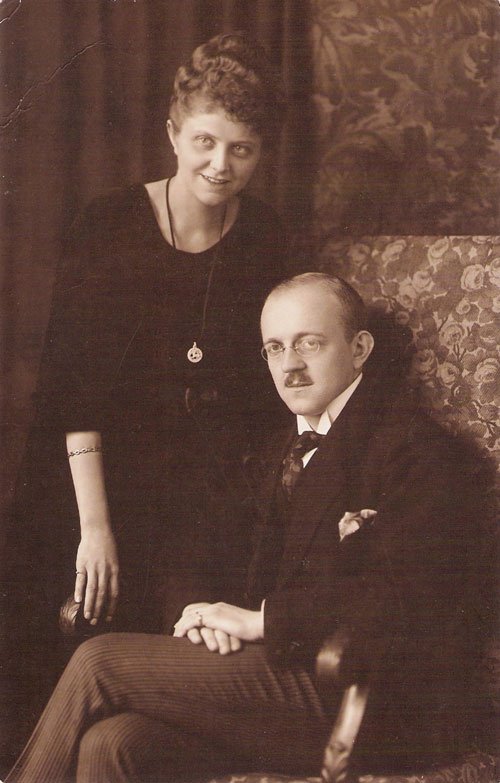
Above: engagement photo of Arno and Gertrud Bierast. Gertrud had been born into a prosperous family at Neustadt an der Orla in the Grand Duchy of Saxe-Weimar-Eisenach (Sachsen-Weimar-Eisenach) on 15th April 1895. Her father Paul Reinhold (from Heinrichswalde, Kreis Frankenstein in Silesia) had been baptised Catholic but converted to Protestantism, apparently for social or marital reasons. In fiercely Protestant Saxe-Weimar-Eisenach this minor 'scandal' was still a source of gossip when my grandmother was growing up.
Arno and Gertrud were married in Altenburg on 6th May 1922, by which time Arno had established a secure position with the DHV. Their only child Margot Annemarie Bierast (my grandmother) was born in Dresden on 5th June 1923.
Arno's surviving CV from 1934 indicates that he had been a member of and volunteer worker for the DHV for some time, perhaps since his apprenticeship. After a month in their Leipzig offices, he was placed in charge of the local branch at Aue in Saxony on 1st March 1920. By October he was district head for Kreis Bautzen. His subsequent appointments indicate that he was trusted to undertake the most politically sensitive and personally dangerous roles in the organisation.
On 1st March 1921 Arno was appointed head of Kreis Dresden against the wishes of the local leaders, with an explicit mission to purge a wave of radical leftist entryists from the DHV. This was a very dangerous period, since following the politically embarrassing suppression of the sailors' rising in Kronstadt the Bolsheviks had called for armed uprisings by local communist parties across Europe as a distraction. In Germany, the KPD began its 'März-Aktion' on 17th March with a general strike and local attempts at armed insurrection, which were put down by 1st April.
Having succeeded in his mission, Arno was appointed in April 1925 as head of the DHV in Gau Schlesien (Silesia). This included Polish-occupied Upper Silesia, where an unofficial war had been fought four years earlier between Polish and German paramilitaries ahead of a disputed League of Nations plebiscite. In order to take up this post, Arno and his young family moved to Breslau. Bechly's reference letter explicitly states that Arno's job involved mobilising union members in the Polish-occupied areas for 'conscious action on behalf of Germanness' (Deutschtum), which may well have involved travelling into those areas for the purpose. This was scarcely safe, since the Polish government and (even more so) Polish paramilitary groups had proved to be quite ruthless in the past. Nevertheless, within four and a half years Arno had succeeded in doubling DHV membership in Silesia.
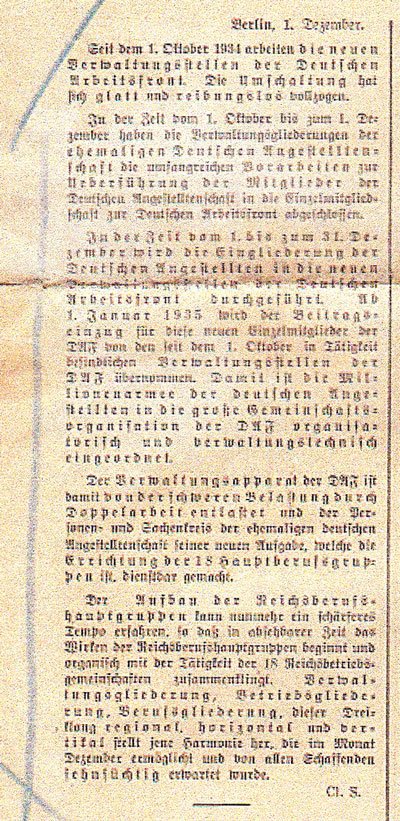
Above: newspaper clipping from Die Deutsche Berlin marking the forcible dissolution of the Deutsche Angestelltenschaft (successor to the DHV) by the Nazi Deutsche Arbeitsfront in Dezember 1934. Arno evidently marked and saved this clipping for posterity, as it was found among his papers after his death.
For this impressive feat he was rewarded in September 1929 with the leadership of DHV Gau Sachsen, becoming head of the union for the entire state of Saxony. It is probably during this period that he made the acquaintance of the future civilian resistance leader Carl Friedrich Goerdeler - from 1930 Oberbürgermeister of Leipzig, where the family was now living. In later life, my grandmother would recall being introduced to Goerdeler as a young girl. His Deutschnationale Volkspartei (DNVP) was politically sympathetic to the DHV, although the latter officially eschewed party politics.
Hitler's rise to power spelled the end of Arno's career and of the family's life in Saxony. Arno had made himself a known opponent of the NSDAP by his hostility to its attempts at entryism into his union. As a result, when the DHV was negotiating for its future political survival under Nazi rule he was one of a number of senior figures whose removal became necessary. The DHV leadership hoped that by replacing these openly hostile individuals with others who held NSDAP membership (but whose first and foremost loyalty was nevertheless to the DHV) it could appease the Nazis and thereby preserve the union's existence.
In 1933 Arno was 'kicked upstairs' to the central Berlin offices of the DHV's successor organisation, the Deutsche Angestelltenschaft, working directly under its national leader Max Habermann. The family accordingly moved from Leipzig to Berlin-Charlottenburg in February 1934. To Arno's anger and disgust the Deutsche Angestelltenschaft was nevertheless forcibly incorporated into the Deutsche Arbeitsfront (DAF), the Nazi state trade union organisation. Leaving his career as a union leader in 1935, he returned to bookkeeping for a car dealership in Berlin.
One minor mystery is his brief membership of the SA-Reserve (part of the brownshirted 'Sturmabteilung' of the NSDAP), from which he successfully requested his resignation in 1939. My theory is that Arno had previously belonged to the Stahlhelmbund, the paramilitary monarchist war veterans' organisation. When the Stahlhelmbund was taken over by the Nazi state, its entire veteran membership was automatically transferred into the SA-Reserve on paper. Despite the value of this membership as political camouflage, Arno's resignation at the height of Nazi power indicates that he was deeply comfortable with this situation.
To my great surprise, my late grandmother once pointed to a photo of an MP18 submachine-gun in a book I was reading and told me that there had been one hidden in the house during her childhood! Officially forbidden to the Reichswehr (but not the police), this novel weapon from the last months of WW1 was much used both in the open civil war of the early 1920s and later for political assassinations. I can only surmise that this highly illegal firearm may have been linked to Arno's presumed membership of the Stahlhelmbund or some other right-wing paramilitary group. Arno also possessed at least one automatic pistol, a much more easily explained and less flagrantly illicit weapon.
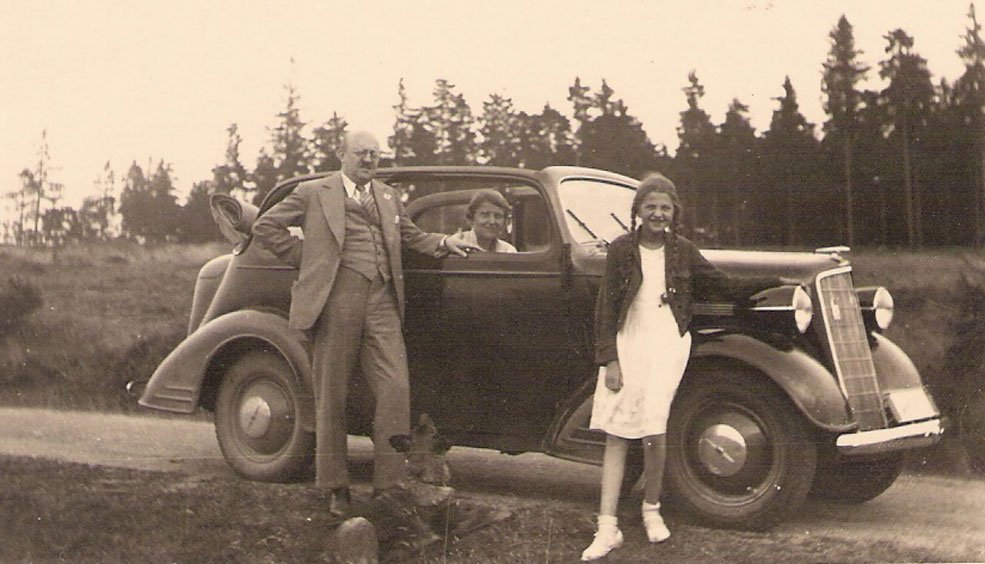
Above: Arno, Gertrud, Margot and their dog with the family car in the 1930s.
According to my grandmother, Arno greeted the outbreak of WW2 with nothing short of despair. While she was conscripted in 1940 to work on the land in occupied Poland as a member of the RADwJ (the women's branch of the compulsory state labour service), her father was offered two choices when he too was ordered to serve the war effort. He could either work for Organisation Todt (effectively a paramilitary mobilisation of German construction firms) in occupied Norway, or as a civil servant at the main employment office (Arbeitsamt) in Berlin. Unsurprisingly he took the latter choice, and used his position - at considerable personal risk - to issue 'essential war work' exemptions to numerous victims of Nazi political and racial persecution. My strong suspicion is that his appointment was part of the wide-ranging effort by General Olbricht (himself a veteran of the Royal Saxon Army) at the Ersatzheer to put as many oppositionists as possible into key military and government posts within the capital for the future purposes of the 'Valkyrie' coup plan.
To her parents' relief, Margot soon returned from Poland and was given a job in Berlin issuing telephone bills. From 1943, the city came under increasingly heavy air attack - the RAF coming by night, and the USAAF by day. Charlottenburg was repeatedly hit by bombers aiming for the factories in the nearby Siemensstadt. Margot would later recall how Arno and his fellow veterans would calmly play cards during the air raids, just as they had done during bombardments in the Great War. On at least four occasions the family's apartment building was hit by incendiary bombs and Arno and Margot had to fight fires and repair the shattered roof. One by one, Margot's young male friends were called to the front and did not return.
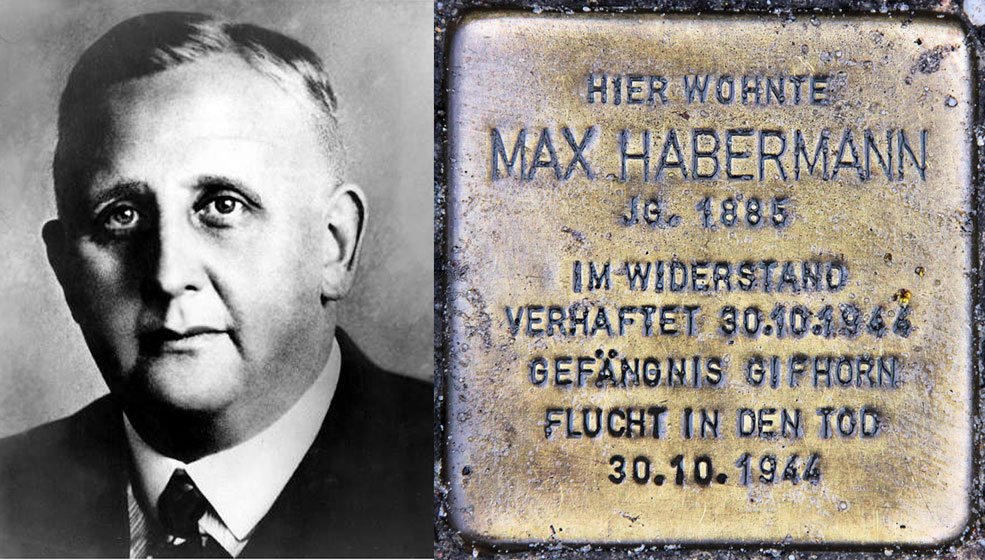
Above: on 20th July 1944, Margot heard the radio announcement that Hitler had survived an assassination attempt; she did not see her father for several days. It was not until after his death that she would learn that he had been chosen to play a part in the new government envisaged by the coup plotters, with specific responsibility for the dissolution of the DAF in Saxony. His immediate contact had been his former boss Max Habermann. Fortunately for Arno and many others, Habermann managed to commit suicide in Gestapo custody before he could be tortured for the names of his associates. Goerdeler however was hanged in Plötzensee prison on 2nd February 1945 after implicating many others. My grandmother believed that her father had been among the thousands questioned, but was able to convince the Gestapo of his innocence.
By spring 1945, the Red Army had surrounded Berlin. After a last trip to the office under fire from Russian artillery rockets, Margot was told by amazed German soldiers to stop going to work. Like every able-bodied male of his generation, Arno was now liable for service in the Volkssturm. Somehow he appears to have avoided the call-up.
Mercifully, Charlottenburg was spared both the worst of the fighting and the subsequent Soviet atrocities against German civilians. Arno prudently threw a pistol which he still owned into the Landwehr Canal, as the Russians would have shot him out of hand if they had found it in the apartment. The arrival of the conquerors was frightening, but also unexpectedly comic, as the Soviet soldiers reacted with incredulous awe to such marvels as plumbing. They took a childish delight in collecting wristwatches (functional or otherwise) and Arno, skilled in the ways of the black market and adequately fluent in Russian, was quite prepared to barter with them.
With the subsequent arrival of the Western Allies in Berlin, conditions became safer. Margot secured work with the Americans as a telephonist (in the mistaken belief that, as an employee of the state telephone company, she possessed the necessary skills). In this role she would meet her future husband Ronald Hemmings, a young British signalman.
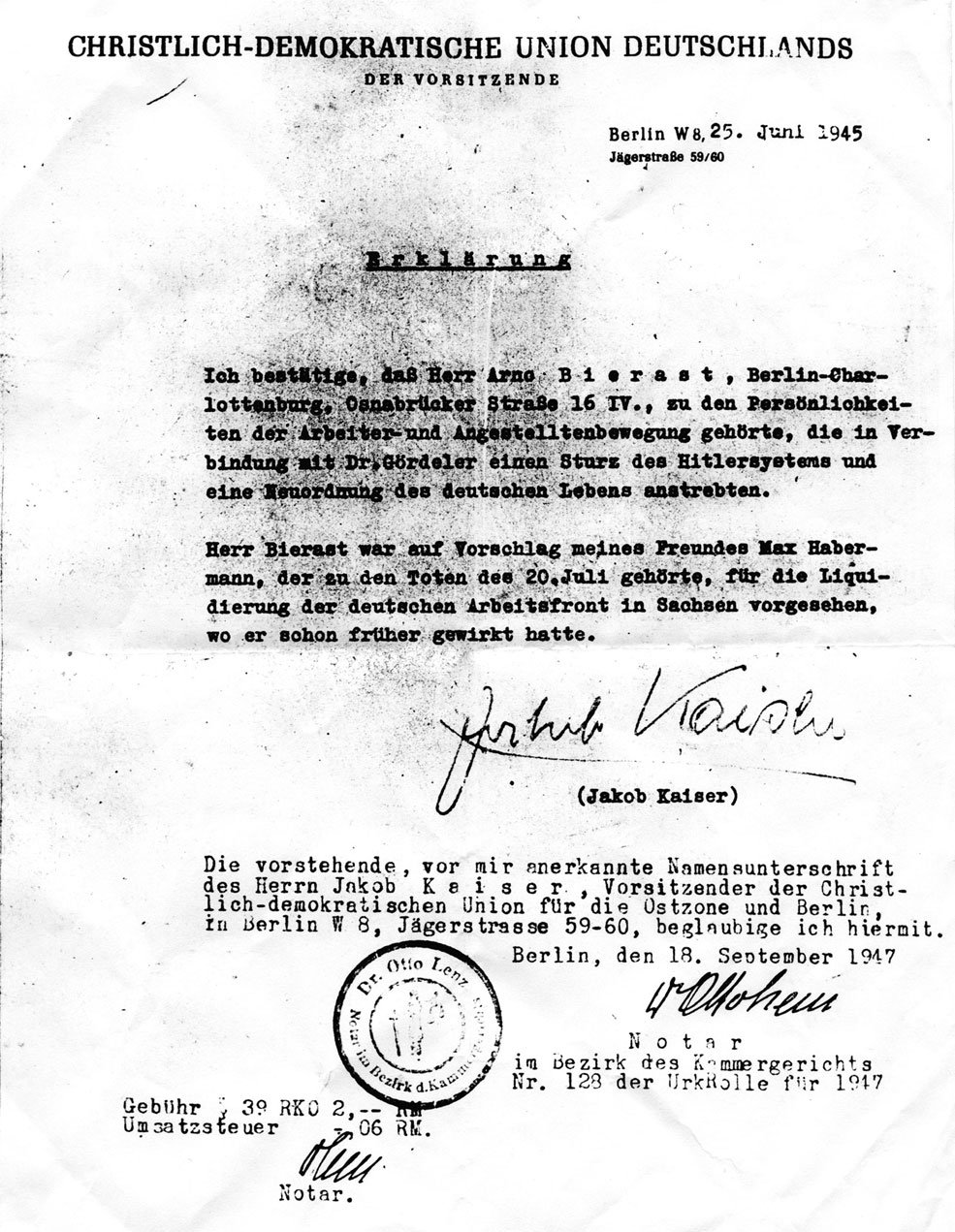
Above: post-war affidavit from Jakob Kaiser, founder of the (by the present day, only nominally) centre-right CDU party. As one of the most senior surviving members of the WW2-era conservative resistance, Kaiser testifies to Arno's membership in Goerdeler's loosely-organised conspiracy.
Like thousands of others, Arno was subjected to Entnazifizierung (denazification) by the occupying powers after the war. This may have been prompted by his brief and unwelcome membership in the SA-Reserve and DAF, his role as a civil servant during the war, malicious allegations or some combination of all of these.
A large bundle of surviving documents from this process includes affidavits from numerous individuals, mainly testifying to his use of his wartime position to shield acquaintances and even former centre-left political opponents from the attentions of the state. Others record his struggle against the Nazi takeover of the DHV and his close association with Max Habermann. It is through these documents alone that we know anything at all about his clandestine activities.
Although certified fit to hold a political role under the new regime, Arno instead spent the rest of his life working for the Allianz insurance company. Due to the partition of what was left of Germany by the occupying powers, it is likely that he never saw Saxony again. Nevertheless the family remained in touch with those relatives who still remained on the other side of the Berlin Wall, including his brother Rudolf. Arno finally died peacefully in Charlottenburg on 14th February 1959.
His widow Gertrud would live just long enough to see the wall come down in 1990. Margot was visiting at the time, and had the great satisfaction of personally participating in its destruction. She too finally passed away in 2015, leaving two children, three grandchildren and a great-grandchild in England to pass on the Bierast legacy.