
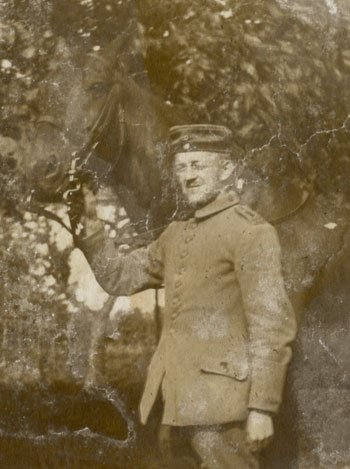
At this point we have sadly exhausted all of Arno's photos and all of the documentary evidence from Feldartillerie-Regiment 48 which refers to him. This is highly regrettable, as 1918 was by far the toughest and bloodiest year for the regiment - it was overwhelmingly this year which was responsible for FAR 48 suffering the heaviest total losses of any Saxon field artillery regiment during the war. Since Arno is known to have served with this same unit up until demobilisation and was never recorded sick or wounded, there can be little doubt that he was involved in the terrible battles described in this section.
Most of this part is specifically devoted to describing the cataclysmic events of 18th July 1918 in detail. Sixteen pages are devoted to that terrible day in the published history of FAR 48, plus large sections of the histories of IR 472, 473 and 474. It was beyond all doubt the greatest reverse suffered by 241. Infanterie-Division or any of its units by that point, after which the remainder of the war would consist entirely of retreat, rebuilding and desperate defensive battles.
At the end of 1917, the 241. Infanterie-Division was still on the (by now entirely inert) Eastern Front. Having gained extensive combat experience of mobile warfare and with plenty of young and fit men in its infantry regiments, it was inevitable that it would be remaining in the east for long. The main body of FAR 48 had been pulled out of the line in the Chorostkow sector as early as 18th December, allowing the entire regiment to celebrate Christmas in the rear. The relief of the rest of the division by Austro-Hungarian troops began on 1st January 1918, greatly hindered by deep snowdrifts and ongoing harsh weather. The rest of the month was supposed to be devoted to training, but considerable manpower had to be devoted to clearing the snow and gathering firewood - a problem greatly aggravated by the poor condition and inadequate numbers of the division’s horses. Partly the result of the relentless pace of the 1917 Austro-German counteroffensive, together with the harsh and unhealthy conditions of the Eastern Front, this lack of horses would continue to bedevil the 241.ID (and FAR 48 in particular) for the remainder of its existence.
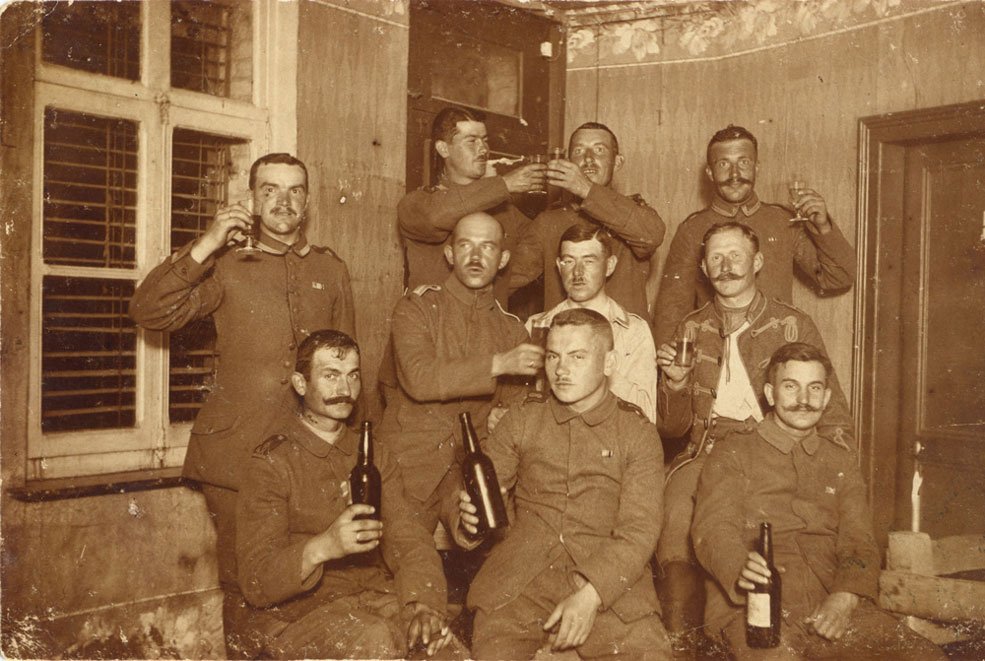
Above: presumably on leave or returning from hospital, a group of NCOs and men from FAR 48 (plus a stray Saxon hussar) celebrate the new year in Dresden. At least five are recognisable as combat veterans by their medal ribbons - typically the Iron Cross 2nd Class (black/white) and the Saxon Friedrich-August-Medaille (blue/yellow).
In early February the division began moving westward by rail and road, passing through the same area where it had fought the previous summer. On 12th February the I. Abteilung (presumably including Arno with the 3. Batterie) stopped for the night in Brzeżany (Berezhany). The loading of the division for transport to the west began on 22nd February at Złoczów (Zolochiv) and Zborów (Zboriv). The I. Abt. / FAR 48 embarked on the 27th at Złoczów station, beginning a lengthy railway journey across Austrian Galicia, ex-Russian Poland and Germany all the way to the massive rear area hub of Charleville in northern France.
The first elements of the regiment (including 3./48) arrived on 1st March and were quartered south-west of Charleville, with the I. Abteilung in Dommery. Almost immediately an outbreak of glanders (endemic on the Eastern Front) was discovered among the horses of the regimental staff. Three had to be shot and others hospitalised. On 8th March the regiment received a desperately needed batch of 278 fresh horses.
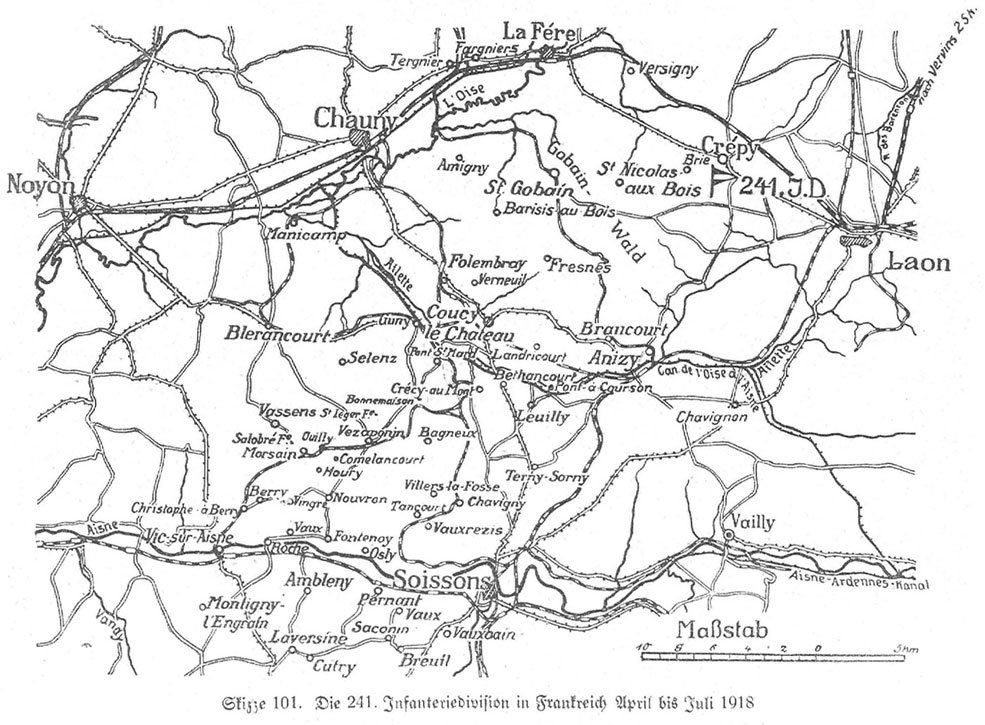
Above: overview map of the operational area of the 241.ID up to July 1918. Vendeuil lies a short distance beyond the upper edge of the map, north of La Fère.
The divisional composition was still largely as per the order of battle shown in Part 4, with the following additions (all exclusively Saxon):
- As was now the norm, during 1917 the division had formed a volunteer Sturmabteilung (assault detachment) with personnel seconded from its infantry regiments. This formation had likely received training from Sturmbataillon 8 while serving with the Südarmee, and had distinguished itself in the fighting in Galicia.
- The divisional signals element now had its own command staff (Nachrichten-Kommandeur 241, under Rittmeister von Kleist) and consisted of a telephone and a radio detachment.
- As a designated attack division the 241.ID was assigned its own organic heavy artillery battalion, Fußartillerie-Bataillon 102, soon after its arrival on the Western Front. This unit is described in a listing dated October 1918 as consisting of two 15cm howitzer batteries and one 10cm gun battery.
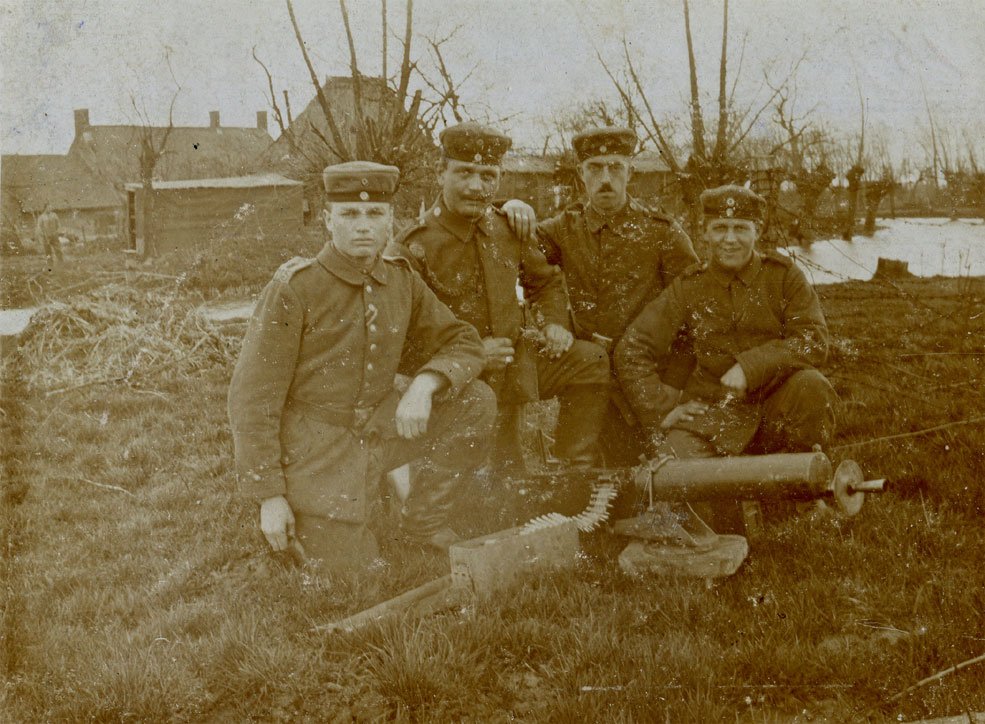
Above: the only photo I possess of a battery machine-gun team of the Saxon field artillery - in this case one of the two guns of 7. Batterie / FAR 115 (58. Infanterie-Division) on the Flanders front in May 1918. The weapon is a standard MG 08, mounted on a metal bracket which would be screwed into place on a tree trunk or sturdy pole for anti-aircraft defense. This bracket could also be attached to a wooden board (usually far sturdier than this one) as a crude form of 'light' machine-gun like those used on the Somme in 1916. It is unclear whether the artillery machine-gunners would have been issued with the four-legged sledge mount (Schlitten) and optical sight used by the infantry.
From the end of 1917 every battery (field or heavy) on the Western Front was allocated two machine-guns, for which it was expected to provide the crews. Another photo sent home by a gunner of 6. Batterie / Reserve-Fußartillerie-Regiment 12 indicates that artillerymen were already being sent on the necessary training courses as early as November 1917. As a result of this measure, each field artillery regiment would have eighteen MG 08 - three times as many as an 'active' infantry regiment in 1914!
It is unclear when FAR 48 received its machine-guns or the training to operate them, but they would see extensive use in July 1918. Personnel from the regiment had already received hand grenade training as early as 1916, which would also prove its worth.
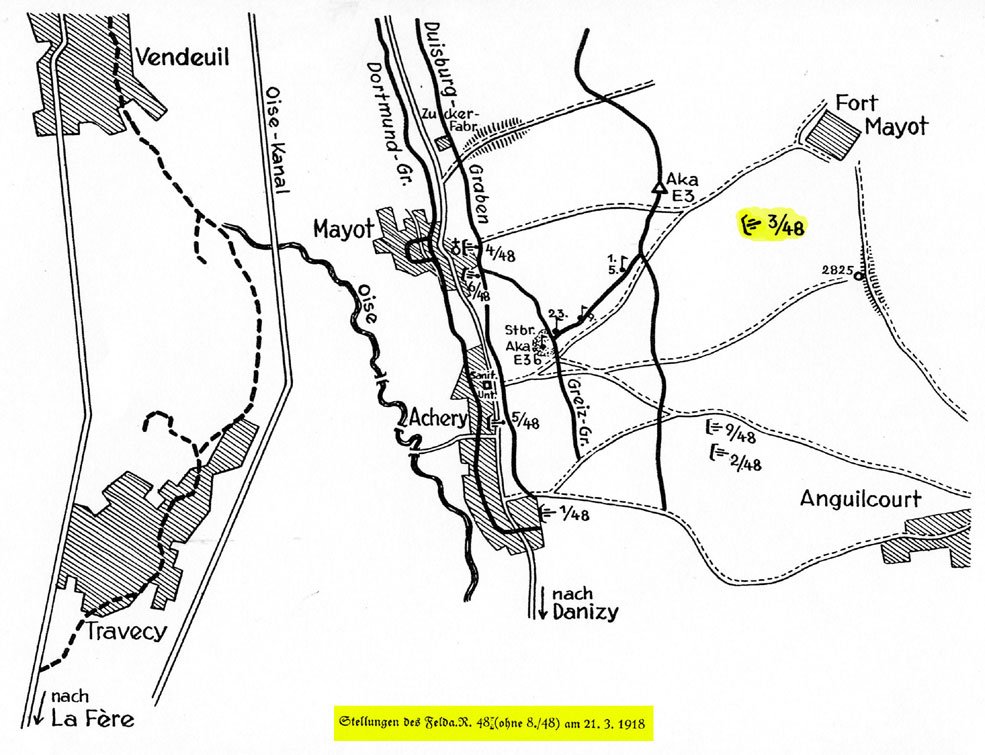
Above: FAR 48 in support of 13. Landwehr-Division on the Oise at the opening of 'Operation Michael'.
While most of the 241.ID would initially be held in reserve, its artillery was to participate directly in 'Operation Michael' - the first of Ludendorff’s great offensives of 1918 in the west. On 11th March FAR 48 was sent marching westward, now temporarily subordinated to 13. Landwehr-Division on the Oise north of La Fère. This placed it on the extreme left flank of 18. Armee (Gen. der Inf. von Hutier) and of the Michael offensive as a whole. For an overview of 18. Armee dispositions please refer to the excellent "Kaiser’s Cross" website.
The regiment had originally been earmarked to accompany the attacking infantry in the close support role, but despite the recent supply of fresh horses it was still believed to lack the necessary mobility. Instead it took its place in the medium-range gun line on the night of 20th-21st Match, designated as AKa E 3 - the third Artillerie-Kämpfungs-Artillerie (counter-battery) group of Generalkommando E (designation of Gruppe Freiherr von Gayl, an ad-hoc corps under the commander of 13. Landwehr-Division). Arno and his regiment were now cogs in the colossal destructive machine of the massed artillery of 18. Armee, expected to follow a precisely orchestrated fire plan to the letter and to the minute. Excerpts of this plan were supplied to individual gun crews, allowing them to play their designated role regardless of any breakdown of the chain of command.
By midnight all of the crews were 'stood to' in their fire positions. In the foggy pre-dawn of 21st March 1918 the gun commanders carefully checked their synchronised watches. At 04:40 they gave the signal and the entire regiment opened fire together with thousands of other guns, in the greatest bombardment yet seen. Initially fire was concentrated on the enemy artillery, until at 05:50 part of the regiment took part in the Sturmreifschießen (softening up for the assault) of the British front line. At 06:15 the creeping barrage made its first leap forward, coinciding with the German infantry assault.
Already at 06:00 the 4. Batterie had one of its four 10.5cm howitzers knocked out by British artillery. It suffered further severe shelling over the course of the morning, crippling a second gun and burying its telephone and first aid dugout. Casualties were severe by artillery standards, including nine from 4./48 and two from 8./48 killed or mortally wounded. Nevertheless the regiment continued firing well into the afternoon at various targets in support of the assault on Fort Vendeuil and other objectives in its sector. In total each battery consumed around 2500 rounds that day, a third of it consisting of gas shells.
At 01:00 on 22nd March the regiment opened fire again in support of the resumption of the infantry assault. Over the course of the morning its batteries gradually fell silent, as the enemy were pushed back and the range increased. By 11:00 the whole regiment had ceased fire, and its part in the offensive of 18. Armee was over. On the morning of 23rd March it was ordered south to join the rest of 241.ID in the Saint-Gobain sector, where it was in the process of relieving the Bavarians of 3. Bayerische Infanterie-Division.
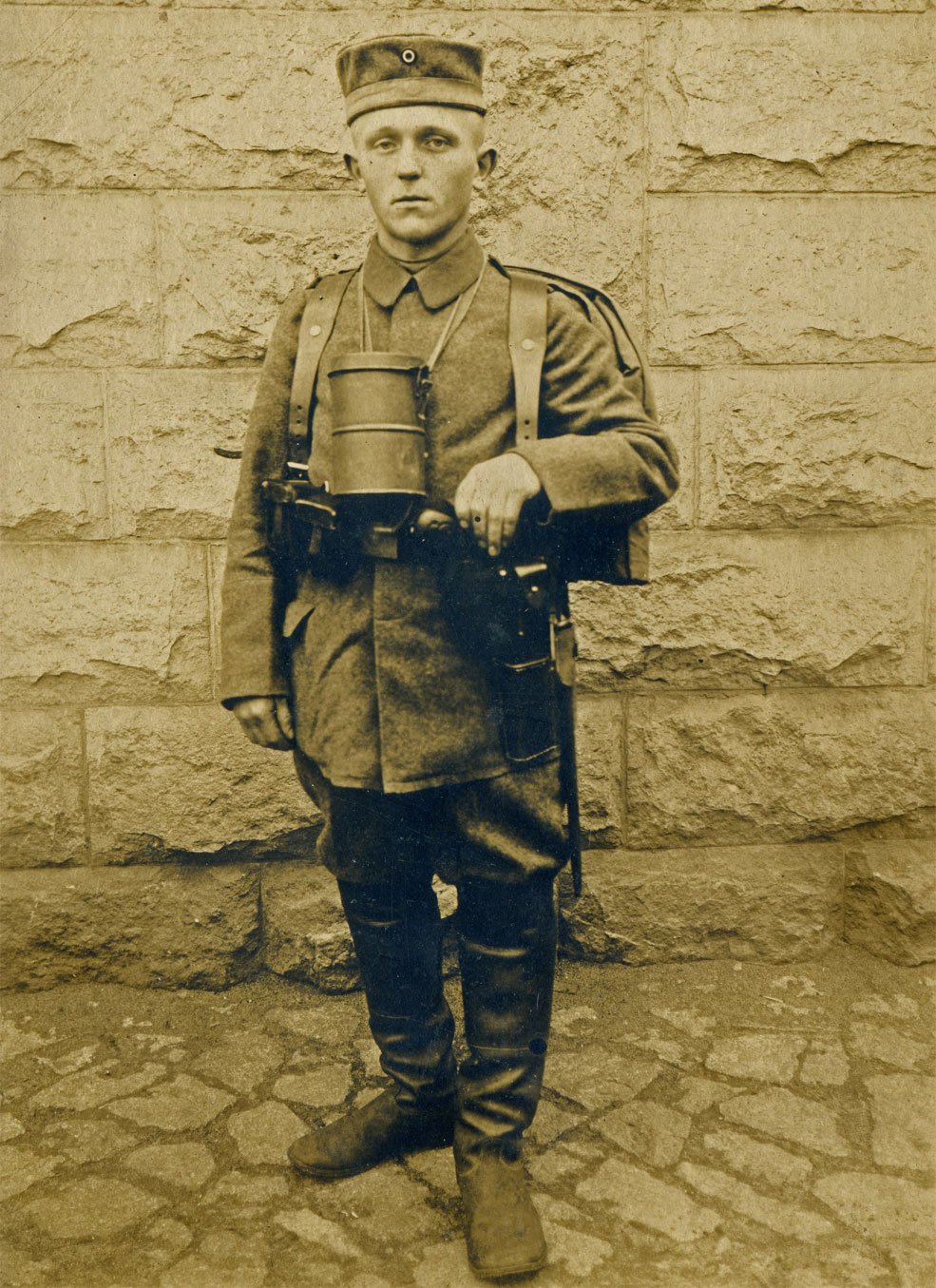
Above: a young recruit to FAR 48 identified only as 'Martin', photographed at the König-Georg-Kaserne in Dresden in early 1918 - probably shortly prior to his departure for the front. He wears the full marching order for this late stage of the war, save only for the absence of a steel helmet.
In wartime the Royal Saxon Field Artillery had gradually expanded from eight to twenty-two regiments, plus independent batteries and ammunition columns. Hence the II. Ersatz-Abteilung of FAR 48 in Dresden did not solely supply replacements to its parent regiment, and we have no way of knowing which unit 'Martin' may have served with in the field. His appearance and equipment is nevertheless representative of any of those units in the last year of the war.
His basic uniform consists of an M1915 Feldbluse (entirely devoid of any branch or state distinctions) and mounted troops' Reithose (riding breeches) tucked into high Reitstiefel (riding boots). By this time all personnel of the Feldartillerie except for regimental tradesmen had officially ceased to wear infantry trousers and marching boots. His Feldmütze has the by now universal grey camouflage band - this could (as seen here) be used to cover the lower cockade and remove another clue to the unit's identity, in conjunction with the commonplace masking of shoulder straps.
Armament consists of what looks like the old and impractical Artillerie-Seitengewehr 71 plus a Mauser C96 rechambered for 9mm Parabellum (note the large '9' engraved in the butt). Multiple earlier photos show this iconic pistol (possibly in its original 7.63mm chambering) issued to the regiment without any leatherwork, with the wooden stock/holster simply supported by what looks like a breadbag strap.
The rest of Martin’s equipment consists of an M1917 Lederschutzmaske in its metal canister, one set of rifle ammunition pouches (possibly adapted to carry ten-round clips for the pistol) and the very rarely seen artillery backpack (with rolled greatcoat and Zeltplane). These backpacks, which differed in detail from the familiar infantryman's Tornister, were usually left with the regimental baggage.
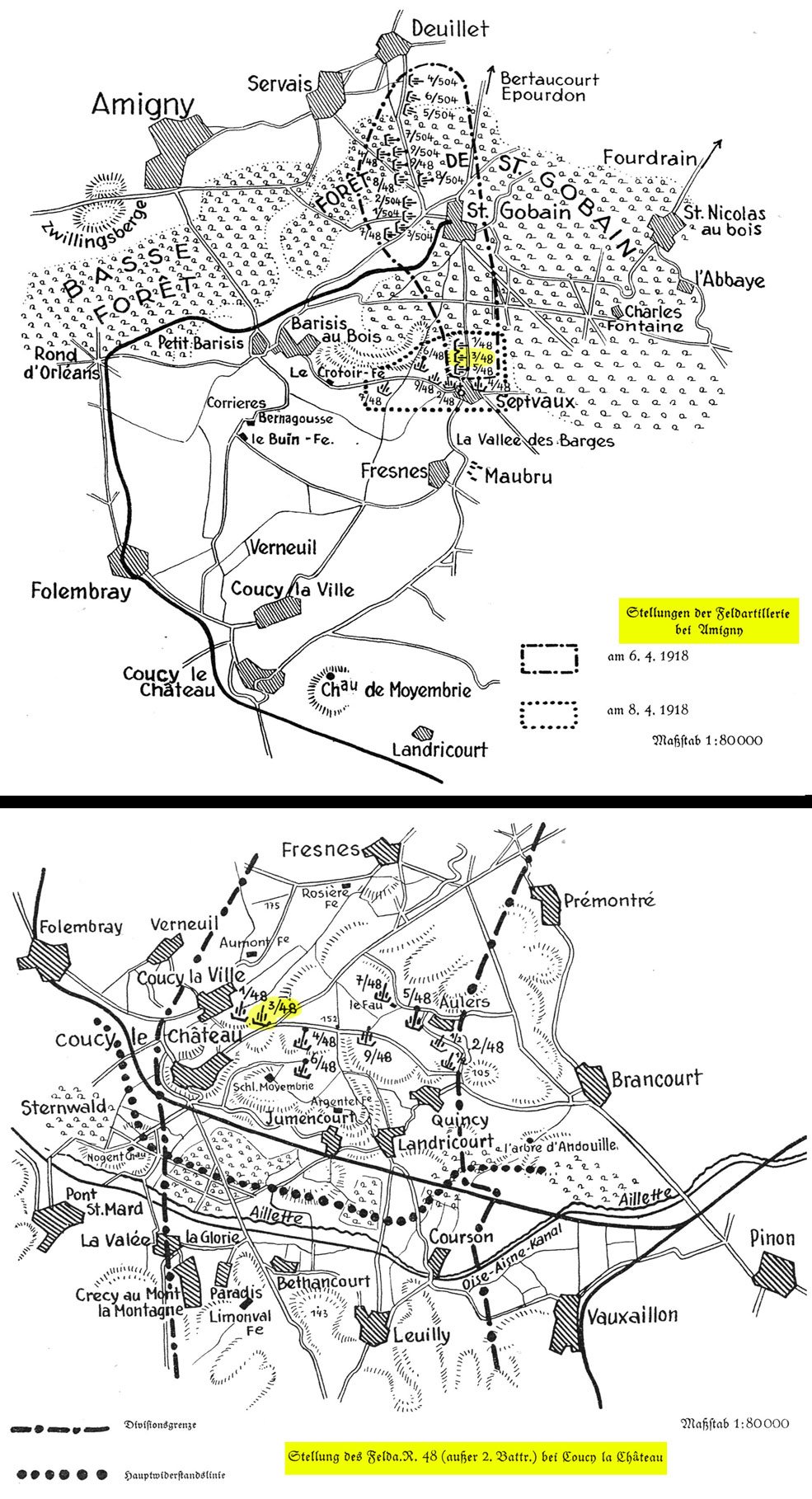
Above: FAR 48 at Amigny and Coucy, April 1918.
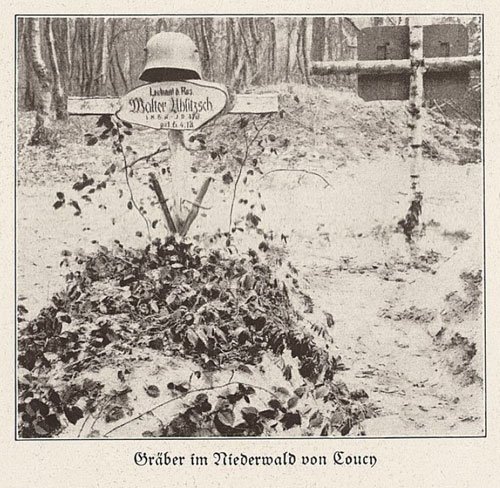
Above: the success of 'Archangel' was inevitably accompanied by a significant butcher's bill. The grave in the foreground is that of Leutnant der Reserve Walter Uhlitzsch of 1. MG-Kompagnie / IR 473, killed in action on 6th April. From FAR 48 a total of nine men were killed, mortally wounded or recorded missing and presumed dead during the four days of the operation.
The advance of 18. Armee north of the Oise created a salient in the French line southwest of La Fère, opposite the right flank of 7. Armee where the 241.ID now held the line. While 'Operation Michael' was still underway, much of the army's artillery strength was on loan to its neighbour and it was questionable whether it possessed the strength to launch its own local offensive against this pocket. 241.ID itself was temporarily without I. Abt. / FAR 48, which was deployed near Tergnier in support of 47. Landwehr-Division of 18. Armee. The proposed 'Operation Archangel' was initially scheduled for 1st April, then postponed until 6th April. By this time 'Michael' had ground to a halt, and not only had I./48 been returned to the division but it had also been reinforced by the addition of FAR 504 (from the army artillery reserve).
The attack front of 'Operation Archangel' on 6th April 1918 consisted from left to right of 241.ID, 14.RD, 5.RD and 75.RD. The latter two crossed the Oise from the 18. Armee front at Chauny and Condren to attack southwards, while 14.RD (spearheaded by Sturmbataillon 7) and 241.ID attacked westward. For an overview of this offensive please see Kaiser's Cross.
FAR 48 and 504 began their bombardment at 03:30 in concert with their neighbours and the long-range artillery to their rear, which had already been engaging their French counterparts with Gelbkreuz (mustard gas) for some time. The French artillery and communication routes were attacked with gas and shrapnel, and smoke laid down to disrupt enemy observation. From 04:45 the French trench system was subjected to intense destructive fire in conjunction with Minenwerfers, with a quarter of the munitions used being Blaukreuz chemical shells (filled with arsenic irritant compounds intended to breach gasmasks). The infantry attack began at 06:00, with the barrage creeping ahead of it in programmed bounds.
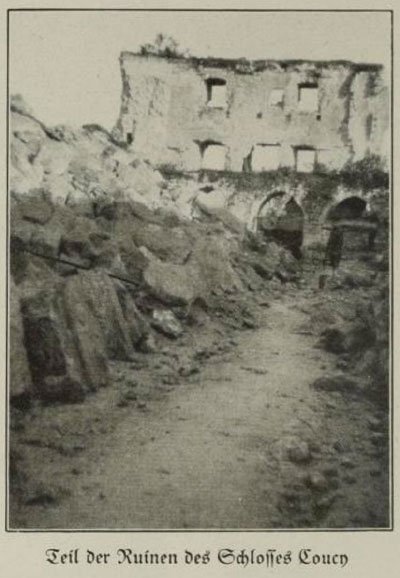
Above: sadly, the 13th century Château de Coucy already lay in ruins when it fell to IR 474 on the evening of 8th April 1918. During 'Operation Alberich' (the planned German withdrawal of March 1917) the keep and towers had been demolished by Pioniere in order to deny an observation platform to the enemy artillery.
In the 241.ID sector, the assault was spearheaded by IR 473, accompanied by 2./48 as designated Infanterie-Begleitbatterie (infantry escort battery) or Nahkampfbatterie (close combat battery). Significant resistance was encountered only at Amigny (Amigny-Rouy). The first day's objectives were taken by early afternoon, including the Zwillingsberge, Amigny and the woods north of Barisis. An attempt to resume the offensive in the evening had to be called off, as fresh stocks of shells first needed to be brought forward. The artillery of 241.ID also needed to change position, with many batteries relocating southward as shown on the map and others turning in place.
The attack on the morning of the 7th was preceded by a four and a half hour bombardment. This time IR 474 bore the brunt of the assault, with 8./48 and the divisional Sturmabteilung attached. By evening the Saxon infantry were dug in 500 metres from Verneuil, and the French had been driven back to Coucy-La-Ville and Coucy-Le-Château. The resumption of the attack on the 8th was hindered by the artillery's difficulty in bringing its batteries far enough forward, due to poor going on the rain-sodden ground and the usual problems with insufficient horses. The infantry inevitably faced far stiffer resistance, but IR 474 nevertheless reached Coucy-Le-Château by evening. During the night of 8th-9th April the French withdrew their main force behind the Oise-Aisne Canal, leaving outposts on the north bank which were easily overwhelmed by the 241.ID on the following day.
The 'Archangel' operation had now achieved its aims, and 241.ID settled down to hold the line which it had reached on the northern bank of the canal. Besides the ground gained, the Saxons had taken a total of twelve French officers, 700 men, 43 machine-guns and two trench mortars.
241.ID held the Coucy sector until the last days of May 1918, under the codename Frontdivision Oberwald. On 11th May it received its first visit by King Friedrich August III of Saxony since 1917, and decorations were awarded for the heroes of 'Michael' and 'Archangel'. After a protracted period of incessant heavy shelling the sector eventually became relatively quiet, apart from clashes between forward patrols and incessant small-scale raids across the canal. One such operation near Pont-Saint-Mard on 19th May (directly supported by a single forward-deployed gun of 1./48) would cost the life of Leutnant der Reserve Kurt Schmidt, the decorated and irreplaceable commander of the divisional Sturmabteilung.
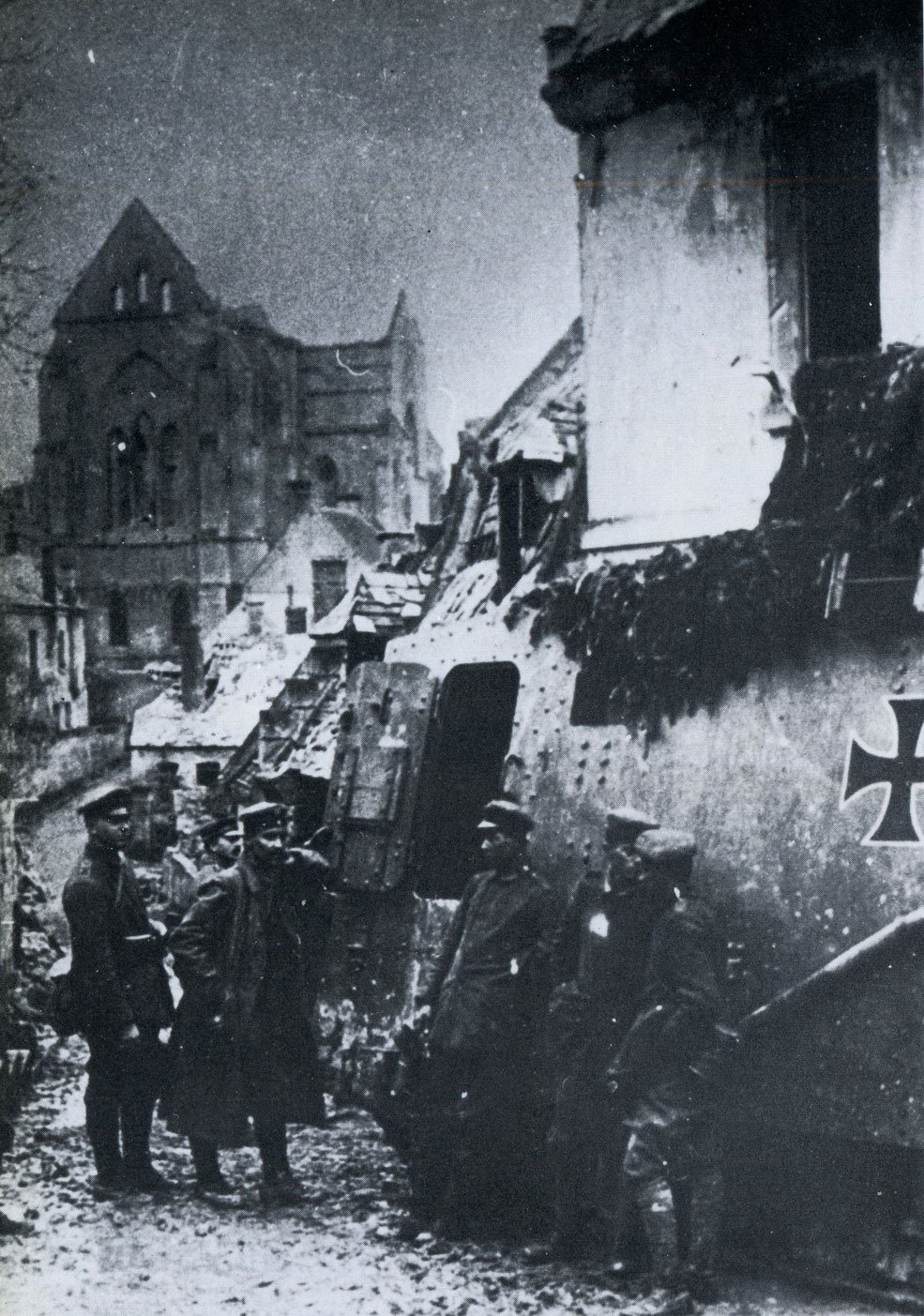
Above: for the 'Archangel' offensive a total of ten A7V tanks of Sturmpanzerkampfwagen-Abteilungen 1 and 2 were transported to Saint-Gobain, where they were held in readiness in the rear of 241.ID. In the event, the advance progressed so quickly that the tanks were never needed. Once the French had retired behind the Oise-Aisne Canal, a tank attack became entirely impossible and both units were withdrawn without seeing combat.
It is tempting to imagine that my great-grandfather may have seen one of these rare and fearsome beasts in those few days when FAR 48 was deployed around the outskirts of the town...
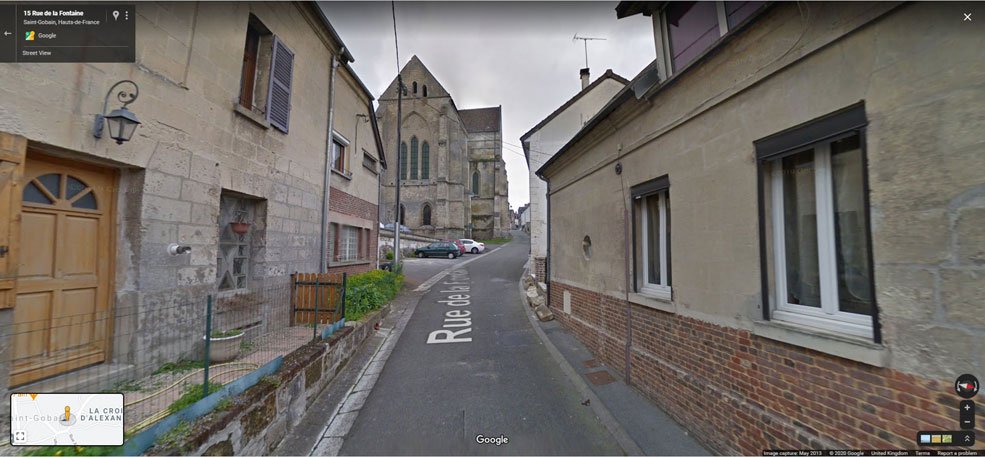
Above: Google Streetview image of approximately the same location. Saint-Gobain church lost its roof but survived the war, and is clearly recognisable today.
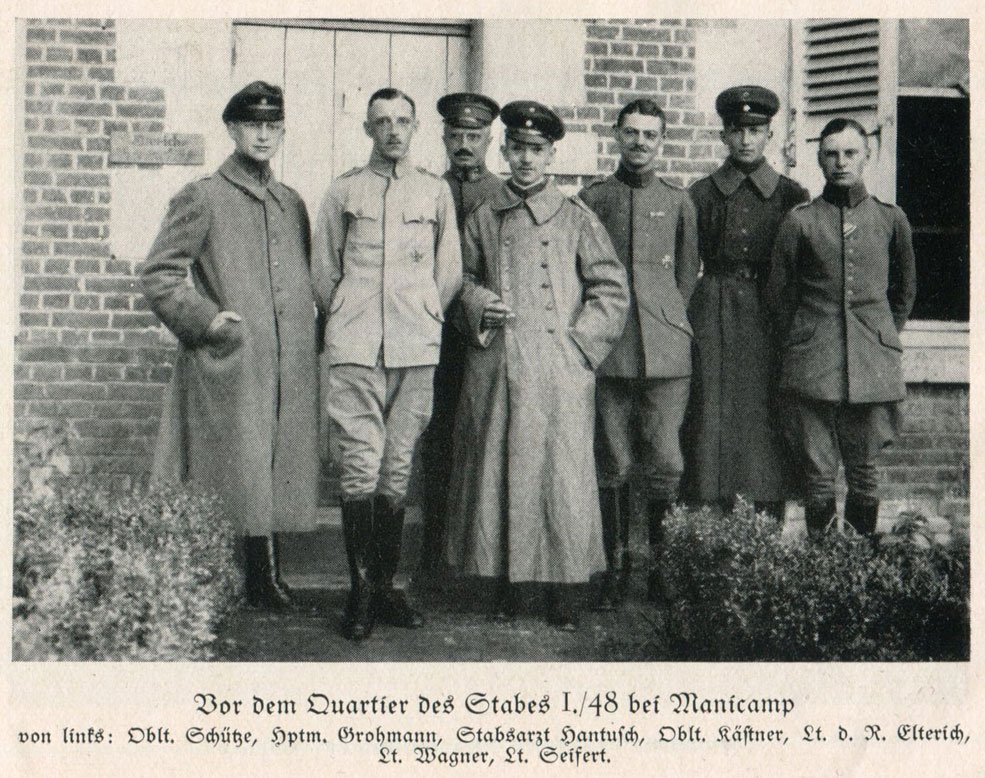
Above: officers of I. Abteilung / FAR 48 in front of their HQ at Manicamp northwest of Folembray. Their then-commander Hauptmann Walter Grohmann (who had served with the regiment since peacetime) was awarded the Ritterkreuz des Militär-St.Heinrichs-Ordens on 16th April 1918 for his role as an artillery group commander in 'Operation Michael'.
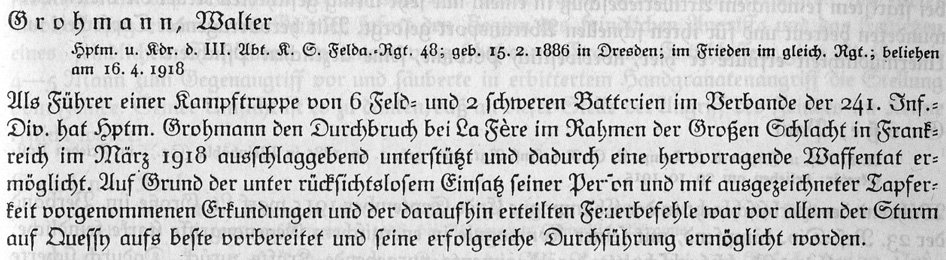
Above: Hauptmann Grohmann's citation praises his boldness in forward reconnaissance and the resulting effectiveness of his fire missions, particularly against Quessy (north of Tergnier and west of La Fère). Grohmann had been adjutant of II./48 in peacetime, and commander of 4./48 in 1915. Despite his appearance in the preceding photo as commander of I./48, by 1918 he was more usually in command of III./48 as per his citation.
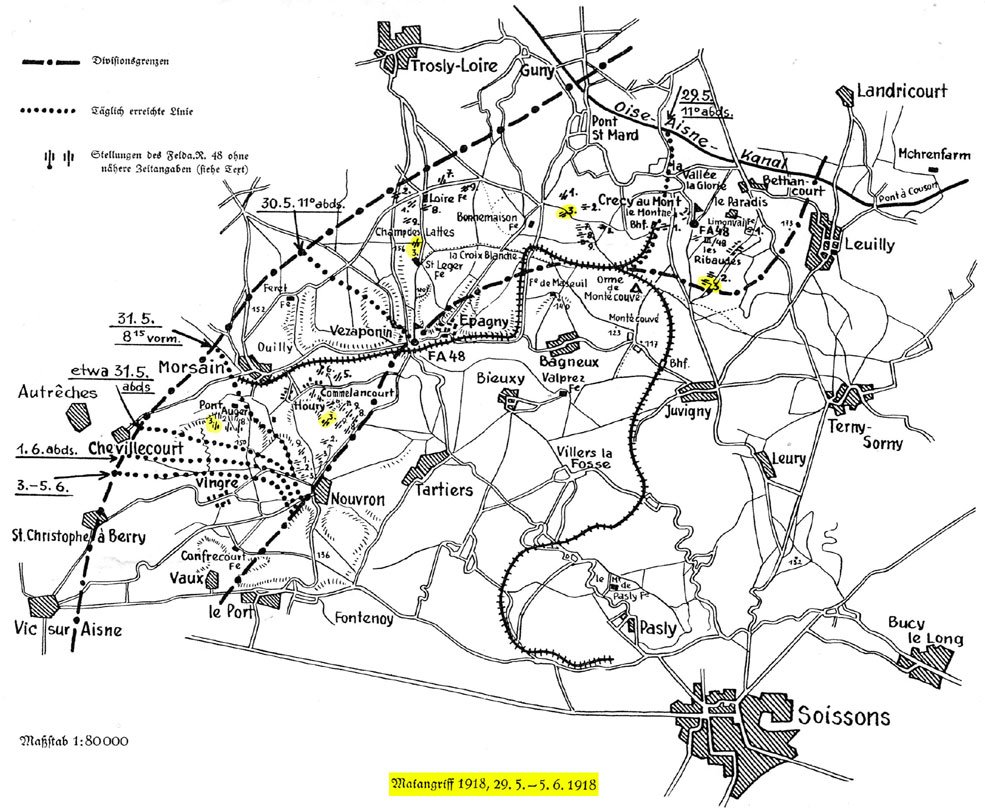
Above: FAR 48 in the May 1918 (Blücher) offensive.
On 27th May, 7. Armee launched a major offensive against the French on the Chemin des Dames, designated 'Operation Blücher'. Again, please refer to Kaiser's Cross for a useful summary and overview map of this battle.
Due to its position behind the Oise-Aisne Canal, the role of 241.ID on the first day was limited. FAR 48 had moved to new positions where it could support the main effort by 6. Bayerische Reserve-Division on their left. The bombardment began at 02:00 and began to creep forward after two hours as the Bavarians attacked. On their flank II./472 forced a crossing at Pont-à-Couson and established a bridgehead; this was fiercely defended throughout the day, and eventually reinforced by III./472.
On 28th May IR 472 enlarged its tenuous foothold on the south bank, clearing the Kanonenberg two kilometres south of Pont-à-Couson (which dominated the crossing) in the teeth of fierce resistance. This allowed IR 473 to be brought across the canal under cover of darkness and deployed behind the Kanonenberg to drive westward the following morning. In addition I. and III. Abt. / FAR 48 were brought over to the south bank and directly attached to IR 473 and 472 respectively as close support, each battery bringing only two of its guns but four ammunition wagons plus the battery field kitchen. The bombardment from the massed artillery north of the canal was supposed to begin at 04:00 and last for two hours, but according to IR 473 not a single shell had been fired by the time they began their advance; fortunately the expected French small-arms fire was likewise absent. As the attackers approached Leuilly-sous-Coucy the artillery finally began to shell the ruined village. After they had finally been induced to shift their points of aim westward, IR 473 entered Leuilly and arrested its sole inhabitant - a drunken French cook, who readily revealed his hidden stash of red wine, fresh bread and butter to his captors. Beyond the village the attackers came under fire from the main French position, and became increasingly disorganised in the wooded and hilly terrain. Nevertheless by evening the area shown on the map had been secured, partly in the course of ferocious close-quarters fighting. Meanwhile the supporting batteries had relocated forward several times to stay close behind their assigned regiments. The day's fighting had cost IR 473 alone 43 dead and 122 wounded. Their loss of fourteen officers was particularly serious, including six company commanders and one battalion commander (Major Lengnick of III./473, killed in action). For its part FAR 48 had five dead and an unknown number of wounded to mourn.
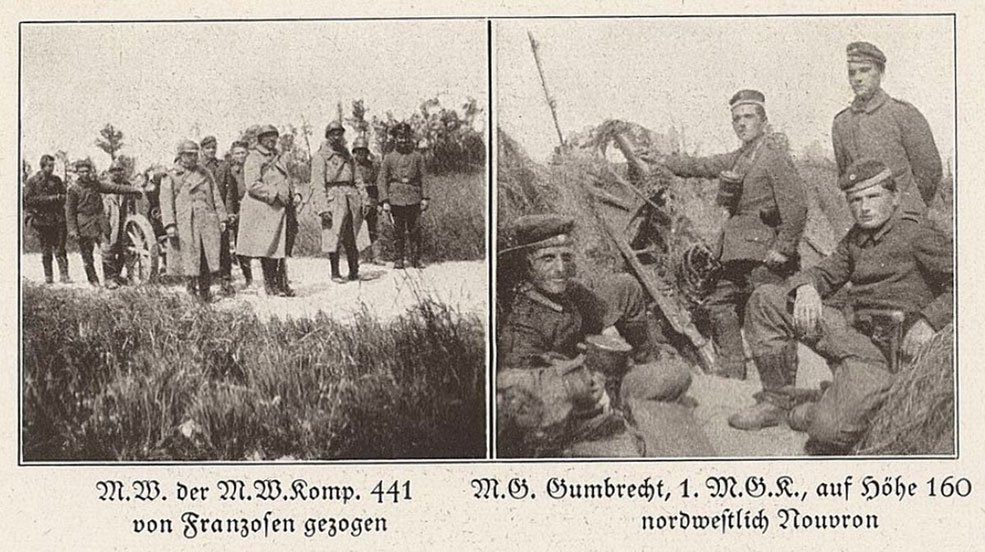
Left: French prisoners being put to work moving a medium or heavy Minenwerfer of Minenwerfer-Kompagnie 441 (the divisional trench mortar company) behind the lines.
Right: Machine-gun team under Unteroffizier(?) Gumbrecht of 1. MG Kompagnie. / IR 473, deployed for high-angle fire against long-range targets at Hill 160 northwest of Nouvron.
Under the pressure of the offensive the French were now falling back. On 30th May IR 472 and 473 were able to make substantial progress, facing only localised fighting against French rearguards. In the afternoon IR 474 also crossed the canal and followed its sister regiments, as their attack became a general divisional advance. By evening the left flank was at Vezaponin. The division's objective for 31st May was the Aisne, but near Morsain IR 473 suddenly ran into intense machine-gun and artillery fire and made only slow progress thereafter; IR 472 was unable to get far beyond the edge of Nouvron, and even the piecemeal commitment of elements of IR 474 (partly to fill gaps on the flanks) failed to rectify the situation. The divisional advance had now well and truly bogged down in a devastated tangle of old French trenches against a well dug in enemy. Further attacks on 1st and 2nd June achieved little, and for subsequent days only localised stormtroop assaults were ordered; it was hoped that progress by neighbouring divisions would now force a further French withdrawal.
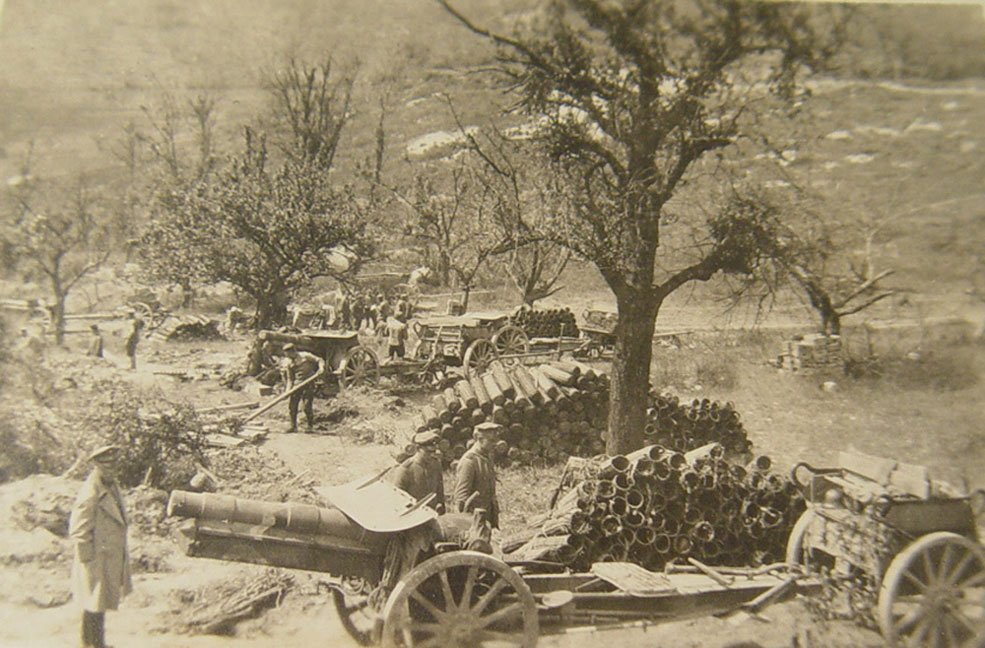
Above: 15cm lg. sFH 13 (long-barreled 15cm heavy howitzers) of 2. Batterie / Fußartillerie-Bataillon 102 (the division's organic heavy artillery battalion) in their fire position on 31st May 1918.
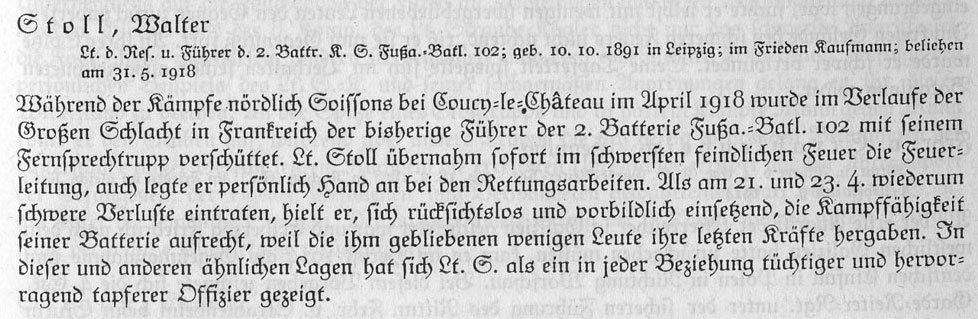
Above: coincidentally on this same day the battery commander Leutnant der Reserve Walter Stoll was awarded the Ritterkreuz des Militär-St.Heinrichs-Ordens - though obviously the award ceremony must have taken place later! Around 20th April 1918 his unidentified predecessor and the battery telephonists had been buried (presumably in their dugout by shelling). Stoll immediately assumed command, personally aiding in the attempt to rescue the trapped men and subsequently keeping the battery firing irrespective of heavy losses on the 21st and 23rd April.
A further divisional attack was launched on 5th June, spearheaded by 'official' stormtroops from Sturmbataillon 7. On the left IR 473 (still directly supported by I. Abt. / FAR 48) managed to get as far as the heights of Saint-Christophe-à-Berry, but was forced to fall back again due to lack of progress by 14. Infanterie-Division on its right. Elsewhere the massive weight of defensive machine-gun, rifle grenade and artillery fire soon stalled the advance. A further effort in the afternoon was equally fruitless, as was a localised attack by stormtroops of IR 473 on 12th June with the limited aim of improving their positions.
Finally on 14th June the exhausted 241.ID received orders for its relief by the (likewise Saxon) 53. Reserve-Division. This began two days later, with FAR 48 finally relieved on the night of 18th-19th June. According to Sachsen in Grosser Zeit, the fighting since 1st June had cost 241.ID a total of 169 dead (including five officers), 788 wounded (including thirty officers) and 178 missing (including one officer). According to its published roll of honour, FAR 48 had lost twenty dead, mortally wounded or missing plus an unknown number wounded.
The following period out of the line was put to good use with intensive training in the latest techniques of combined-arms warfare. In the expectation of a French attack south of the Aisne, the 241.ID was then assigned as Eingriefdivision (intervention / counterattack division) to 53.RD on 29th June. It was soon reassigned to take over the sector immediately to the left of 53.RD on the south bank of the Aisne, a process which was completed on 5th July. While the new sector seemed quiet, ominous signs were soon apparent. On the night of 10th-11th July two French deserters reported that an offensive was in preparation. As a result, a massive bombardment of likely approach routes and troop concentration areas was ordered. However on 17th July the corps staff lifted the previously ordered state of heightened readiness, despite the misgivings of Major Wagner of FAR 48. His regiment had reported sightings of enemy troops in 'flat helmets' (Americans) and believed that fresh enemy batteries were registering on targets in the German lines.
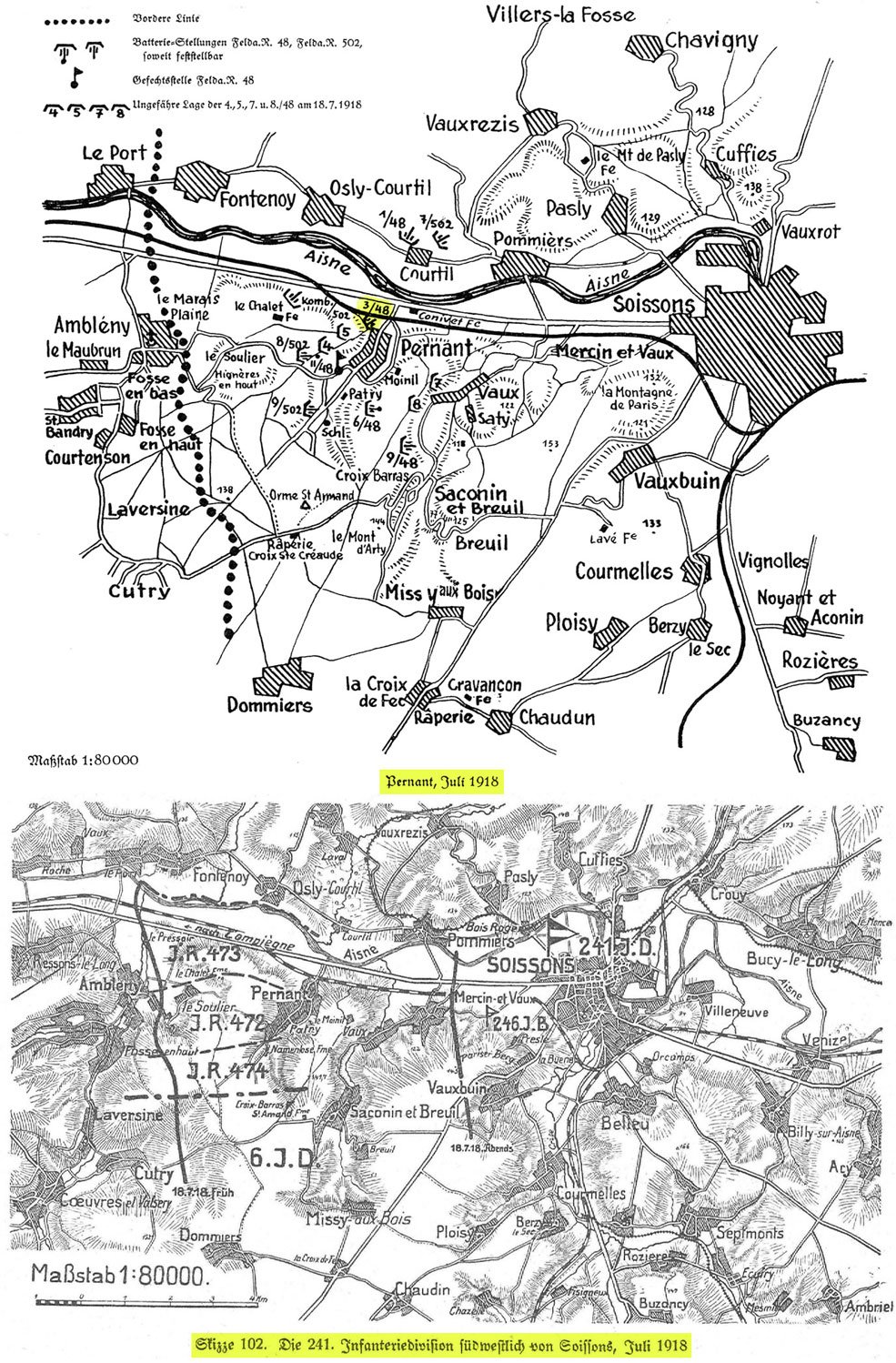
Above: FAR 48 and 241.ID in July 1918. The upper map (from the regimental history) shows the approximate battery positions of FAR 48 and attached elements of FAR 502 on the morning of 18th July 1918, with one notable exception; as designated Tankabwehrbatterie, 2./48 was distributed along the Hauptwiderstandslinie (the main infantry defensive line) to provide direct fire support to the trench garrison. The remaining batteries were grouped into three Untergruppen headed by Abteilung staffs: Untergruppe Links (6., 8. and 9./48 plus 9./502, under Hauptmann Zumpe of III./48), Mitte (4. and 7./48 plus composite 8./502, under Hauptmann der Reserve Arndt of II./48) and Rechts (1., 3. and 5./48 plus 7./502, under Hauptmann Wirth of I./48). These groups were in direct telephone contact with their commanding Gruppe, which was Major Wagner's regimental staff.
According to the published history of IR 474, at about 05:00 a massive French bombardment was opened on 11. Bayerische Infanterie-Division (immediately to the left of 241.ID) and further south. The 241.ID was initially untouched, but according to the published history of FAR 48 (which does not mention the earlier bombardment on their southern neighbours) and Sachsen in Grosser Zeit, its infantry positions were suddenly subjected to relentless annihilation fire from 05:30. Initially unmolested, the artillery of 241.ID immediately retaliated against the predicted assembly areas for enemy assault troops. The right-hand section of 2./48 directly observed and engaged French infantry advancing en masse under cover of the woods west of Le Soulier. Within ten minutes around twenty aircraft were seen circling over the massed Saxon batteries around Pernant, and were believed to be directing the counter-battery fire which now began to fall on them. 9./48 lost a gun to a direct hit, but claimed an aircraft shot down by its machine-guns.
Meanwhile it could be seen and heard that the bombardment on the hapless Bavarians was massively increasing in intensity. Dense clouds of smoke and dust were blowing northward into the Pernantschlucht (the narrow valley between Pernant and Vaux) and across the neighbouring hills, disrupting any attempt to use Morse signal lamps as a substitute for the disintegrating telephone network. Around 06:00 the French barrage advanced beyond the Hauptwiderstandslinie, and the left-hand section of 2./48 on the Saxon flank observed Bavarian infantry falling back past them and being blown to pieces by the creeping barrage as they ran. The gunners soon found themselves encircled by French infantry and defended themselves with their machine-guns until these were knocked out; only a gun commander and two men managed to break out to the rear.
The chaotic situation that developed is difficult to reconstruct, in particular due to the collapse of communications. The area south of Pernant was saturated with smoke and gas, and by 06:05 Major Wagner had lost telephone contact with Untergruppe Mitte and Rechts. Partly via runners, he ordered all three Untergruppen to prepare to fire in direct support of the Bavarian division.
It would later be established that the unfortunate Bavarians had been overrun by the 1st U.S. Division, supported by massed French tanks. At the southern end of the Pernantschlucht I./474, that regiment's Bereitschaftsbataillon (immediate reserve battalion), was firing blindly to the west when American and French infantry appeared on their flank only 30-40 metres away. The battalion was quickly overwhelmed, the BTK (Bereitschaftsbataillon HQ) taken and the two battalions of IR 474 which had occupied their outpost line and Hauptwiderstandslinie overwhelmed from three sides. As the enemy rampaged northward, the regimental staffs of IR 472 and 474 under Majors Oppermann and Krantz were cut off at Schloss Pernant ('Schl.' on the map) where they fought a desperate last stand. 8. and 9./502 both fell silent before retreating infantrymen could warn the batteries and command staffs of FAR 48 that the enemy was approaching. Only 150 metres from the battery position of 8./502, the headquarters of Untergruppe Mitte was hastily evacuated. While trying to reach the nearby Regimentsgefechtsstand (regimental battle HQ), the Untergruppe commander Hptm. d. R. Arndt and his signals officer were cut off and captured.
Each surviving battery quickly took its machine-guns from their anti-aircraft mountings to defend themselves from infantry attack; where possible, stray infantrymen were pressed into service as crews so that the artillerymen could concentrate on feeding their field guns or howitzers as rapidly as possible. The enemy descended on 4./48 before they could bring their 10.5cm main armament to bear. Using their one surviving machine-gun and hand grenades they were able to hold out just long enough to render three howitzers unserviceable and break out toward the Aisne taking the optical sights with them. Having been apprised of the disastrous situation by Ltn. Fischer (Hptm. d. R. Arndt's adjutant), 5./48 managed to bring two howitzers and a machine-gun into action at near point-blank range. However they too were forced to retreat when the machine-gun suffered a stoppage and the battery came under intense small-arms fire.
By 07:45, 6./48 (Ltn. Ziegenspeck) had also been overrun from the left and front after holding up the attackers for some time with its machine-guns and 10.5cm howitzers fired over open sights. Once the machine-guns had been knocked out and the Americans closed in with fixed bayonets, the survivors disabled the howitzers and fought their way out with carbines, pistols and hand grenades. At about the same time 3./48 spotted the enemy at the edge of a wood 800 metres away and halted their advance with direct fire. Meanwhile at the Regimentsgefechtsstand near Pernant, Major Wagner did his best to rally and reorganise the infantrymen who were flooding back through the artillery lines. Officers of his staff found and deployed a machine-gun in direct defence of their headquarters. The only organised body of infantry defending the village at this point was the brigade reserve, comprising the staff of I./473 with 1. and 3./473 plus half of 1MGK/473 under its command. To the major's undoubted relief, an Unteroffizier from II./472 (in divisional reserve southwest of Vaux) reached his HQ shortly after this, having lost contact with the brigade and division. Major Wagner immediately ordered this battalion to counterattack.
Further east, 7., 8. and 9./48 were all still operational and brought their guns into open positions to fire on the enemy in the Pernantschlucht and approaching from the south. To their horror, 8./48 (Oberleutnant der Reserve zu Jührden) spotted four French tanks (of unspecified type) around 1500-1600 metres away leading the American advance near St. Amand Ferme. Lacking purpose-designed ammunition, the battery used shrapnel impact fuzes and seemingly scored some hits. The tanks retired and were not seen again (one of them apparently breaking down for about half an hour), while the accompanying infantry scattered.
Having observed the loss of 6./48, Major Wagner and his staff abandoned their HQ around 08:00 and relocated to the fire position of 7./48 (Leutnant der Reserve Seyffert). Here they observed II. / IR 472 and II. / IR 24 (lent to 241.ID for use as part of its divisional reserve) beginning their advance, only to fall back rapidly upon realising that the Americans were now advancing northward from Saconin et Breuil, thus threatening to cut them off from the rear. 9./48 (Oberleutnant Palitzsch) now also came under direct attack. The left-hand gun was moved forward to engage the advancing Americans, but its entire crew soon became casualties under heavy machine-gun fire. With a second gun knocked out and a third in the repair shop, the battery defended itself as long as it could with one field gun and a machine-gun crewed by Bavarian stragglers. Under attack from three sides, at 08:30 Palitzsch ordered a retreat to the position of 8./48. The breech block was buried, hand grenades distributed and the survivors fought their way out. Including Palitzsch there were only ten of them, carrying another two who had been severely wounded.
By 08:50, 3./48 (Oberleutnant Fischer) was threatened by infantry approaching at 100 metres from their left flank, where the field guns could not immediately be brought to bear. Thankfully for Arno's battery, this threat was quickly repelled under the fire of both machine-guns. Meanwhile Hauptmann Wirth of Untergruppe Rechts was organising stragglers from 5./48 and 7. / RFAR 32 (the latter belonging to 53.RD on the north bank) to bring up ammunition to feed the guns of his surviving batteries.
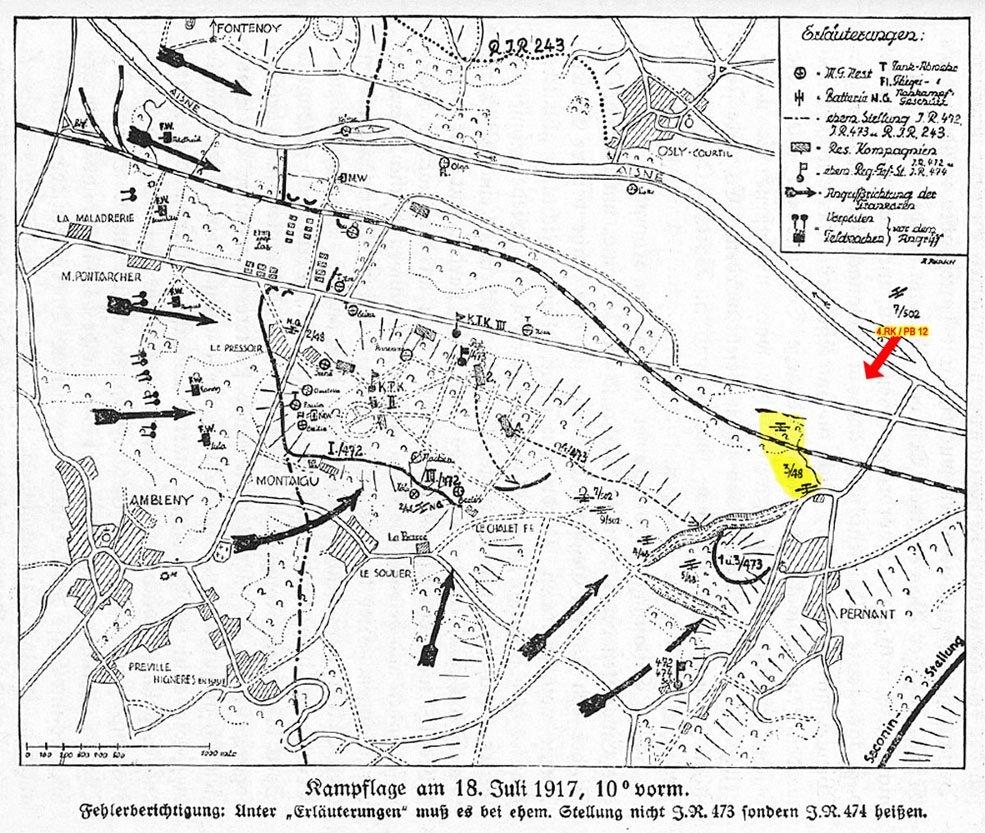
Above: map from the regimental history of IR 473 showing the approximate situation at 09:00. Of the batteries on the south bank which are marked on the map, only 3./48 and the two Nahkampfgeschütze (close-support guns) of 2./48 in the lines of IR 472 and 473 were still firing. On the north bank, 7./502 and the nearby 1./48 (not shown here) were also still in action.
The first IR 473 had heard of the unfolding disaster came via runners from FAR 48 in Pernant. For their part, the right-hand section of 2./48 had been warned by Leutnant Tridon, who had been captured by the enemy but subsequently escaped. As can be seen on the map, IR 473 had managed to withstand the frontal assault on its Hauptwiderstandslinie, while I./472 and the remains of III./472 had formed a defensive flank on its left. This flank was nevertheless dangerously exposed to the French and American infantry rampaging through the artillery lines from the south, who were held at bay only by the elements of IR 473 at Pernant and the direct fire of 3./48.
At 09:30 Major Wagner was forced to fall back again, establishing a new HQ on the ridge south of Mercin-et-Vaux. Despite its position in the so-called Saconinstellung where elements of the divisional reserve were still fighting, 8./48 (now under the acting command of Leutnant Bracht) was under threat and taking losses to small-arms fire. Reduced to two guns (both with red-hot barrels from constant firing), the battery held out until the infantrymen of 5. / IR 24, only 50 metres away, were overrun and forced to surrender. At 09:45 the Untergruppe commander Hauptmann Zumpe ordered Bracht and his men to retreat, after removing the breech blocks and sights and doing what they could to disable the guns. In the course of a fighting retreat pursued by hand grenades, Zumpe and his force fell back to the position of 7./48, gathering up a stray Pionier-Kompagnie on the way. 7./48 was engaged in firing frantically at the enemy advancing from Saconin-et-Breuil, while heavy machine-gun fire raked across their position. Already wounded in the face, the battery commander Leutnant der Reserve Seyffert was now shot through the belly. Hptm. Zumpe and Ltn. Ziegenspeck of 6./48 assumed command of the surviving gunners and directed their fire. By 10:00 the ammunition was exhausted, the enemy within 100 metres and no friendly infantry in sight. Once again the guns were disabled and the now grievously wounded Zumpe's mixed force of stragglers hurriedly retired, possibly in the direction of Mercin-et-Vaux.
Attempts by Major Wagner to persuade what remained of the divisional reserves (now holding the Vauxbuinstellung) to launch a counterattack were prudently rejected, though it is unclear whether they had yet received divisional orders to that effect. According to Sachsen in Grosser Zeit, around midday Generalmajor Fortmüller of 241.ID decided that only the Vauxbuinstellung was realistically defensible. III. / IR 396 (like IR 24, seconded from Prussian 6. Infanterie-Division) was committed to defend this position, together with three scratch companies formed from the baggage personnel of the three infantry regiments of 241.ID. Similarly when the commanders of 1./48 and 7./502 (currently in action on the north bank) reached Major Wagner at 11:30 in response to his orders to redeploy on the 'Montagne de Paris' north of Vauxbuin, they were intercepted by a contradictory order from the divisional artillery commander Oberstleutnant von Wolf. These batteries were instead to deploy northwest of Cuffies (north of Soissons) alongside Fußartillerie-Bataillon 135, with orders to defend Soissons at any cost.
Around 14:00 the staff of IR 473 received orders by radio to break out to the rear, together with all attached units. Their response was incredulous, emphasising the extreme danger of making such an attempt by daylight. However it was soon quite clear that no counterattack could be expected, hence the only alternatives were surrender or death. From about 15:00 the surviving units began to fall back one after another, starting with the battalions of IR 472 on the left. Having disabled their guns, the survivors of 2./48 accompanied the retirement of IR 473, covered by fire from 3./48 and by infantry rearguards.
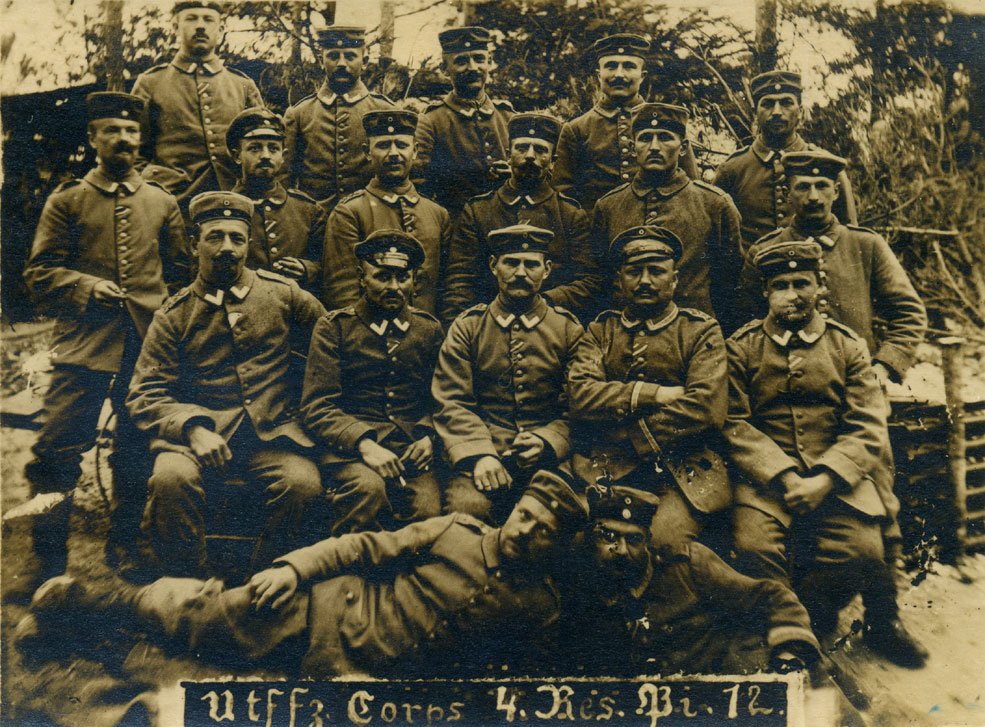
Above: undated group photo of the Unteroffiziere of 4. Reserve-Kompagnie / Pionier-Bataillon 12.
Remarkably the great majority of the retreating troops were able to disengage successfully and retreat across the Aisne, including 3./48 complete with all of its guns. This was in part due to the actions of 4. Reserve-Kompagnie / Pionier-Bataillon 12 (53. Reserve-Division) under Leutnant der Reserve Hellmuth Lenke.
The 53. Reserve-Division had itself been hard-pressed to hold its own positions, and its southernmost regiment RIR 243 had been forced to yield some ground. Seeing the plight of their fellow Saxons on the south bank, Lenke organised his company to construct an improvised bridge somewhere in the vicinity of Osly-Courtil, despite the proximity of the enemy and incoming fire. He was subsequently awarded the Ritterkreuz des Militär-St.Heinrichs-Ordens and credited with rescuing "more than 600 men" of IR 472 and 473. The survivors of 2./48 were surely also among them. It is unclear how 3./48 escaped, but considering that they took their guns it is likely that they crossed further downriver; the regimental history of FAR 48 states that they got away "via Pommiers", taking the reserve companies of IR 473 from Pernant with them.
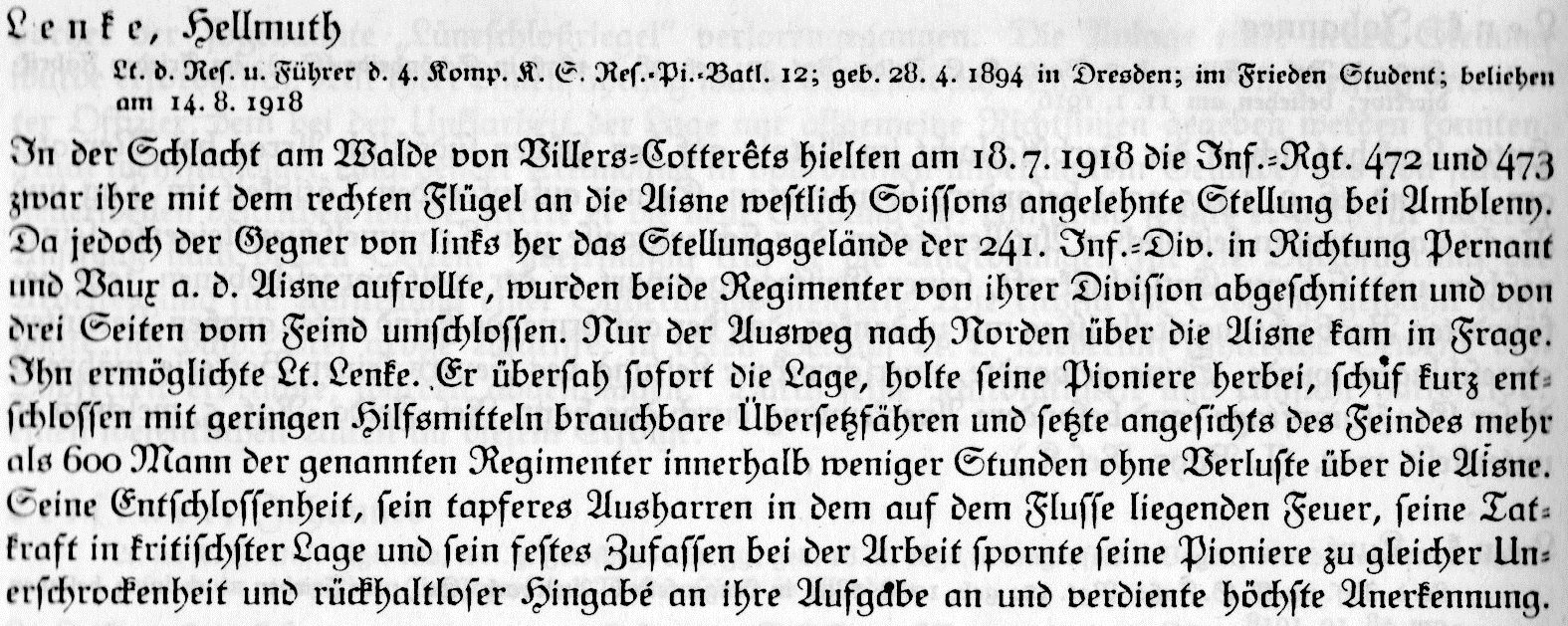
Above: MStHO citation for Leutnant der Reserve Hellmuth Lenke. Lenke had volunteered as a student in August 1914, and was wounded in action with Reserve-Pionier-Kompagnie 53 (53. Reserve-Division) during the First Battle of Ypres on 12th November 1914. Upon recovering, he was sent to XII. Reservekorps in the Champagne and assigned to 4. Reserve-Kompagnie / Pionier-Bataillon 12 as a newly promoted Vizefeldwebel on 7th October 1915. A month later he received his reserve officer's commission. Having fought with 24. Reserve-Division / XII. Reservekorps on the Somme, his company was transferred to 53. Reserve-Division in May 1917 while both divisions were with the Südarmee in Galicia. Now serving alongside his original company as part of Pionier-Bataillon 353 of 53.RD, Lenke fought in the Kaiserschlacht with 17. Armee near Cambrai in March 1918. It is unclear when he became company commander. He was severely wounded on 6th August, while 53.RD was still holding the same sector as on 18th July.
Lenke survived the war and served with the Reichswehr until 1920, receiving an honorary promotion to Oberleutnant after retirement. Besides the MStHO, he was awarded the Iron Cross (both classes), the Saxon Ritterkreuz des Albrechts-Ordens (with swords) and the Verwundetenabzeichen (wound badge) in black.
3./48 now joined 1./48 and 7./502 southwest of Pasly under the command of Major Wagner, where they were joined by Fußartillerie-Bataillon 135 the following day. The surviving infantry were sent to hold the Vauxbuinstellung, with all three regiments of 6. Infanterie-Division on their left. Here they held off successive enemy attacks until the 21st, after which the offensive temporarily subsided. The relief of the division began on the night of 26th-27th July, though IR 473 and 472 initially remained in reserve at and west of Soissons.
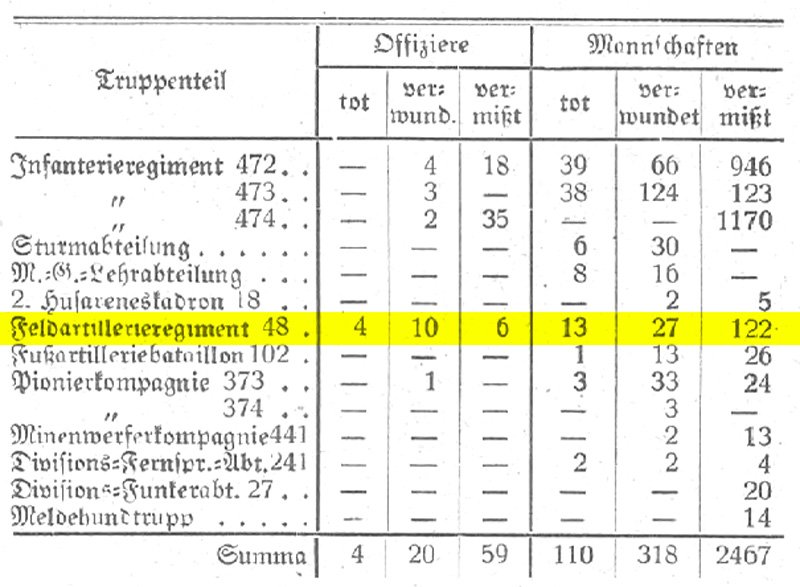
Above: by any measure, 18th July 1918 was a disaster for the 241.ID. This table from Sachsen in Grosser Zeit shows the full extent of the losses. The regimental history described it as the 'black day' of FAR 48. Besides the casualties listed here, they had lost twenty-six guns - the armament of seven entire batteries (two of which had been missing their fourth gun before the battle began).
More broadly, this day could reasonably be called the 'black day' of the Royal Saxon Army as a whole. During the Franco-American counteroffensive which began on 18th July and continued until 6th August, no less than six Saxon divisions (23.ID, 40.ID, 24.RD, 53.RD, 241.ID and 19. Ersatz-Division) were sucked into the fighting and badly mauled. For an overview of this battle, please see Kaiser's Cross.
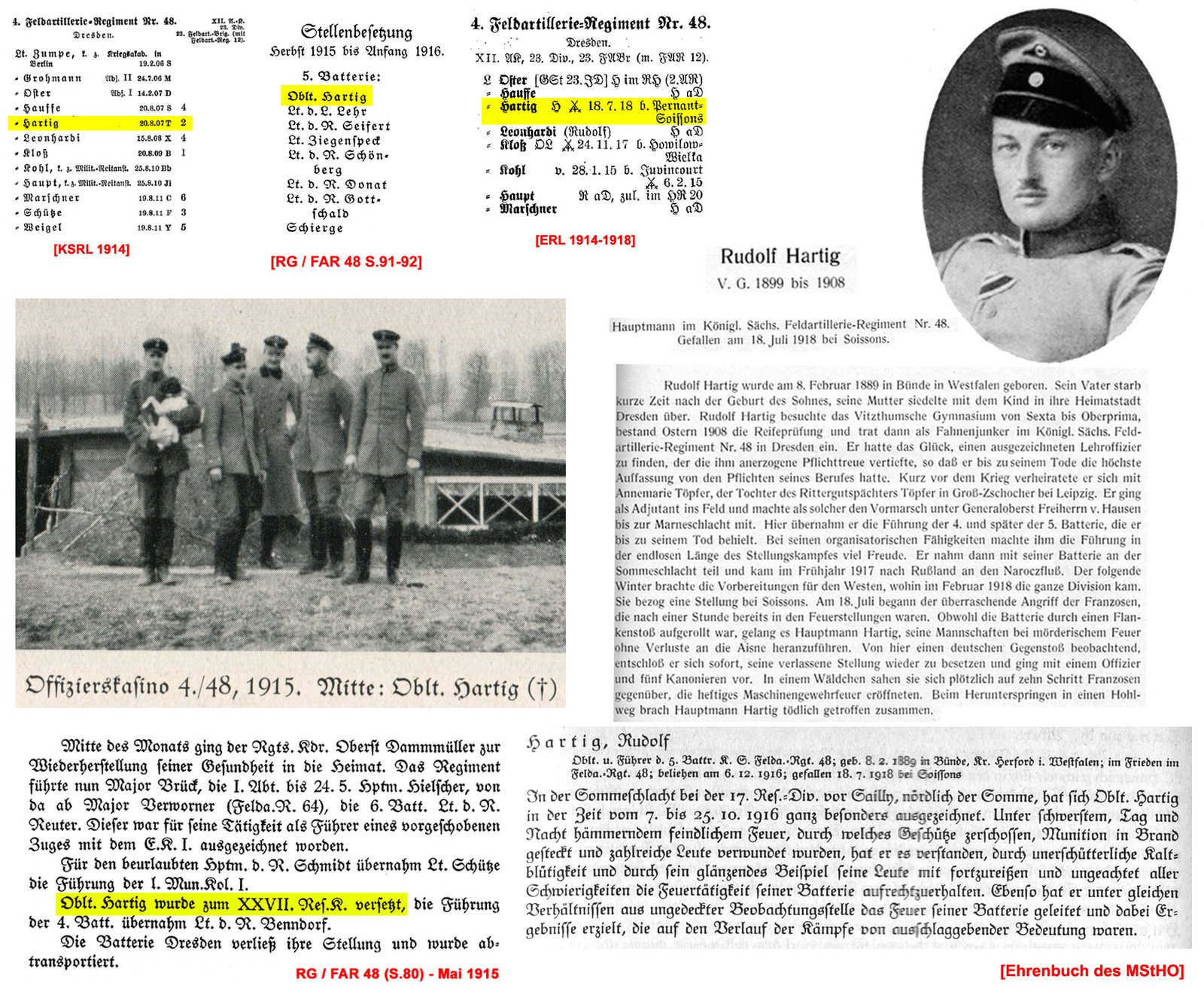
Above (click to enlarge): among the regiment's numerous casualties was Hauptmann Rudolf Hartig, the long-serving commander of 5./48 who had been awarded the Ritterkreuz des Militär-St.Heinrichs-Ordens for his leadership on the Somme in October 1916.
Around midday on 18th July 1918, Hartig observed what he believed to be a successful infantry counterattack at Pernant. Together with Leutnant der Reserve Peter Hansen (the future Waffen-SS general) and his last six gunners, Hartig boldly set out with the aim of reoccupying his battery position. Whether he hoped to bring one of the howitzers back into action or simply to destroy those which he had previously been forced to abandon in an unspiked state remains unclear.
While approaching the battery position via a sunken road, the party suddenly ran into the French a mere ten paces away and immediately came under machine-gun fire. A bullet passed through both officers, fatally wounding Hartig and lightly wounding Hansen. Somehow the party managed to escape, bringing Hartig's body with them.
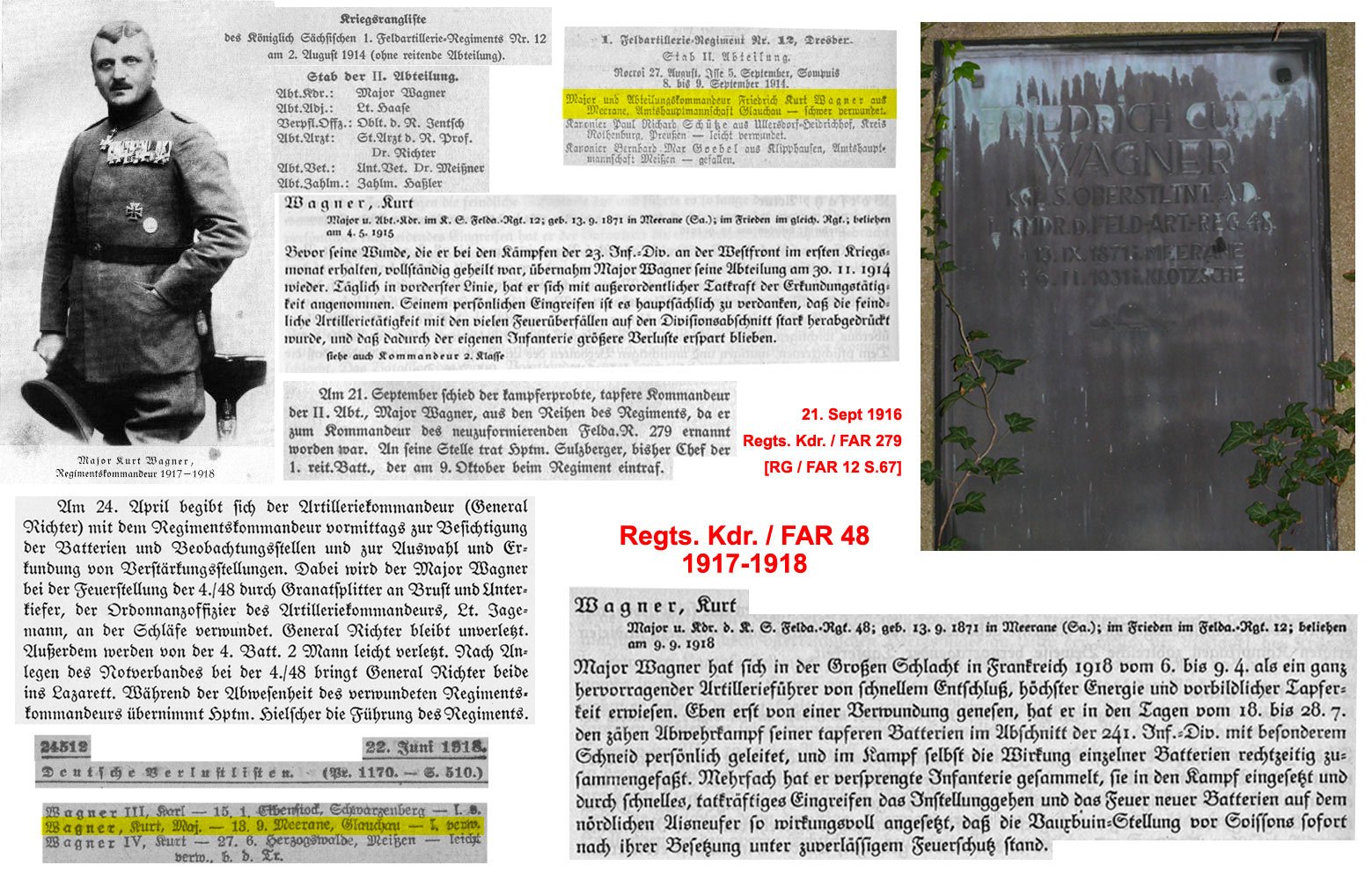
Above (click to enlarge): a long-serving career artillery officer, Major Kurt Wagner had commanded II. Abteilung / FAR 12 in 1914. On 21st September 1916 he was given command of the newly formed FAR 279 (212. Infanterie-Division). During 1917 he was transferred to command of FAR 48, and would remain with them until demobilisation.
Major Wagner was finally awarded the Ritterkreuz des Militär-St.Heinrichs-Ordens on 9th September 1918. His citation refers both to his command of the regiment in the 'Archangel' offensive and (at greater length) to his actions on 18th July. He is credited with rallying the infantry and organising the batteries for the vital defense of the Vauxbuinstellung, despite having recently recovered from wounds. This refers to 24th April, when he was hit by shrapnel in the chest and lower jaw while visiting the fire position of 4./48.
In addition to Major Wagner, Hauptmann Kurt Zumpe, Leutnant Willy Tridon and Leutnant Waldemar Bracht were all awarded the Ritterkreuz des Militär-St.Heinrichs-Ordens for their parts in this desperate and ruinous battle.
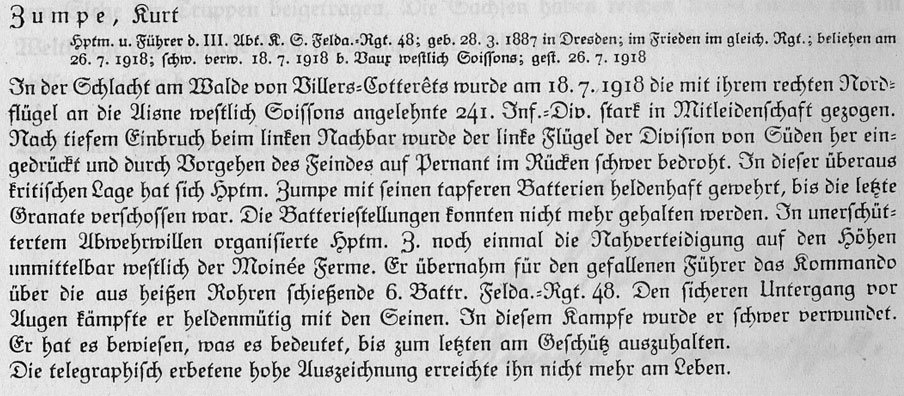
Above: MStHO citation for Hauptmann Kurt Zumpe, describing his previously described role in the desperate withdrawal to and defense of the 6./48 fire position. Although Zumpe held out to the last and was evacuated with the survivors when this position had to be abandoned, he died of his wounds on 26th July and received his award posthumously.
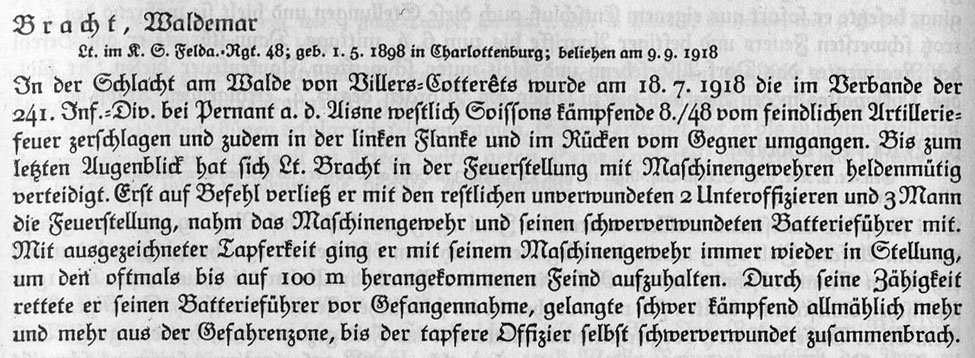
Above: MStHO citation for Leutnant Waldemar Bracht, describing his role in the defense of the battery with machine-guns and his five surviving men. He is credited with rescuing the wounded battery commander Oberleutnant der Reserve Friedrich zu Jührden, although the latter did end the day in captivity and died on 29th July. This presumably occurred as a result of Bracht himself being severely wounded during the breakout.
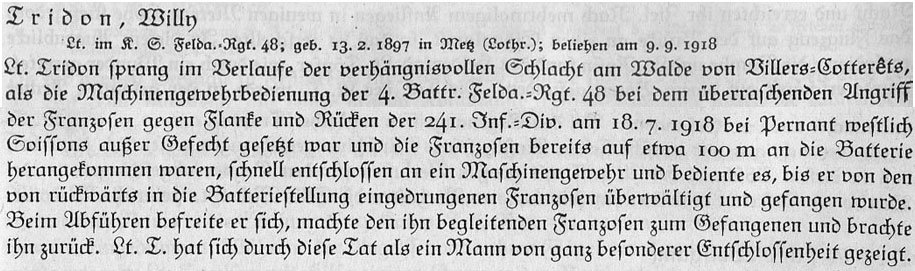
Above: MStHO citation for Leutnant Willy Tridon, describing how he personally manned a battery machine-gun when its crew became casualties and the French were a mere 100 metres away. He was then overwhelmed and captured when the enemy broke into the battery position from behind, but escaped while being led back to the French lines and took his captors prisoner! As previously described, he then proceeded to the lines of IR 473 where he warned the right-hand section of 2./48 that the enemy had broken into the artillery lines.
The 241.ID was withdrawn to the vicinity of Vervins for rebuilding, and received large numbers of replacement personnel and materiel for its depleted units. Even IR 474, reduced to a sad cadre of three rudimentary companies, was successfully brought up to effective strength. However it is unclear whether the divisional Sturmabteilung (which had relied on seconded personnel from the infantry regiments) was ever rebuilt. The first three weeks of August were spent in intensive training as all formations did their utmost to re-establish unit cohesion and operational efficiency. Having received new guns, FAR 48 began fire exercises with its new gun crews on the 17th.
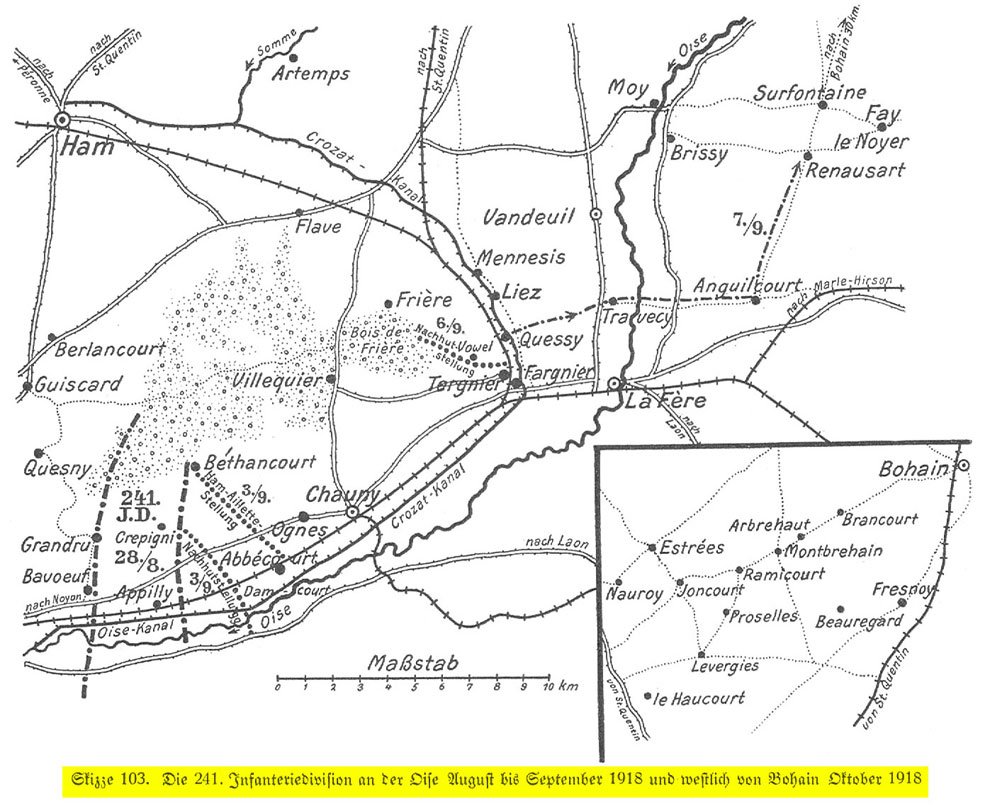
Above: Locations of 241.ID in September / October 1918 as shown in Sachsen in Grosser Zeit.
This difficult and vital rebuilding process was brought to a premature end on the 20th, when the 241.ID was ordered into heightened march readiness. That evening the first troops began to move out in the direction of La Fère. The division was now transferred to the 18. Armee, and on 26th August was ordered to occupy a sector on the Oise-Aisne Canal west of Chauny. Here its infantry endured aggressive probing attacks on 31st August, but managed to retake the lost ground by the end of the day. This became entirely moot on 3rd September, when the 18. Armee started to fall back. Largely untroubled by the enemy, the 241.ID began a dispiriting retreat eastward as shown on the map, leaving behind ground gained at an appallingly high price in blood during the spring offensives.
From 10th to 17th September the 241.ID was Eingreifdivision to XVIII. Reservekorps. Around this time there were some changes to its composition, reflecting those taking place throughout the German forces. On 16th September Minenwerfer-Kompagnie 441 was dissolved and its eight 17cm medium pieces distributed among the infantry regiments, each of which formed its own organic Minenwerfer-Kompagnie incorporating its twelve existing 7.58cm weapons. The four 25cm heavy Minenwerfers of MWK 441 and their crews were withdrawn into army reserve.
The 241.ID now briefly held the line on the Oise-Sambre Canal opposite Vendeuil - which must have given those gunners of FAR 48 who had been there six months earlier a particularly acute feeling of futility. Incredibly, the worst was yet to come. On 29th September the division was hurriedly relieved and rushed to Montbrehain northeast of St. Quentin, with motor lorries laid on for the dismounted troops. There it would face an even greater trial than the disaster at Soissons.