
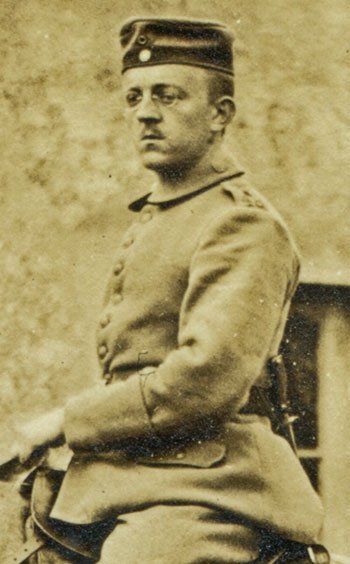
Sadly Arno's experiences in the last three years of the war must largely be deduced from the known history of his unit. We know that he served with FAR 48 for the duration and was never reported wounded or sick. Having searched the regiment's surviving personnel files, I also found no indication of any transfer from the 3. Batterie to another subunit of FAR 48. As we will see in this week's instalment, there are nevertheless some tantalising clues that by summer 1916 his role was no longer simply that of deputy head of a gun crew.
Following the severely destructive bombardment that marked the opening of the Entente's autumn offensive on 25th September 1915, the La Ville-aux-Bois-lès-Pontavert sector once again settled into its established routine of low-key trench warfare. As far as Arno's battery is concerned, it is worth noting that on 1st November 1915 they lost the only man of 3./48 to die that year, and not through enemy action; Gefreiter Herbert Schurz died in hospital at Feldlazarett XII.9 of an unspecified illness. This was not entirely representative of the regiment's experience, as the 4. Batterie (one of three armed with 10.5cm howitzers) lost eighteen men killed or fatally wounded on 26th September alone by French artillery fire.
The following year would bring radical changes for the regiment, starting in April with the biggest operation undertaken by the 23. Infanterie-Division since 1914. By July the units of XII. Armeekorps began to leave their old front on the Aisne (now increasingly marked by raiding and artillery exchanges) as reinforcements for the Battle of the Somme, replaced by unfamiliar Prussian formations. FAR 48 too would eventually join the battle in its final stages that October. By the end of the year Arno's regiment would be permanently separated from the 23.ID, now earmarked to form part of an entirely new Saxon division in a completely different theatre of war.
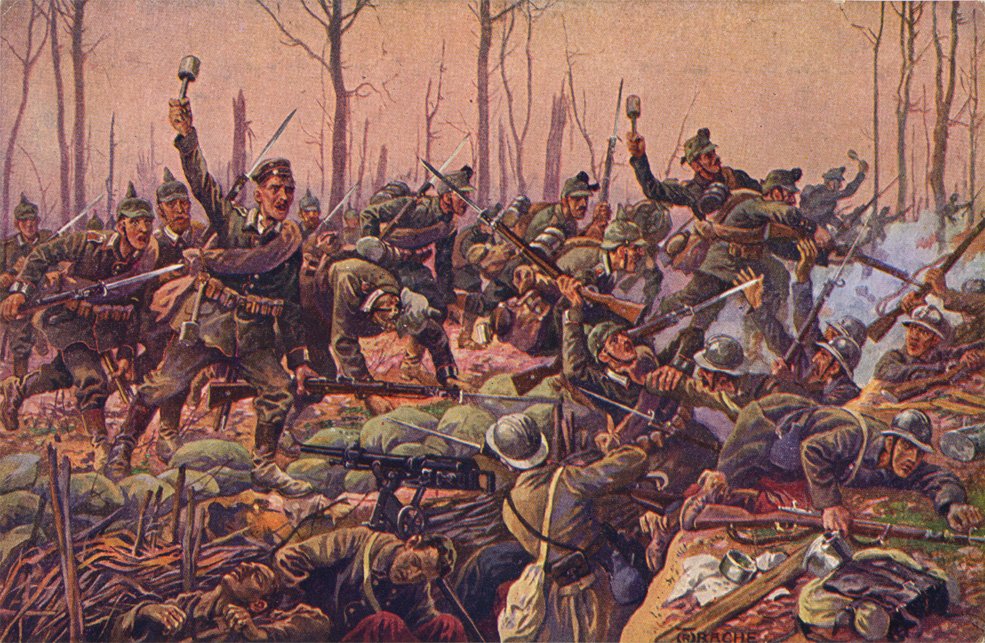
Above: a Saxon newspaper artist’s dramatic depiction of the storming of the 'Berg von La-Ville-aux-Bois' (Bois des Buttes) on 10th March 1916 by Kgl. Sächs. Schützen (Füsilier)-Regiment Prinz Georg Nr.108 (SR 108) and Kgl. Sächs. 2. Grenadier-Regiment Kaiser Wilhelm, König von Preußen Nr.101 (GR 101) of 23. Infanterie-Division. As one would expect by this stage of the war, the attackers did not actually wear their Pickelhauben or Tschakos in this assault.
As described in Part 2, the various low peaks of the raised ground in the Bois des Buttes gave French artillery observers a wide field of view across the fortified village of La-Ville-aux-Bois. Naturally the staffs of the 23.ID and XII. Armeekorps had long desired to eliminate this threat. However it was not until the opening of the German offensive at Verdun (for which it could serve as one of many local diversionary operations) that the necessary additional artillery would be available from the Armeeoberkommando in Laon. This included a whole Abteilung of 10.5cm howitzers (on top of the organic one possessed by FAR 48), five batteries of 15cm howitzers and small numbers of 21cm howitzers, 10cm guns and 15cm long-range naval guns. Additional Pioniere, Minenwerfer, observation aircraft, labour troops and infantry were also provided. According to the regimental history of SR 108, no less than 146 guns with a total of 45,400 rounds were allocated for the operation.
Despite this massive build-up of troops, the attack achieved complete surprise. The bombardment opened at 7:40 a.m. and continued with three roughly half-hour breaks until the assault by six companies of SR 108 at 4:30 p.m. The bombardment continued for a short period, now focused exclusively on the Hexenkesselwäldchen, a smaller rectangular wood south of the Bois des Buttes. This was the designated objective for two companies of GR 101, which attacked shortly afterwards. Both of the attacking regiments were accompanied by artillery forward observation parties, equipped with telephones and cable reel backpacks to establish contact with their batteries as soon as the high ground of the Viller Berg had been taken. The two parties accompanying SR 108 were both drawn from FAR 48 and led by Ltn. Dietrich and Ltn. Frölich of its 4. Batterie (the latter would go on to command 8. Panzer-Division in WW2).
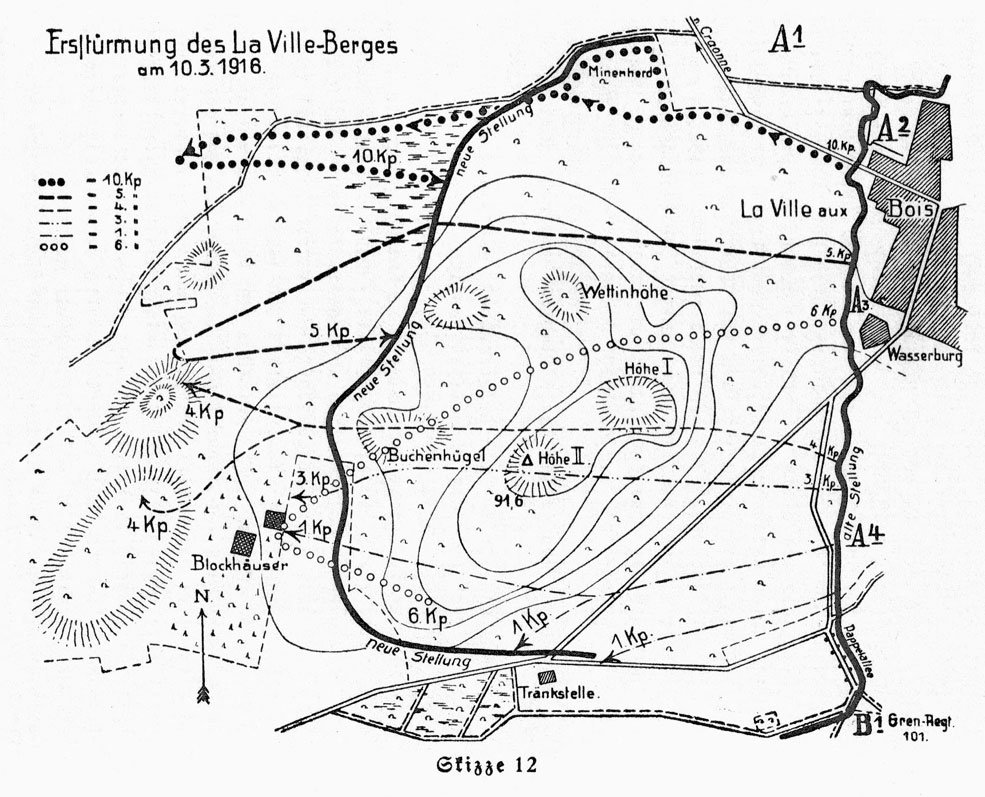
Above: map from the published history of SR 108 showing how they not only achieved but also temporarily exceeded their objectives. GR 101 initially encountered more serious resistance, but quickly overcame it and likewise seized the Hexenkesselwäldchen according to plan.
As many as 800 shell-shocked and terrified French prisoners were taken, the great majority of them from 276e RI (the infantry regiment was holding the sector at the time). In addition large quantities of materiel were captured. Sachsen in Grosser Zeit records the total German losses as four officers and 78 other ranks killed, four officers and 280 other ranks wounded.
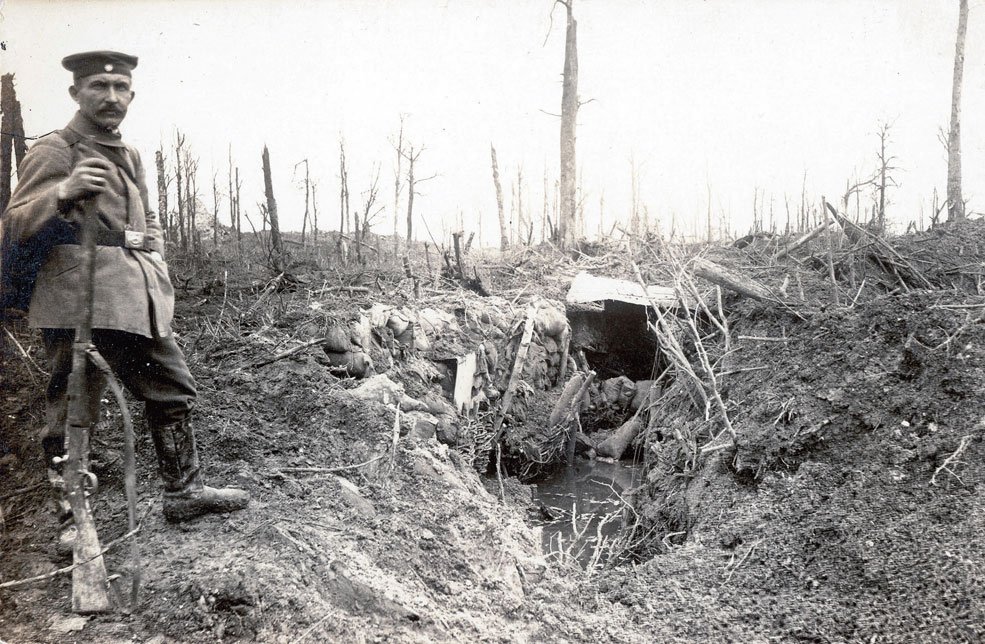
Above: one of a series of photos from the album of Hans Berthelen (SR 108) depicting the devastated French positions in the Bois des Buttes (Credit: Jürgen Schmieschek collection).
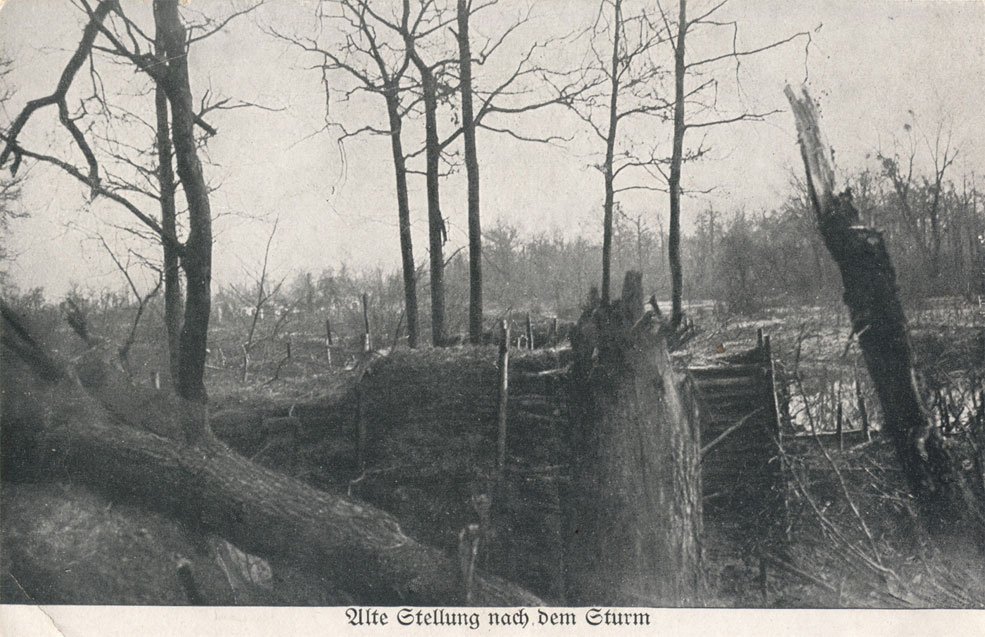
Above: one of numerous commercial cards of the aftermath, in this case a view of the old German line.
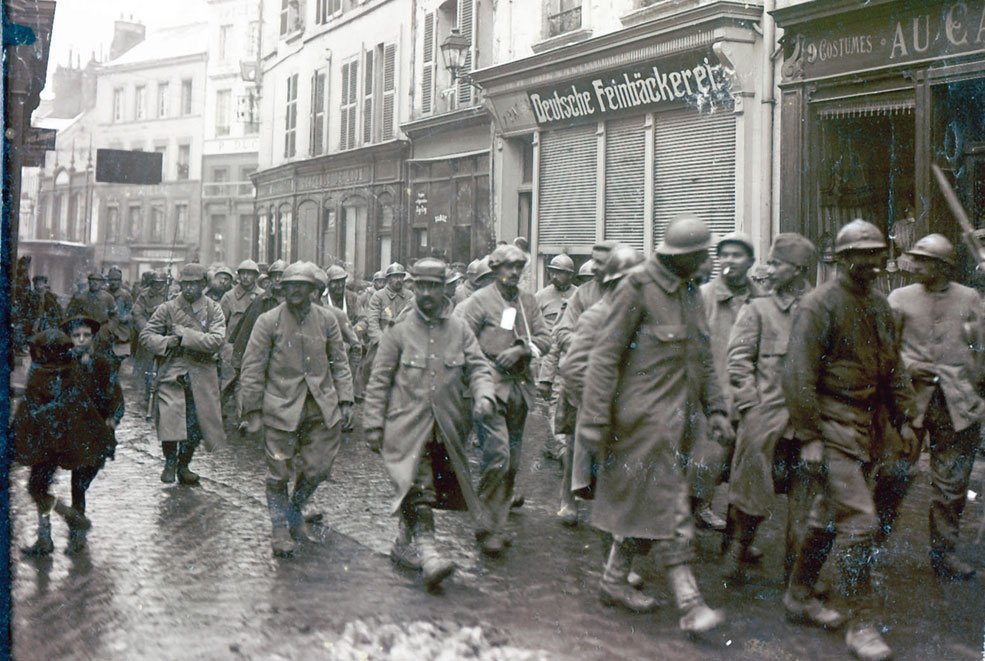
Above: French prisoners taken by 23.ID on 10th March 1916 being escorted through the streets of Laon (HQ city of 7. Armee). There they would be held at the citadel prior to transfer to POW camps within Germany. Credit: Jürgen Schmieschek collection.
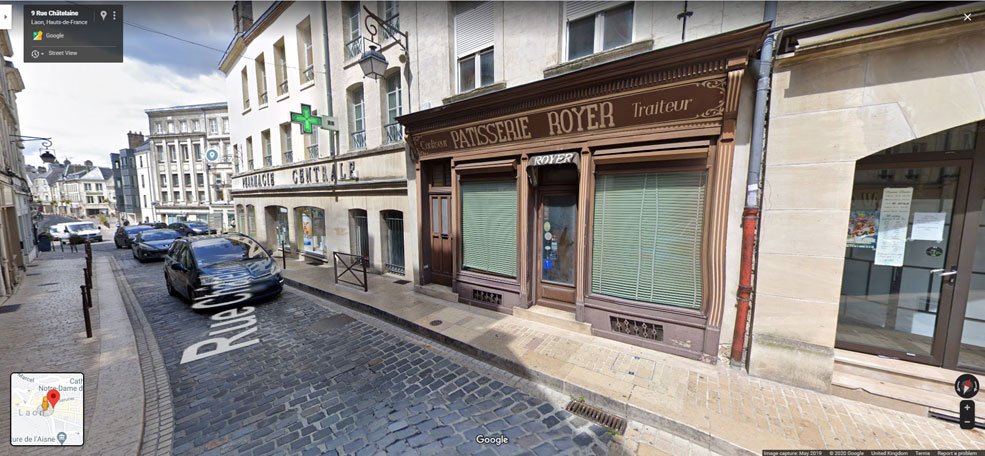
Above: our friend Mark Beirnaert has identified the exact location on the Rue Châtelaine in Laon. The "Deutsche Feinbäckerei" is still a patisserie today! Other photos of the building taken during WW1 suggest that the Royer family were already the proprietors prior to the German occupation and temporary appropriation of their business.
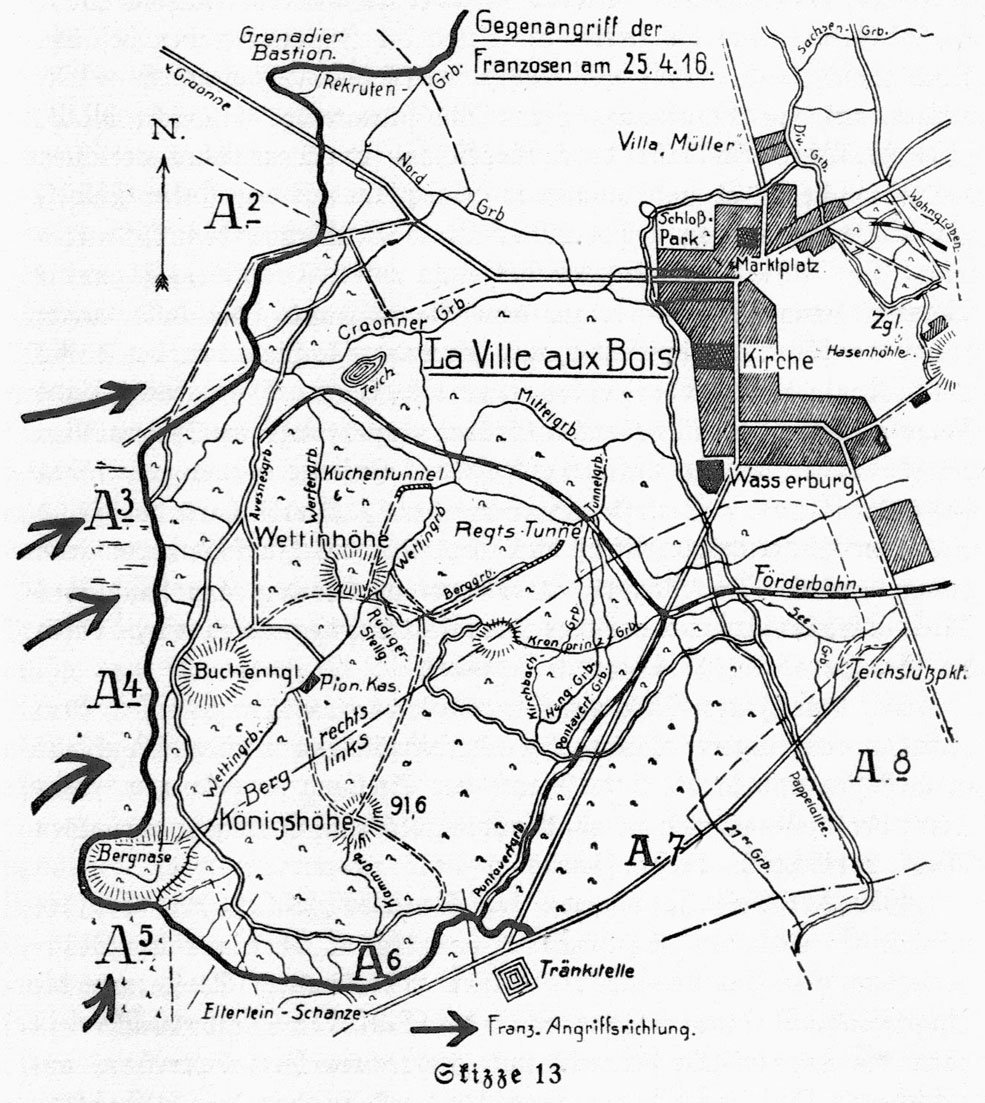
Above: map from the published history of SR 108 showing the French counterattack on 25th April 1916. According to SR 108 this operation was preceded by an even heavier bombardment than the Saxon attack on 10th March (including gas), but was nevertheless entirely repelled in their sector. GR 101 was less fortunate, as the isolated garrison of the Hexenkesselwäldchen (2./101) was cut off and overrun.
As can be seen in this map, the defences of the 'Viller Berg' had been substantially developed since 10th March under the direction of the Saxon Pioniere. Note the network of tunnels and the extension of the narrow-gauge field tramway (Förderbahn) from La-Ville-aux-Bois into the frontline trench system.
The Bois des Buttes would remain in German hands until the French Nivelle Offensive in April 1917, giving their artillery observers a clear view of the French positions as far as the Aisne. In May 1918 both the fortified 'Viller Berg' and the rubble of the village would be defended by British troops during the Third Battle of the Aisne.
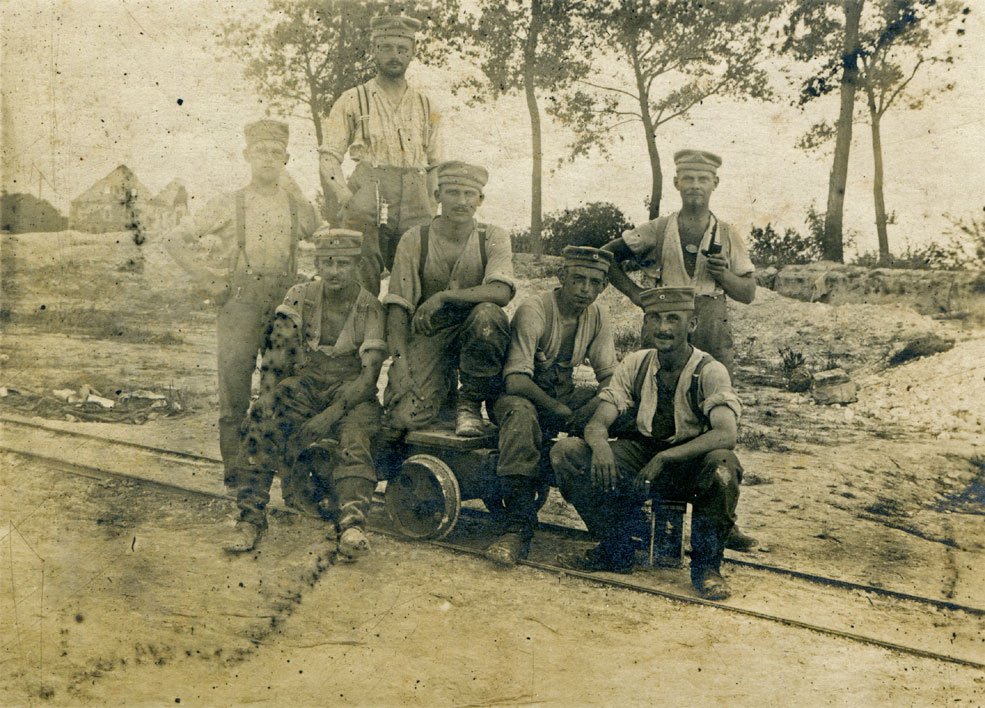
Above: sadly undated photo from the album of Max Wunsche (SR 108), depicting one of the small but invaluable trolleys used on the Förderbahn shown on the preceding map. A trolley wheel exactly like those seen here was recently dug up in this area!
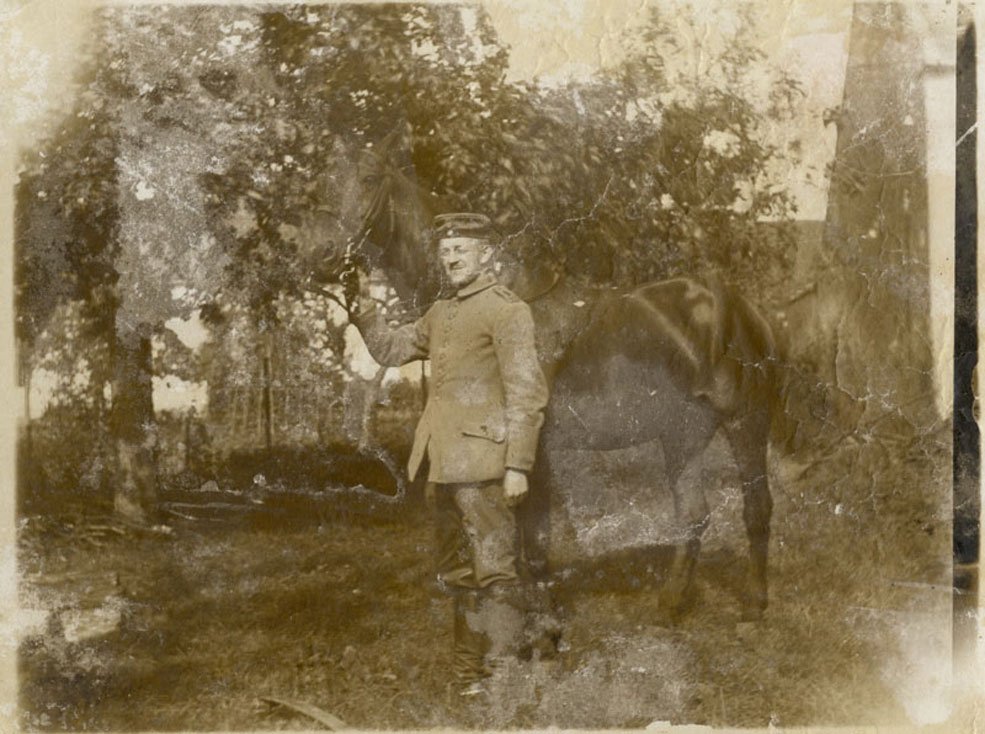
Above: the text on the back of this photo referring to 'Rudolf' initially led us to the erroneous belief that this was Arno's brother Rudolf, and that he too had served with FAR 48. On closer inspection and comparison with the other known photo of Arno from 1916, we are absolutely certain that this is actually Arno himself. We now believe that the text reads 'Rudolf & Arno 1916' and that 'Rudolf' is the name of the horse!
Based on a Verlustliste entry from 1918 and an Offizierstellenbesetzungliste in the published history of Kgl. Sächs. 5. Infanterie-Regiment "Kronprinz" Nr.104 it appears that Rudolf Bierast was in fact an Offizersstellvertreter (NCO platoon commander) with that regiment in 1918, and was lightly wounded. We know that he survived the war, became a teacher in Chemnitz and attended Arno's funeral in 1957.
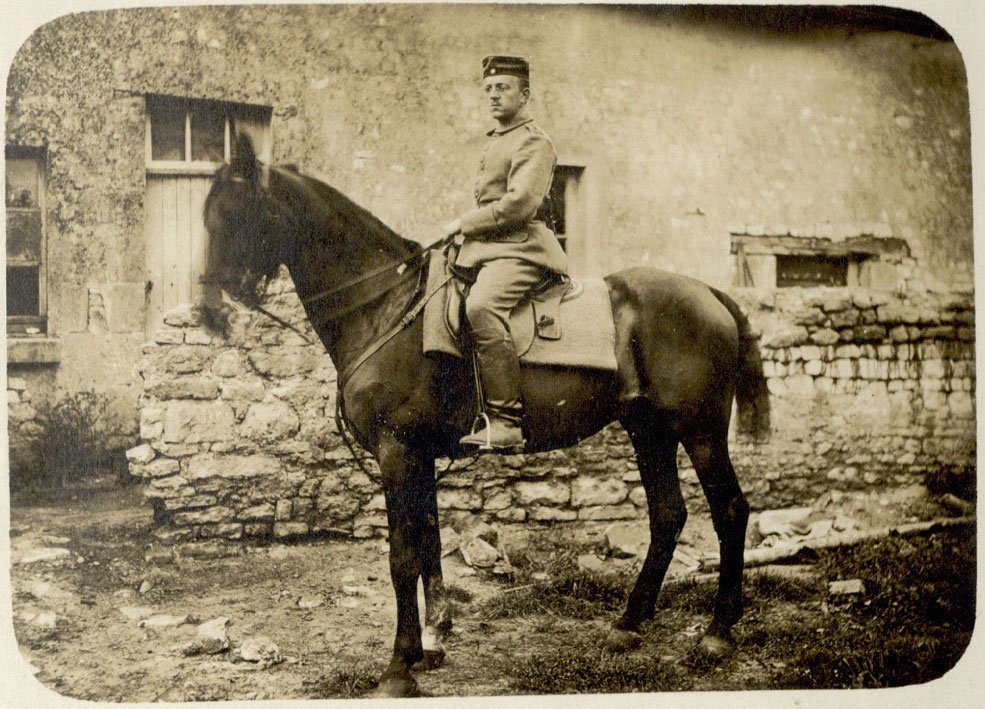
Above: the last known wartime photo of Arno, with a note to the Leonhardis ("Onkel und Tante") on the back dated 29th July 1916. By this time the battle of the Somme had been raging for four weeks. Elements of XII. Armeekorps (IR 102 minus its III. Bataillon, IR 103, LGR 100 and JB 12) had been committed to the fighting for a week, and now formed an ad-hoc Division Francke holding the line Estrées-Soyécourt-Vermandovillers against the French. The prospect of transfer to the Somme surely weighed on Arno just as it did on every soldier of his corps, but he also had grave personal worries. Though a full transcription of the text is beyond my limited ability to decipher Arno's handwriting, it clearly refers with acute concern to his parents. Arno’s father Friedrich Wilhelm Emil Bierast was evidently in hospital, and would die on 4th August 1916.
Arno has been issued with a new tunic at some point in the year since we last saw him. He now wears a vereinfachte (simplified) Waffenrock of wartime manufacture with plain barrel cuffs. The rank button on the side of his collar is now the larger Sergeantenknopf intended for the senior NCO ranks of Sergeant upwards rather than the small Gefreiterknopf. However careful examination of this and the preceding photo reveals no trace of the braid collar edging (Unteroffiziersborte) which should accompany it for those ranks, and archival documents have now confirmed that Arno was still a mere Gefreiter at the end of 1916.
Previous photos show Arno kitted out as a Bedienungskanonier (a member of a gun crew) with infantry trousers and marching boots. His horse and riding boots here suggest that his role in the regiment has changed. Still more intriguing is the unusual weapon visible at the back of his belt, recognisable by its highly distinctive 'crank handle' hilt. This is an 'aufpflanzbarer Grabendolch' manufactured by Demag of Duisburg, a trench dagger which could also be fixed as a bayonet on a standard G98 rifle. Significant quantities of these daggers are known to have been purchased by the Kgl. Sächs. Kriegsministerium and issued to the Saxon infantry in gradually increasing numbers from May 1915. Photographic evidence is scarce, but examples are known to exist with armourer's stamps from IR 102 and 103. There are also known examples from FAR 12, indicating use by the Saxon field artillery. It would unquestionably have been far more practical than the obsolete long bayonets and sabres routinely issued to artillerymen, especially in confined spaces! It seems logical that, if supplied with a small number of these weapons, a Feldartillerie-Regiment would issue them to those personnel whose duties took them into the trenches- forward observation parties, telephonists and messengers. Unfortunately with no further evidence of Arno's exact role, the presence of this rare piece of equipment raises more questions than it answers.
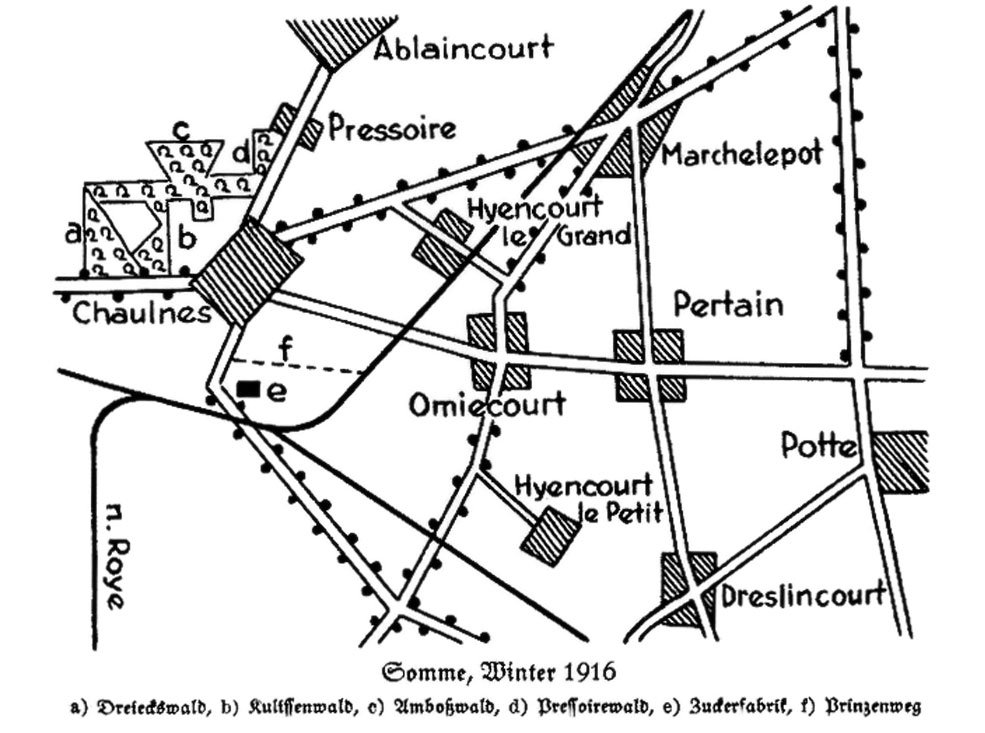
Above: map of the Chaulnes sector, where I. Abteilung / FAR 48 (including Arno's 3. Batterie) relieved I. Abteilung / 1. Garde-Reserve-Feldartillerie-Regiment on the nights of 18th-20th October 1916. By this point the French offensive here was petering out. The regiment’s II. Abteilung (with its scarcer and more effective 10.5cm howitzers) had already been committed on 8th October further north, and saw significant action opposing British and French attacks near Sailly-Saillisel.
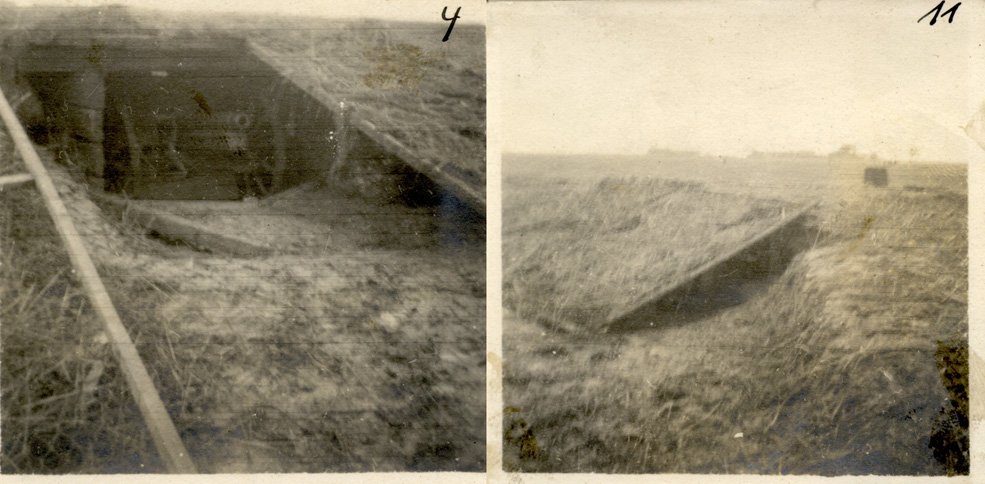
Above: a well-camouflaged fire position for a 7.7cm FK 96 n.A. field gun of FAR 12 near Omiécourt on 3rd December 1916.
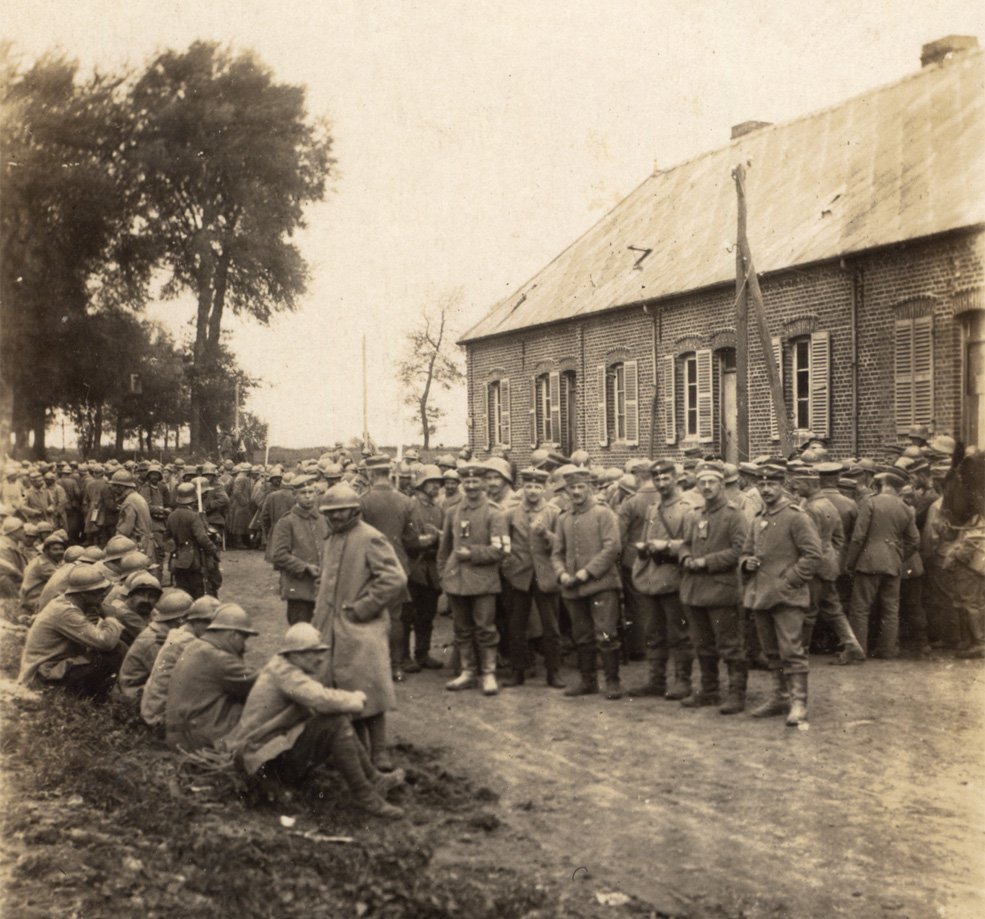
Above: a casual scene in the rear of the Chaulnes sector in September or October 1916. Men from a reserve company of Schützen-Regiment 108 (without weapons or equipment) have come out to see their comrades returning from the front with a large crowd of French prisoners.
Units of XII. Armeekorps were issued steel helmets for the first time on the Somme front. This photo was probably taken on one of the three occasions when SR 108 reported hauls of over a hundred prisoners: 6th September, 11th and 13th October. On the last occasion six French officers and around 400 men were captured in a successful Saxon counterattack on the Amboswald.
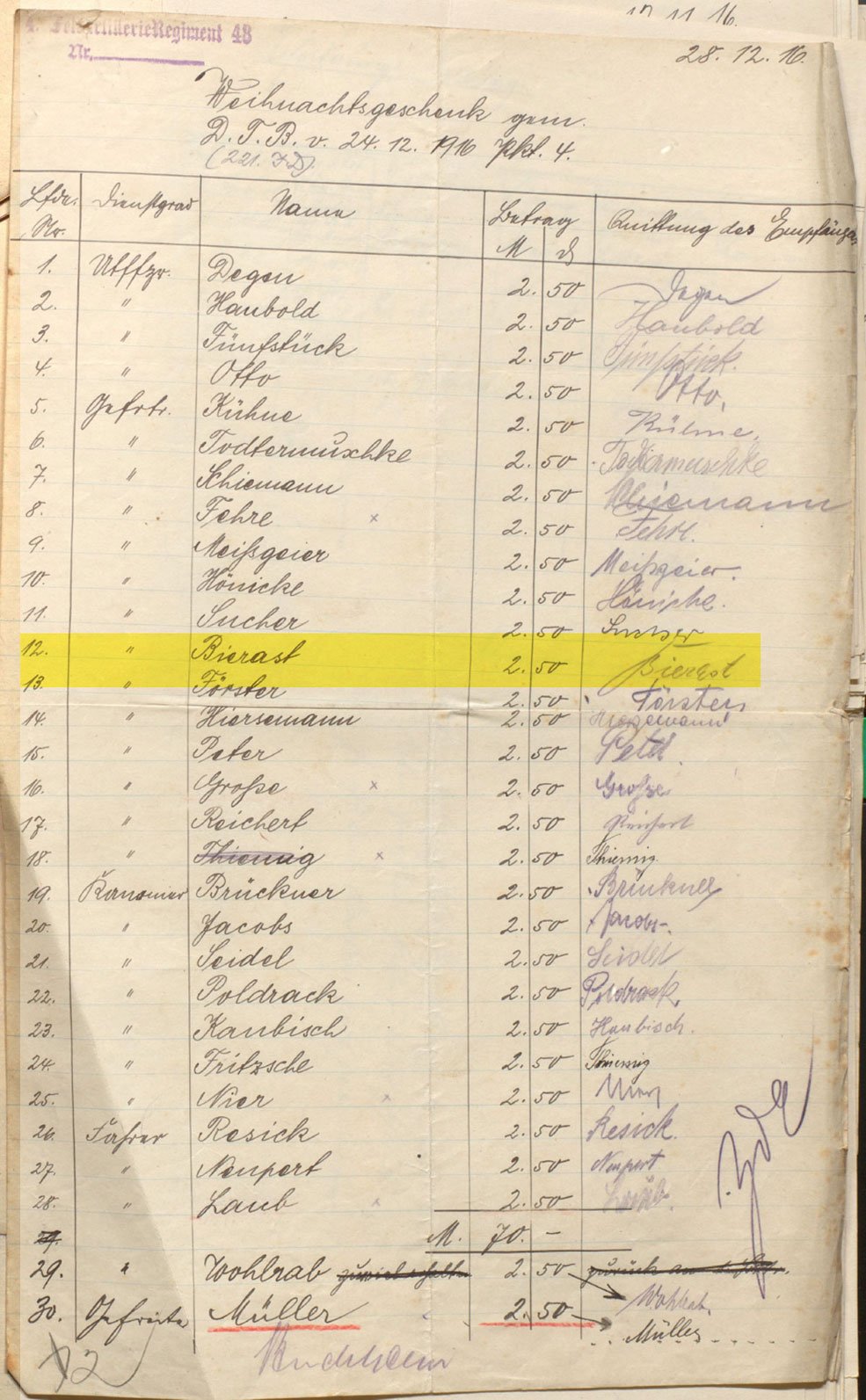
Above: the last mention of Arno I was able to find in the course of a day spent digging through the personnel files of FAR 48 at the Sächsisches Staatsarchiv in Dresden. Having been ruled unsuitable for promotion, he no longer figured other than incidentally in the regimental paperwork.
His signature on this document dated 28th December 1916 acknowledges receipt of a Christmas bonus of two marks and fifty pfennigs, issued by divisional order of the day (Divisionstagesbefehl) on Christmas Eve. At this time the regiment was still on the Somme, with at least the I. Abteilung apparently under the temporary command of the Prussian 221. Infanterie-Division.
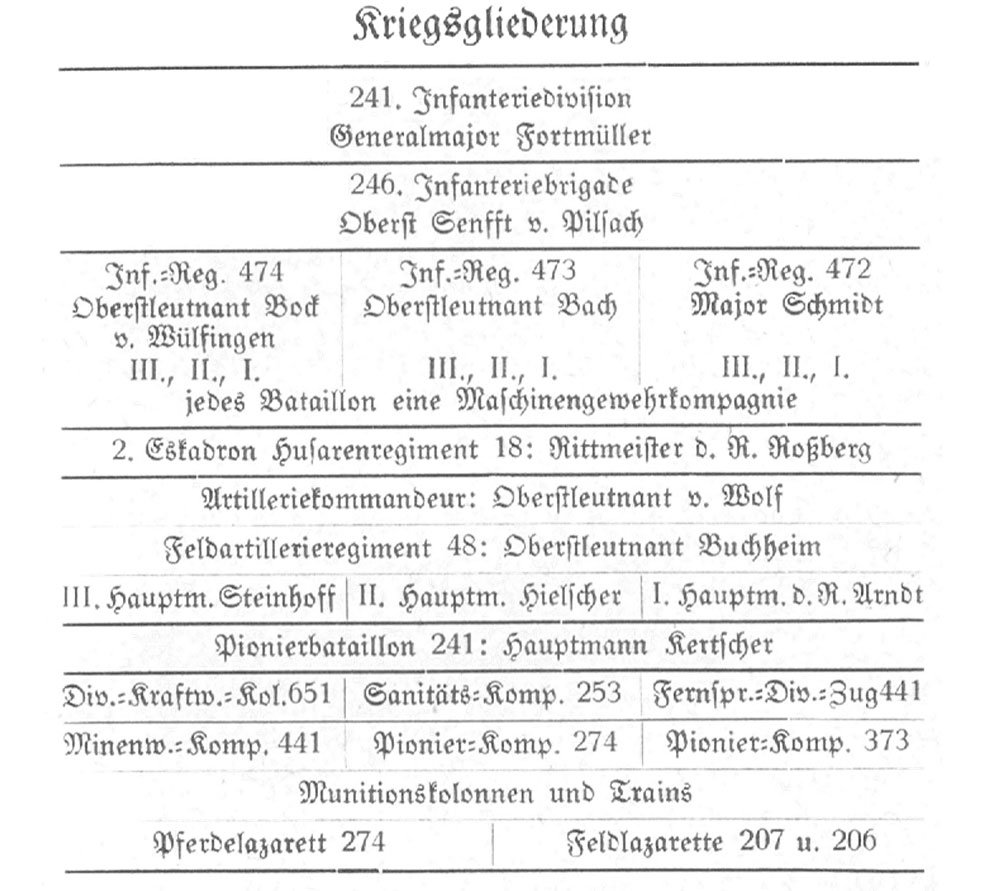
Above: FAR 48 did not return to the 23.ID after the battle. Under one of the many reforms introduced by the new Hindenburg / Ludendorff regime at OHL, the organic artillery complement of every German division was now to be standardised as a single Feldartillerie-Regiment of three Abteilungen- two with 7.7cm guns and one with 10.5cm howitzers. The Feldartillerie-Brigade was abolished entirely, with every division instead receiving an Artillerie-Kommandeur (ArKo) responsible for command and coordination of all field and heavy artillery assets in his sector.
As a result, early in the new year FAR 48 received a new III. Abteilung (comprising the 7., 8. and 9. Batterie) and was reassigned to the newly formed 241. Infanterie-Division.
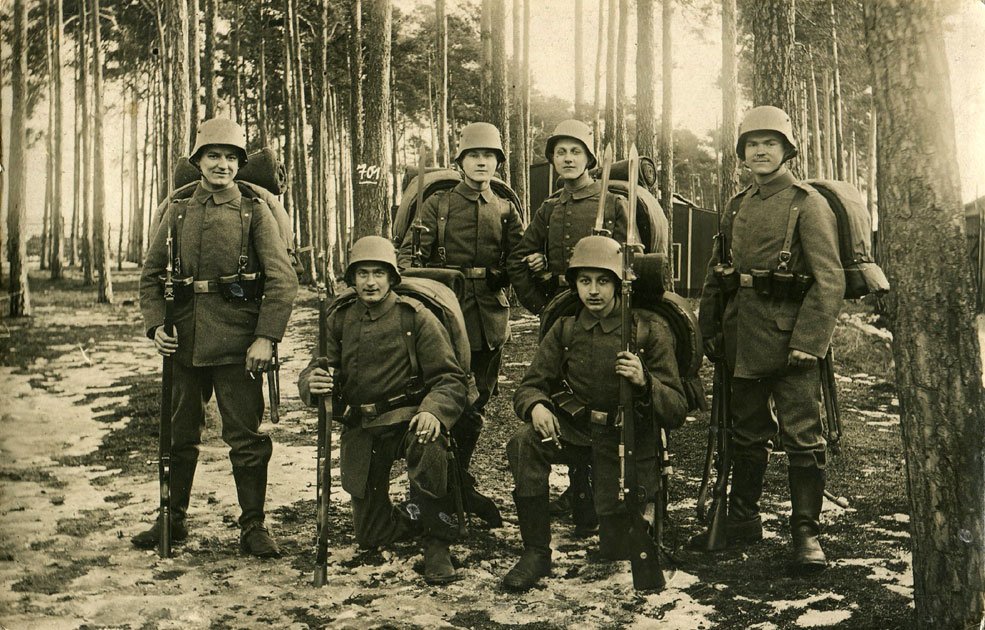
Above: Walter Schürer (right) and comrades from IR 473 at the Truppenübungsplatz Zeithain (the main troop training ground for the Saxon XIX. Armeekorps district), where they had been training since 18th January 1917. Unlike previous waves of new units, IR 473 and its two sister regiments were issued with steel helmets before they even left Germany. According to the text on the reverse, this photo was taken shortly before their departure for the Eastern Front on 2nd March.
The 241.ID would be the last Saxon division to be formed with completely new infantry regiments. In light of the disastrous experience of the green volunteer formations at Ypres in autumn 1914, only one third of the personnel of IR 472, 473 and 474 were new recruits. Another third consisted of returning convalescents, while the remainder came directly from regiments at the front (in exchange for raw recruits). Walter Schürer had previously served with RIR 107 (24. Reserve-Division) and is probably one of the convalescents, assuming that he is the man of that name who was reported as lightly wounded in the Verlustliste of 22nd August 1916.
In addition to these prudent measures, the new division would receive its baptism of fire on the Eastern rather than the Western Front. Credit: Jürgen Schmieschek collection.
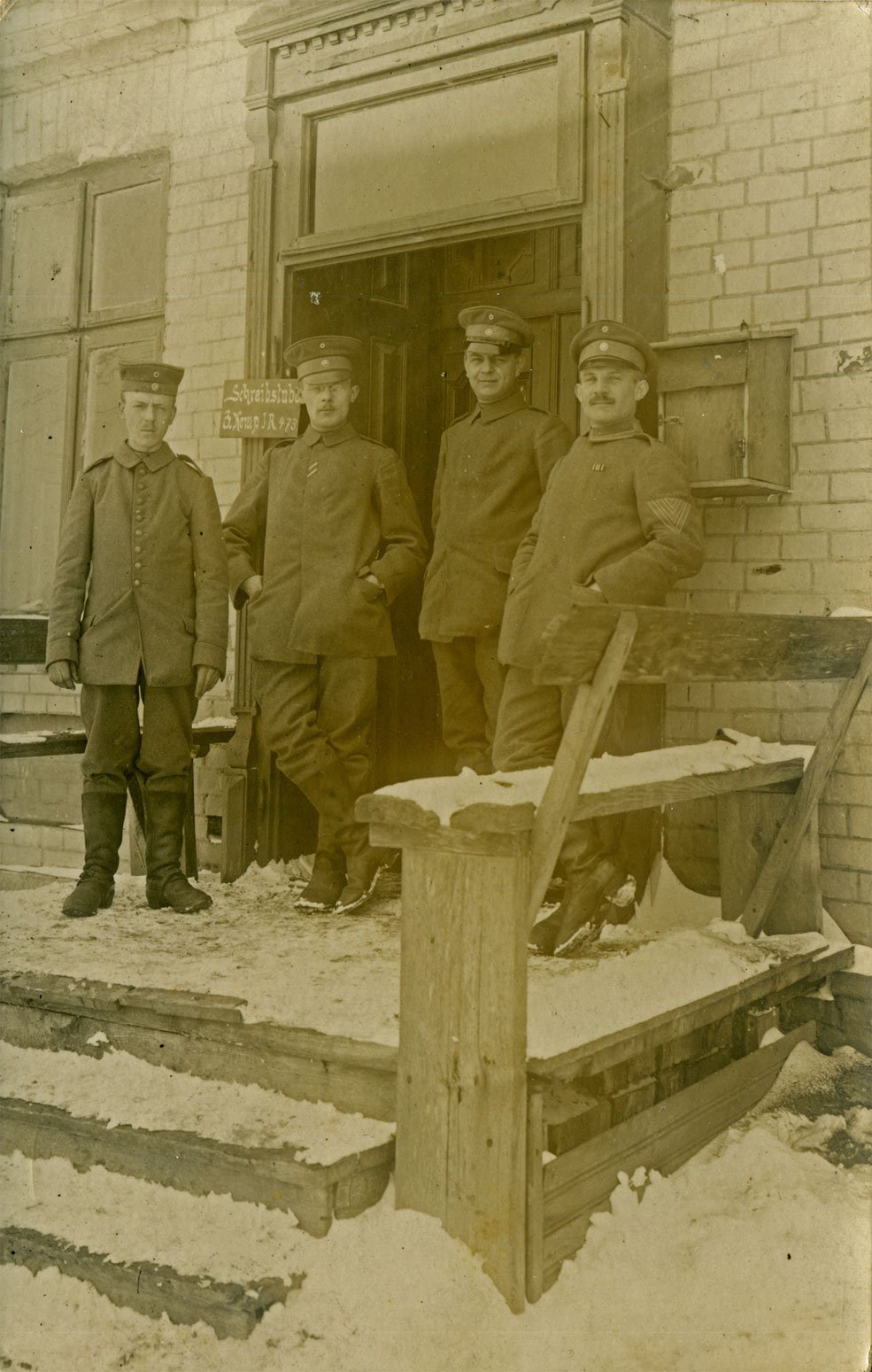
Above: the Schreibstube (company orderly room) of 3. / IR 473 in Brest-Litowsk in early March 1917.
When the units of 241.ID arrived at Brest-Litowsk that March, Imperial Russia was already visibly sliding into revolution. While Arno and his comrades waited in the snowbound city for deployment to the front, the Tsar abdicated and the Provisional Government under Alexander Kerensky assumed power. Although Kerensky was financially and logistically backed by the Entente and committed to continuing the war, Oberost (German high command in the East) remained cautiously optimistic that Russia’s internal turmoil and acute war-weariness would compromise his ability to do so.
On the right is the Feldwebel (company sergeant-major), invariably known as 'der Spieß' (the spear) in remembrance of the polearm he would have carried as a sign of authority in previous centuries. His status is clearly indicated by the rank chevrons on his sleeve. Like one of his three subordinates, he is a decorated combat veteran. The private soldier on the left (described on the back as the orderly room’s "maid of all work") is wearing leather tightening straps around his newly issued boots to help wear them in.
Surprisingly it seems that the sender, one Heinz Schwab, was not a Saxon. Going by his parents' address he presumably hailed from Freinsheim (Pfalz). It is perhaps significant that an Ersatz-Reservist Heinrich Schwab from Freinsheim was wounded in action with 6. Kompagnie of Saxon RIR 245 on 17th March 1915 - the only known Verlustliste entry for this surname / placename combination (based on a search not just of the Saxon lists, but of those for all the German armies and the navy).
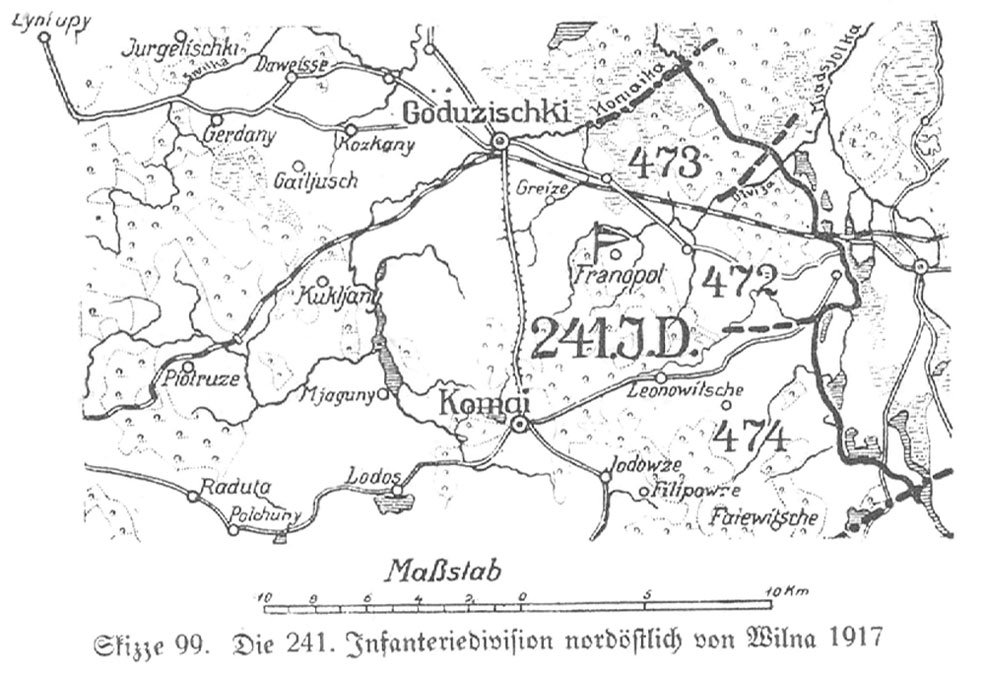
Above: on 11th April 1917 the division received orders to occupy the Postawy (Pastavy, Belarus) sector northeast of Wilna (Vilnius, Lithuania). FAR 48 was transported by train over the successive days of 14th-17th April as far as Lyntupy (Belarus), then continued by narrow-gauge field railway as far as Goduzischki (Adutiškis, just inside the Lithuanian border) on the division’s new right flank. The wretched condition of the roads (except where the Germans had laid carpets of tree trunks) came as a rude shock to troops wholly accustomed to the Western Front.
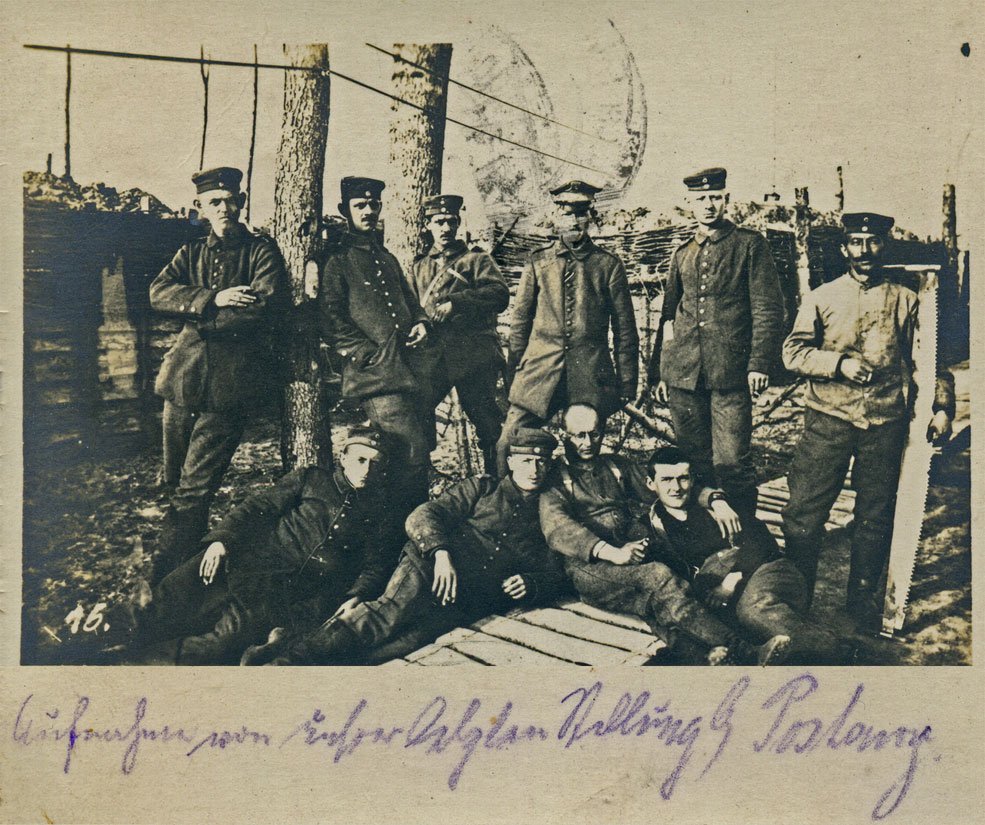
Above: infantrymen of 1. Komp. / IR 473 in their regimental subsector immediately to the east of Goduzischki in spring 1917. The Postawy sector consisted of swamp, lakes and woodland, and bore the scars of heavy fighting in 1916. As in Flanders, the trenches were built up well above ground due to the water table, and held in place with wickerwork and tree trunks. The line was well developed with all mod cons (note overhead telephone cables in the photo). These even included electrified barbed wire charged to 1500 volts, which as always proved more trouble than it was worth and even inflicted casualties on careless Saxons.
As expected this tour was very quiet, and the Russians regularly fraternised in no man's land (bringing bread and sugar to trade for cigarettes and alcohol) until contact with them was forbidden by the division in mid-May. Their evident demoralisation was systematically encouraged by the division’s distribution of propaganda promoting what amounted to the familiar Saxon 'live and let live' arrangement that had once been so characteristic of the XIX. Armeekorps front east of Armentières.
This cosy but tedious existence came to a sudden end on 11th June, with an announcement that the 241.ID was to be relieved immediately and sent to the Western Front. As it turned out, they were only transported as far as Baranowitschi (Baranovichi, Belarus). On 19th June they were then informed that they had been reassigned to the Austro-Hungarian Heeresgruppe Böhm-Ermolli in Galicia (Austrian-ruled Western Ukraine). There they were to help their allies face the expected Russian offensive which would open on 1st July. By the time Soldat Kurt Winkler of 1./473 sent this postcard home on 9th July, his company lay in reserve in an entirely new position at Chatki near the Galician city of Brzezany (Berezhany).
This journey was an ill-omened one for Arno’s battery. On 16th June, Kanonier Richard Helas of 3. Battr. / FAR 48 fell from their train and was crushed to death under its wheels.
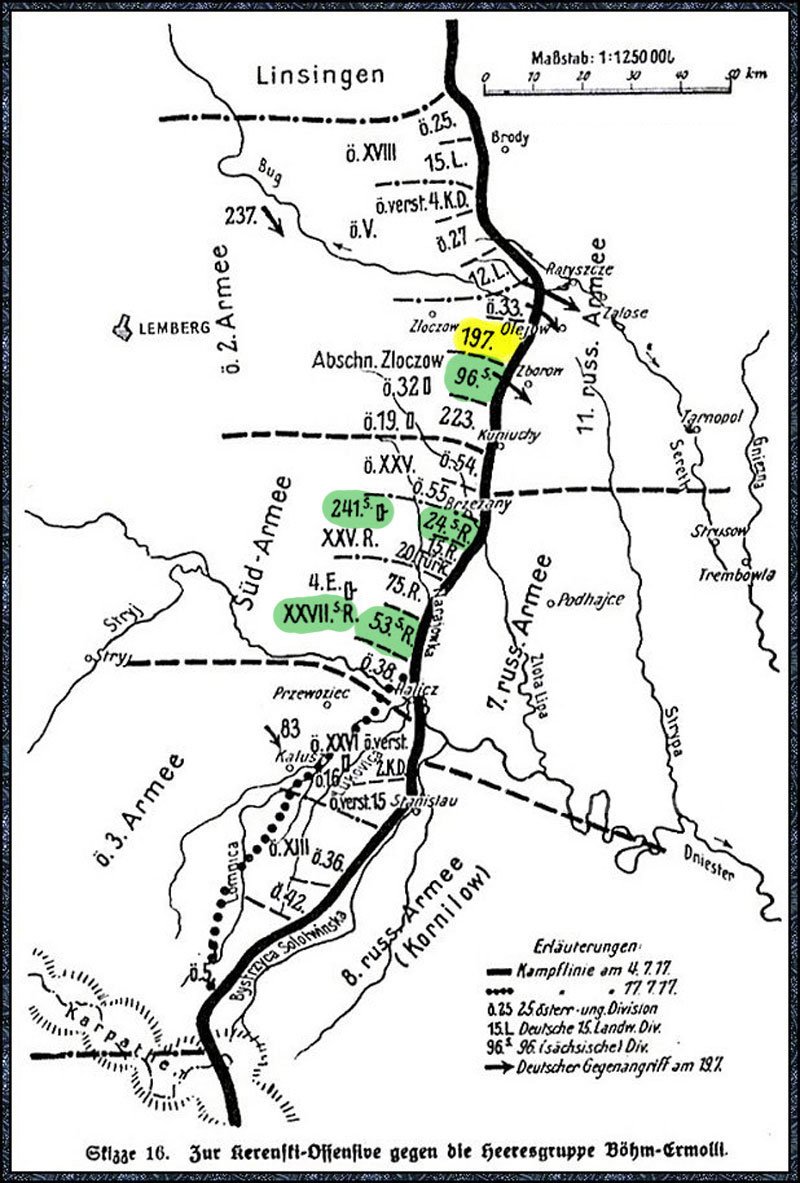
Above: map from Genltn. Schwarte's Der Weltkampf um Ehre und Recht showing the situation at the opening of the Kerensky Offensive on 1st July 1917. Saxon divisions (and a Saxon corps HQ) have been marked in green; in addition the Prussian 197.ID (marked in yellow) included the Saxon Jäger-Regiment 7.
241.ID was one of two divisions assigned as reserve to the Südarmee, a German command created in January 1915 to support the Austro-Hungarians. Always of highly heterogeneous composition, at the beginning of July 1917 it controlled three Prussian, three Saxon and three Austro-Hungarian divisions plus a single Ottoman Turkish division. By this time the latter was the only one on the Eastern Front; in 1916, the Südarmee had included a full Ottoman corps of two divisions.
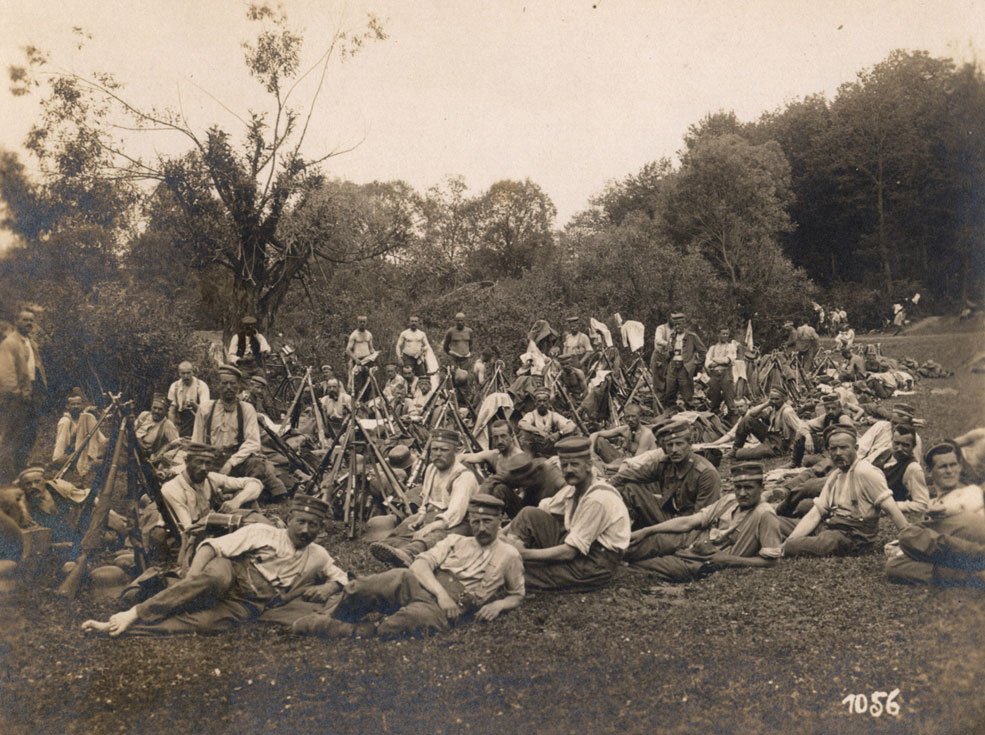
Above: unidentified Saxon infantry (almost certainly from 241.ID) in reserve in Galicia in July 1917; regrettably for us, their shoulderstraps have been deliberately masked to prevent identification. The sparsely inhabited Galician countryside offered insufficient accommodation for the masses of additional troops demanded by an enemy offensive, and the Austro-Hungarian authorities proved unhelpful and (by German standards) inefficient. As is clearly evident here, it was a blisteringly hot summer. Forest fires were not uncommon, and burning undergrowth often fringed the railway lines.
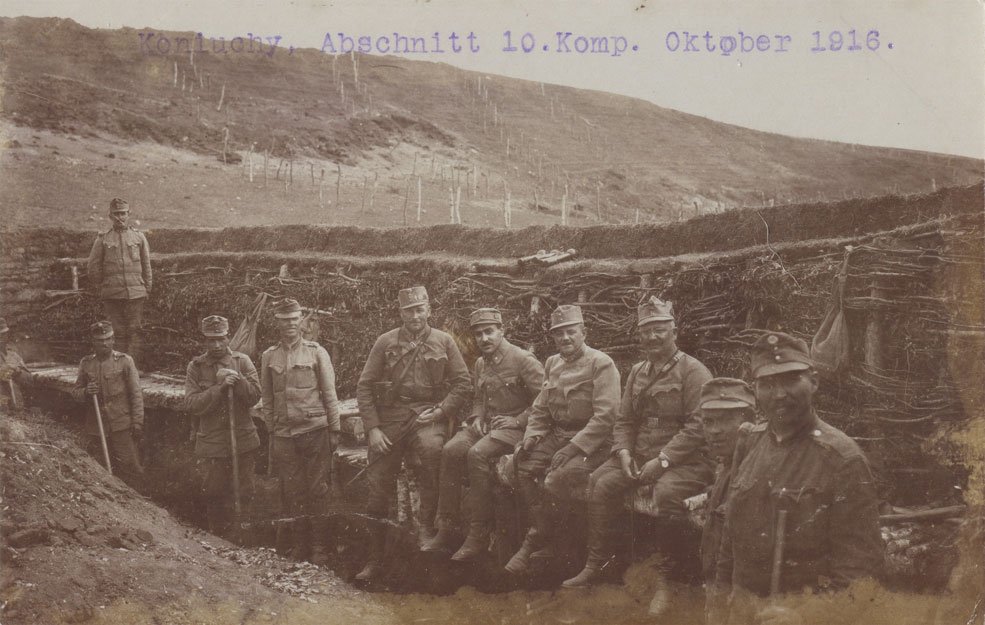
Above: Austro-Hungarian infantry in their trenches near Koniuchy (Konyukhy) in October 1916.
At the opening of the Kerensky Offensive this vital position on the left flank of the Südarmee was held by the k.u.k. 54. Infanterie-Truppen-Division. The I. Abteilung / FAR 48 (with the 1., 3. and 5. Batterie and presumably including Arno) was sent to support them on 30th June. They had barely got into position by the morning of 1st July and, having received no orders, began engaging targets on their own initiative.
The Austro-Hungarian trench system (only 250 metres forward of the Saxon battery positions) was swiftly overrun, allegedly due to the mass surrender of Czechs from k.u.k. Infanterieregiment 'Freiherr von Waldstätten' Nr.81. Keeping their cool as Austro-Hungarian infantry flooded back past them, the Saxon batteries were not directly assaulted and pulled further back after nightfall. Meanwhile the situation to their front was stabilised by the arrival of German reinforcements from IR 473 and the neighbouring Prussian 223.ID, but not before the Ukrainian Legion and the Sturmbataillon of k.u.k. XXV Korps had both been all but destroyed in desperate defensive fighting.
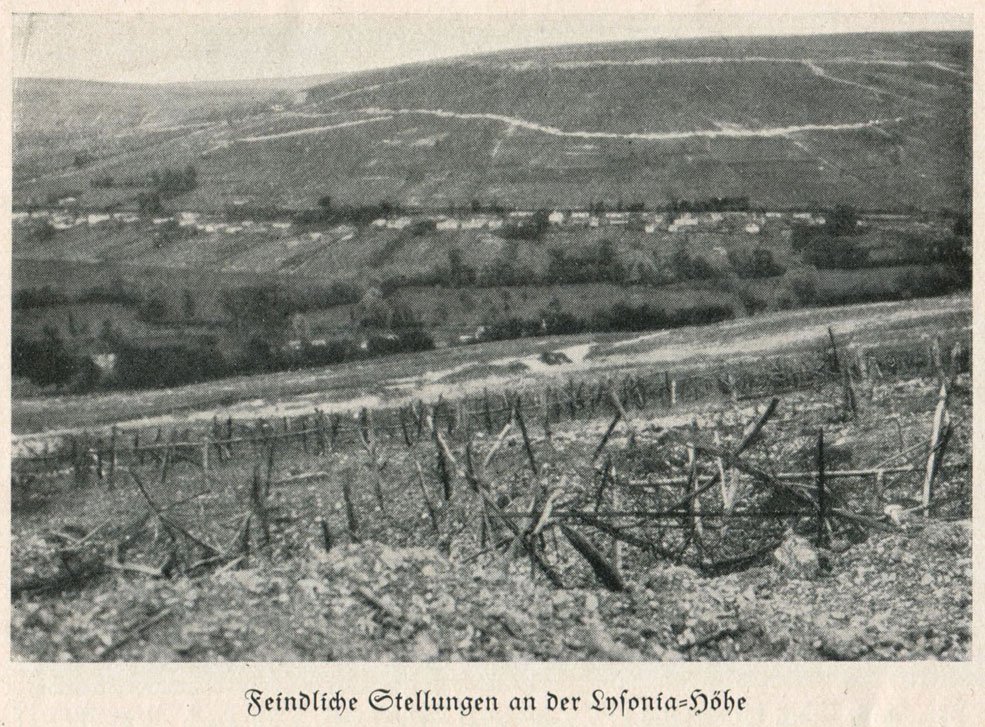
Above: view from the Lysoniahöhe east of Brzezany, looking towards the Russian trench system. While the I. Abteilung fought at Koniuchy, the rest of FAR 48 was deployed in this sector, initially held by Saxon 24. Reserve-Division. The remaining infantry of 241.ID were gradually fed into the front alongside them, successfully withstanding the full force of the Provisional Government’s finest assault troops. After some final local attacks on the Lysoniahöhe on the night of 3rd-4th July, their offensive against the Südarmee had burned itself out.
Now in command of the sector, on the night of 9th-10th July the 241.ID employed its Sturmabteilung and III./472 to clear out the remaining pockets of the enemy which had dug in within the German trench system. On the afternoon of 19th July, a second stormtroop operation also succeeded in taking and holding most of the original Russian front line.
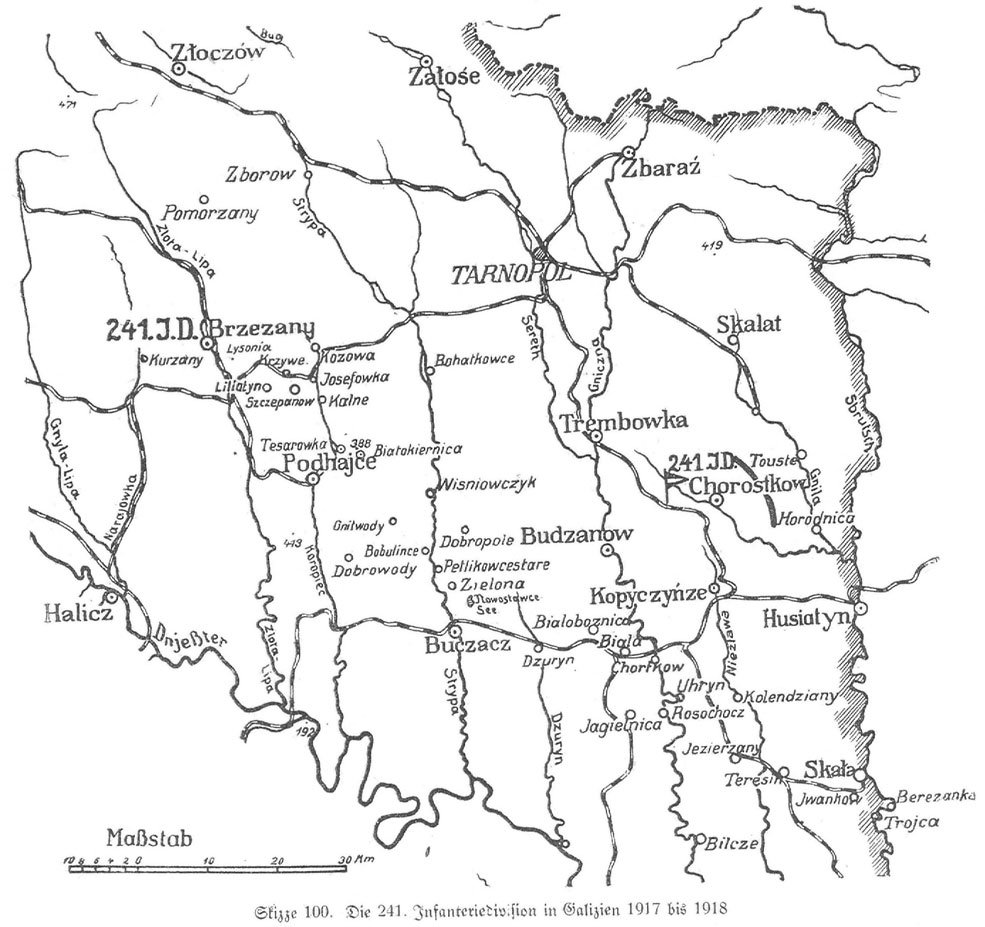
Above: on the morning of 22nd July 1917 the Südarmee launched its counteroffensive. After overcoming some initial stiff resistance, the 241.ID advanced as rapidly as its horse-drawn transport and masses of foot troops allowed, beating back Russian rearguards in a series of skirmishes.
During this advance the I. Abteilung / FAR 48 (and presumably Arno) was still attached to the Austro-Hungarian Korps Hofmann (k.u.k. XXV. Korps) and operating with the artillery of 54. Infanterie-Truppen-Division. Hence it followed a parallel path somewhat further north of the 241.ID. On the 25th it left Austro-Hungarian command and rejoined the rest of its regiment at Zielona.
On the 28th the 241.ID reached the Sbrutsch (Zbruch) river, the eastern border of Galicia and of the Austro-Hungarian Empire. Here the Russians put up more serious resistance, but the Saxons nevertheless secured a bridgehead on the east bank near Berezanka on 30th July. This was successfully defended against a determined Russian assault on 5th August, before it was ordered abandoned the following day and the division relieved on the 9th. The 241.ID was then sent north to hold the line on the newly established front at Chorostkow (Khorostkiv, Ukraine), where it would remain for the rest of its time on the Eastern Front.
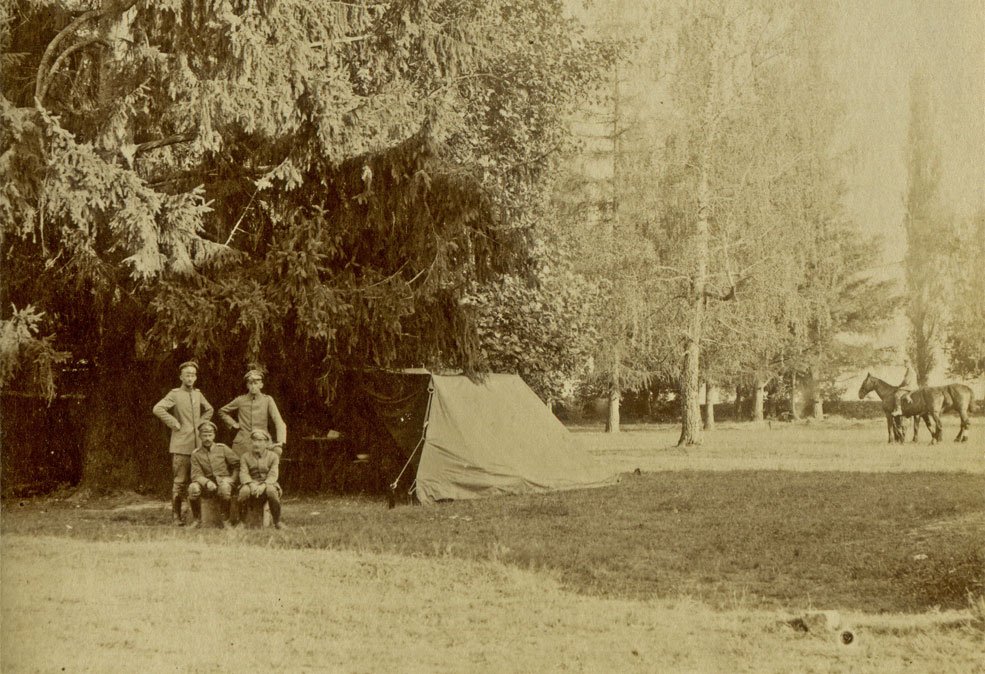
Above: Hauptverbandplatz (casualty clearing station) of Sanitäts-Kompagnie Nr.253 (the divisional medical company) near Borshchiv, during early August when the division held the Berezanka bridgehead. In the absence of suitable buildings, the company has been obliged to set up in tents under the cover of trees.
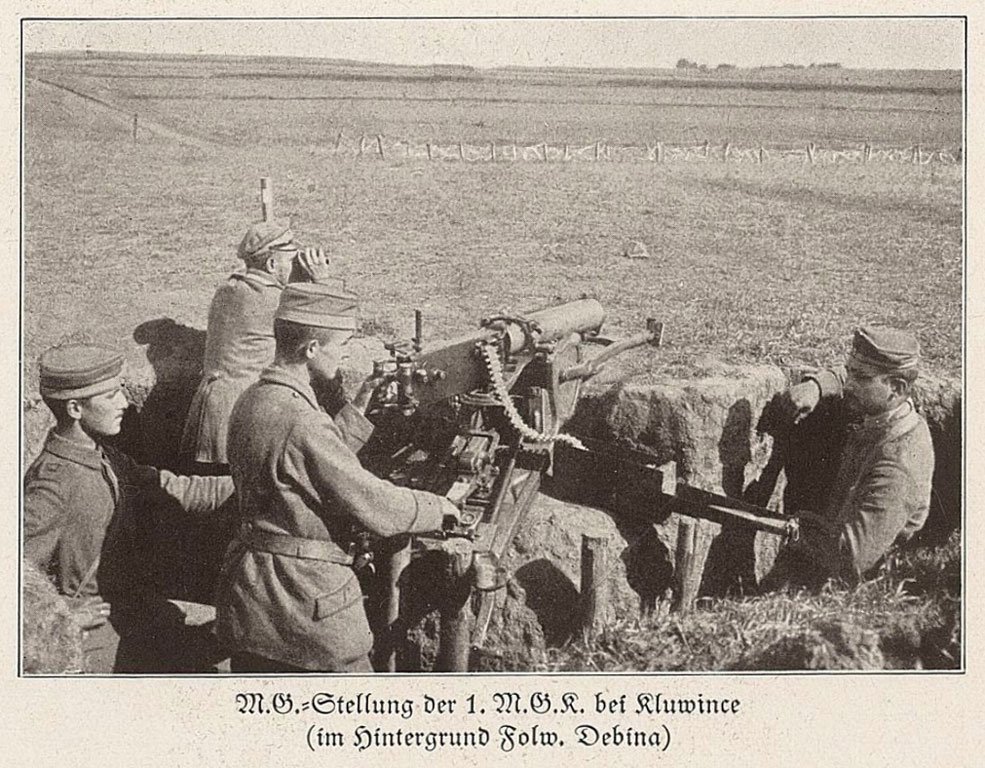
Above: MG 08 team of 1. MG Kompagnie / IR 473 deployed in the crude and shallow trenches of the K1 Linie (the main line of resistance) defending the village of Kluwińce (Klyuvyntsi, Ukraine) in the Chorostkow sector. 'Folw. Debina' is one of the strongpoints of the outpost line.
Although seen here, most of the K1 Linie was unprotected by barbed wire, and dugouts were completely absent. Fortunately, no significant enemy action was expected and none occurred while the 241.ID held this sector.
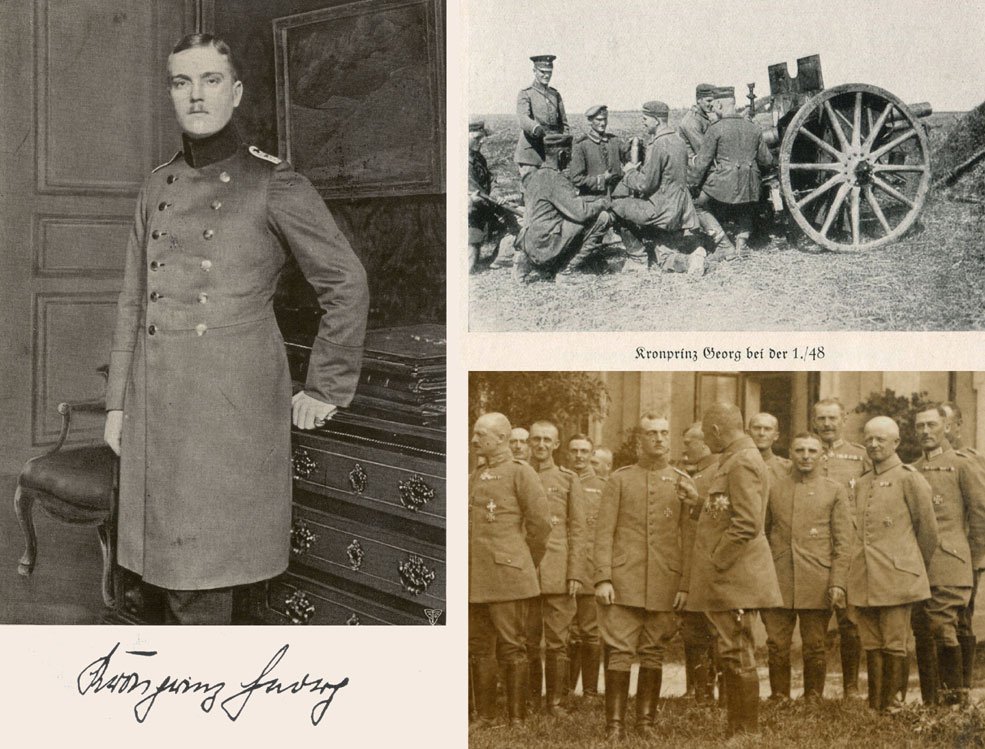
Above: on 19th August 1917 the heir to the Saxon throne, Kronprinz Georg von Sachsen, joined the 241.ID in the field. Like his brothers the young prince had been commissioned in peacetime as an officer with Leibgrenadier-Regiment 100 and held the rank of Major. As part of his ongoing training as future head of the Royal Saxon Army, the prince was now to learn the role of an artillery officer. Major Wagner of FAR 48 was in all probability both surprised and delighted to hear that his regiment (rather than FAR 12 or 32, both of which had the king as their ceremonial 'Chef' and wore his royal cypher) had been selected for this honour. The following day Kronprinz Georg visited the battery positions of 3./48 for the first day of his practical training. Sadly we do not know whether Arno was present.
Although the king had undoubtedly picked the regiment due to the quietness of its current front, the Russians actually raided the outpost line on the night of 25th-26th August, and could be seen developing their lines and bringing fresh artillery into position. Thus the opportunity was taken for the prince to draw up and issue a detailed order for a fire mission to the howitzers of 4./48.
On 28th August Kronprinz Georg assumed temporary command of I. Abt. / FAR 48 until 24th September, and thus became Arno's battalion commander. Since he would subsequently lead IR 104 (Regiment 'Kronprinz') in 1918, it is highly likely that both Arno and Rudolf served under his command. The high point of the prince’s time with FAR 48 came on 6th September, when King Friedrich August III visited the 241.ID at Chorostkow accompanied by the army and corps commanders. Having personally decorated various officers and men of the division with the Saxon Militär-St.Heinrichs-Orden or Militär-St.Heinrichs-Medaille, the king appointed his eldest son as an officer à la suite of FAR 48. This honour for both the prince and the regiment granted him the permanent right to wear its uniform, as seen here (bottom right).
Following the war and his father's abdication, the deeply religious and serious-minded Kronprinz Georg followed the example of his uncle Prinz Max von Sachsen and took holy orders. As a Jesuit priest, Pater Georg would become one of Hitler's most determined and outspoken opponents in the Roman Catholic Church. On 14th May 1943 he drowned in the Groß Glienicker See near Berlin under mysterious circumstances. His younger brother Prinz Ernst Heinrich was among those to allege that he had been murdered by the Gestapo. The former crown prince was interred alongside his father and ancestors in the royal crypt of the Katholische Hofkirche in Dresden.
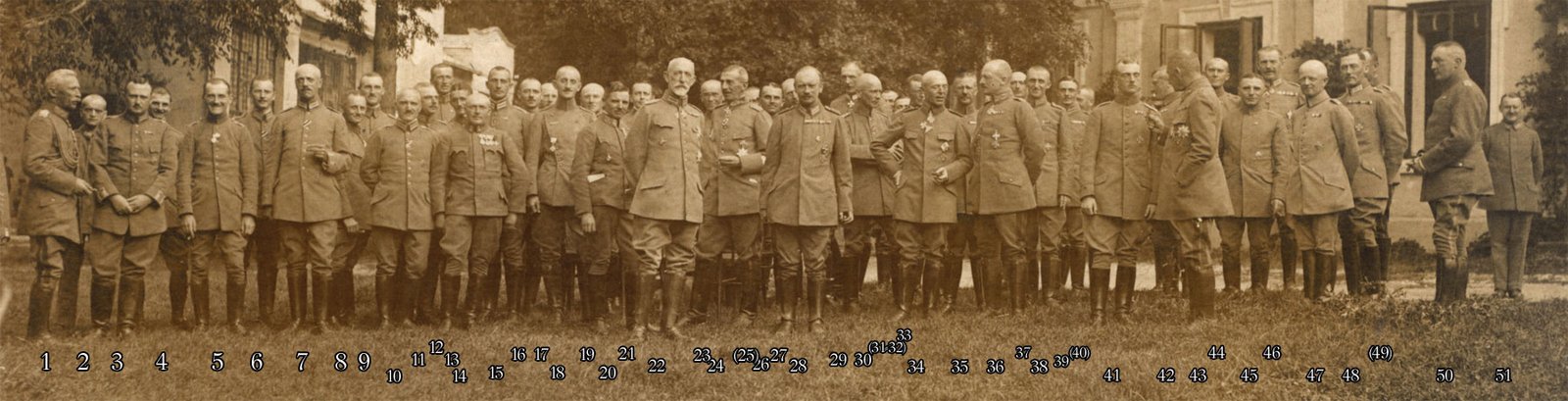
Above: the King of Saxony's visit to the 241.ID at Chorostkow on 6th September 1917 (click to enlarge). I have not yet made a serious attempt at systematically identifying those present, and would welcome assistance!
22: Gen. der Inf. Graf von Bothmer (Südarmee)
24: Genltn. Hofmann (Beskidenkorps)
28: S.M. Friedrich August III, König von Sachsen
41. S.K.H. Kronprinz Georg von Sachsen (in the uniform of FAR 48)
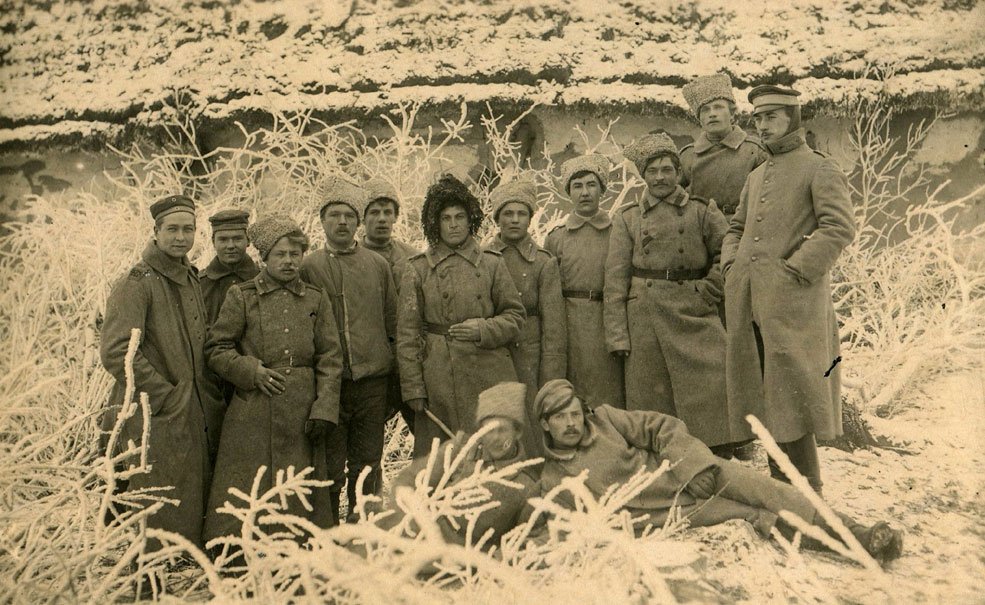
Above: Walter Schürer and comrades from 3. Komp. / IR 473, pictured together with their Russian opposite numbers in December 1917.
Although the Russian forward patrols in the Chorostkow sector had remained surprisingly active into the autumn, the Bolshevik coup in Petrograd on 7th November 1917 spelled the end of the war in the East as anything more than a policing operation. On 6th December the 241.ID was informed that an armistice had been agreed for the entire Eastern front. A demarcation line was agreed in No Man’s Land, with an official meeting point for supervised contact with the Russians via the divisional interpreter. Fraternisation was prohibited, but it is unclear how strictly or efficiently this was actually enforced.
Christmas was celebrated in memorable and optimistic style, in the company of the local 'Ruthenian' (Ukrainian) villagers. The division’s relief by Austro-Hungarian troops began on 1st January 1918, after exchanging its older and less fit men for the fittest men of the Saxon 96.ID (which was destined to remain in the East). The new year would be spent on the Western Front, and was to be marked successively by triumph, tragedy and total disaster. Credit: Jürgen Schmieschek collection.