
7. KGL. SÄCHS. INFANTERIE-REGIMENT 'KÖNIG GEORG' NR. 106 (from the St. Yvon road to the Le Gheer road) actually belonged to 24.ID, but had only arrived from the Champagne front in late October while the battle was already raging - and had consequently been used to reinforce a critical part of the front of 40.ID opposite Ploegsteert Wood. The regiment had taken the edge of the wood on 7 November, but due to appalling weather had gradually abandoned its untenable line there in favour of a new position constructed behind them by Saxon engineers (3. Komp. / Pionier-Bataillon 22) around the hamlet of Le Pelerin. The last advanced posts in the wood were abandoned on 19th December, the sentries falling back to Le Pelerin in the face of a major assault by the British 11th Brigade. This attack broke up with grievous losses in front of the well-fortified Saxon position, known to the British as 'the Birdcage' (due to its - by 1914-15 standards - thick belts of wire) and to the Germans as 'der Entenschnabel' ('the Duck's Bill', due to the shape of this small salient).
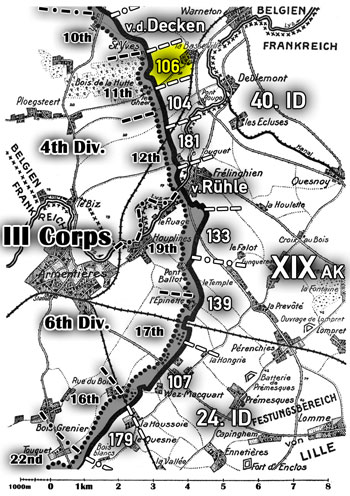
In December the IR 106 sector consisted of two battalion subsectors, divided by the Le Pelerin road (Fabrikstrasse). The northern subsector was held alternately by I. and III. / IR 106, the southern subsector alternately by II. / IR 106 and the attached II. / IR 133. Given the number of sightings of '133' in the British sources, it appears that II. / IR 133 was holding the southern half over Christmas. Opposite IR 106 (and II. / IR 133) was most of 11th Brigade (4th Division), comprising - from north to south - 1st Somerset Light Infantry, 1st Rifle Brigade with the London Rifle Brigade attached and 1st Hampshires.
It seems that the singing in this sector began quite late on Christmas Eve. The regimental band under Musikmeister Capitän played that night at La Basse Ville, beginning about 4am according to accounts from JB 10. Contact with the enemy seems to have been established informally at some point, although Ltn. d. R. Zehmisch of IR 134 describes hearing "idiotic" rifle fire from the IR 106 sector throughout the night.
On Christmas morning a provisional sector truce was agreed with officers of the Somerset Light Infantry and Rifle Brigade for the purpose of recovering the numerous dead scattered between Ploegsteert Wood and the 'Birdcage' for burial. Captain Beckett of the Hampshires later reported that he had kept his men in their trenches, did not interfere with the truce and carefully observed the mass fraternisation that ensued. The regimental history of IR 106 (published in 1927) states that:
Any such permission from XIX.AK was surely retrospective, since (going by his journal entries) the first report reached Generalmajor Richard Kaden at the headquarters of 48. Infanterie-Brigade (which comprised IR 106 and IR 107) on 27th December. Admittedly IR 106 was operating detached from its parent brigade and division, meaning that Kaden was not quite as well informed as usual about its doings. He had no objections to the situation, having already heard about the truce in the IR 107 sector.
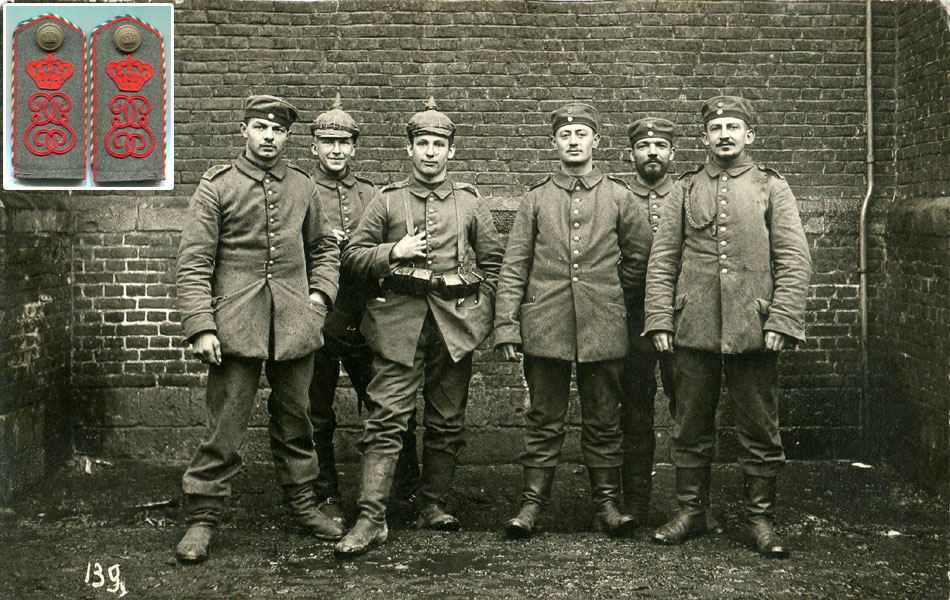
Above: A group from IR 106 pictured behind the line in February 1915 (the sender, who identified himself only as 'Walther', writes from Deulemont on 20th February). Note the royal cypher of the late King Georg (George) of Saxony (1832-1904) worn on the shoulderstraps of this regiment in place of a number. One would reasonably expect that this would have hindered identification of IR 106 by the British during the truce.
Despite his own clear acquiescence to the truce, Oberst Kohl of IR 106 was obviously anxious to keep his regiment's contact with the enemy on a strictly formal (and militarily excusable) basis. On 27 December he ordered a symbolic resumption of MG fire at midnight, of which the Hampshires (and presumably the other British units opposite) were politely warned in advance. On the 30th the Hampshires were informed by the Saxons that they would no longer be able to fraternise (presumably as a result of the OHL order), and that symbolic firing might be required. The same day the Rifles were given the aforementioned New Year truce proposal, signed by Kohl and authorised by Generalkommando XIX.AK. Although the British could not fulfil Kohl's conditions in time, the sector remained quiet well into early January.
1. Armistice for the burial of the dead will take effect on 31.12.14 from 10 a.m. - 2 p.m. (German time), if written agreement to the following conditions by the British commander responsible is received here beforehand.
2. A boundary is to be determined by the German and English officers, which may not be crossed under any circumstances. Members of the English army must be prevented from approaching this side of the line. If necessary, the dead are to be carried up [to the line] by German soldiers.
3. During this period, no firing is to be permitted by either side along the entire eastern edge of the Bois de Ploegsteert from St Yves to Le Gheer, and none with artillery into the entire rear area (including the area east of the Lys).
4. The officer who has the power of command over the infantry and artillery within the sector in question must agree to these conditions in writing and have them returned to the officer who sent them.
5. If this statement of agreement is not in the possession of the German officer by 8 a.m. (German time) on 31.12., it will not be possible to maintain the ceasefire on 31.12.14.
Kohl
Oberst
[War Diary of 1 Battalion Rifle Brigade (The National Archives, London - WO 95/1496/1)]