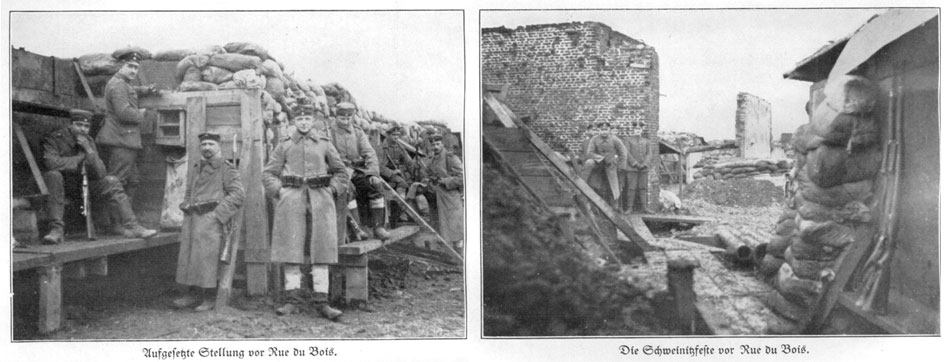
14. KGL. SÄCHS. INFANTERIE-REGIMENT NR.179 (from the railway line at Rue du Bois to Grande Flamengrie Farm) was not involved in the truce, as attested by every available source from both sides. Most of British 16th Brigade (6th Division) was opposite, with 1st Leicesters on the British left mainly facing IR 107 while 1st Buffs and 2nd York & Lancasters faced IR 179.
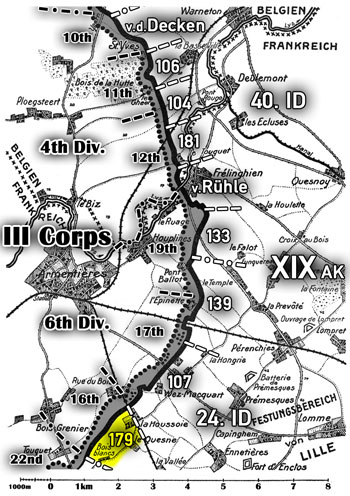
The main text of the published history of IR 179 merely states that Christmas Eve was undisturbed by the enemy, who could be heard celebrating with singing and bagpipes. However according to a personal account from a veteran of 9. / IR 179 (included in the published regimental history), his company was expecting a relief that evening.
While waiting they sang Christmas songs, and were applauded by the British. No trees are mentioned (presumably because the men were not expecting to remain there long) but candles were produced and a seasonal atmosphere developed. However the non-appearance of their relief put the 179ers in a foul mood, under the influence of which they turned from Christmas carols to an exchange of catcalls with the enemy.
The war diary of 2nd York & Lancasters records (formal?) "advances for armistice" on Christmas Day which they rebuffed. IR 179 nevertheless observed developments in the IR 107 sector with interest, and did not attempt to disrupt what the published history of IR 179 characterises purely as an official truce for burial of the dead. However there is no reference in this book (or any other source we have yet seen from XIX.AK) to the known occurrence of trucing and fraternisation in the sector of the regiment's southern neighbour, IR 55 (13.ID / VII.AK).
The Buffs were relieved by 1st King's (Shropshire Light Infantry) on Boxing Day.