
11. KGL. SÄCHS. INFANTERIE-REGIMENT NR.139 (from slightly north of Pont Ballot to La Bleue / La Hongrie) had at least two battalions in line, and had shifted northward on 5th December to take over the former sector of JB 13 at Pont Ballot. At Christmas 1914 it faced 1st Cameronians (see IR 133 above), as well as 2nd Leinsters and 3rd Rifle Brigade both of 17th Brigade (6th Division).
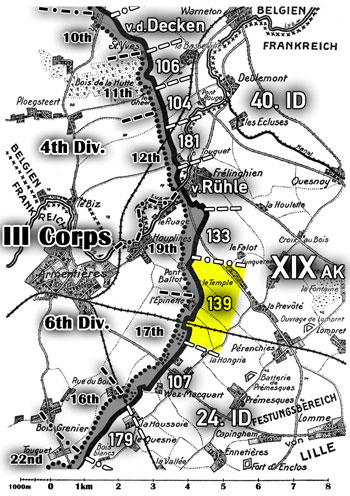
At the northernmost end of the IR 139 sector, low-level hostilities continued throughout as normal - and (as already noted) both 1st Cameronians and 'D' Company of 2nd Leinsters mistakenly believed they were facing Prussians. However on the front held by 'B' and 'C' Company of the Leinsters, together with that of the neighbouring 3rd Rifle Brigade, the British responded warmly to Saxon carol singing and decorations on Christmas Eve. Both a British account 31 and the regimental history of IR 139 (published in 1927) agree that fraternisation occurred between that regiment and the Rifles in No Man's Land that night.
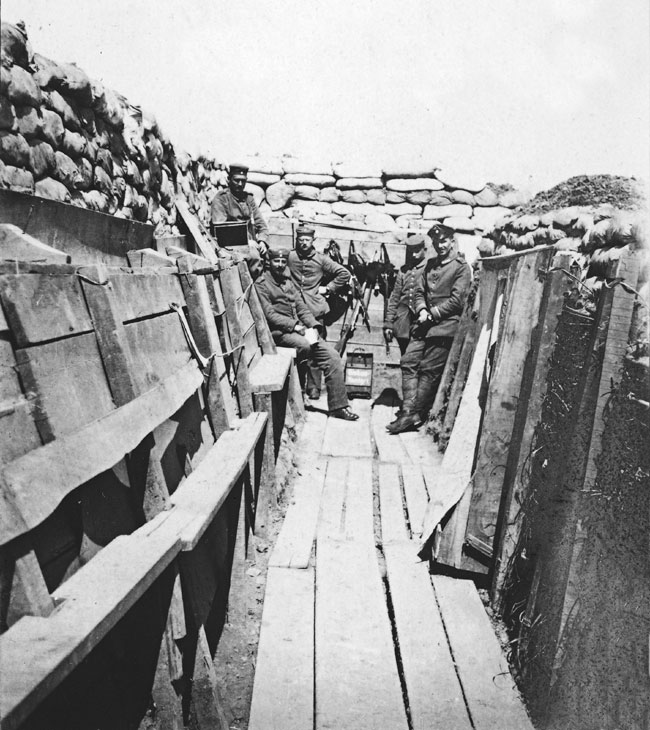
This is one of a large album of photos taken by an unknown officer of IR 139 in 1914-1916. Many more appear in chapter 4 of Fighting the Kaiser's War and another was used on the cover.
According to IR 139, the British were the instigators and a British chaplain was the first to approach them; this has not been corroborated from British sources. While British accounts of the Truce often mention Germans with family or business connections in England, the history of IR 139 claims that a few of the Tommies they met that night had worked in Chemnitz (home town of IR 104 and IR 181) in spring 1914. According to this source, a truce was agreed until midday on Boxing Day, which would include the artillery "as far as possible" while recognising that neither side's infantry could make definite guarantees for the actions of their sister arm.
On Christmas Day fraternisation and the recovery of the dead for burial took place on a large scale, and the Leinsters also became involved. There was a brief panic when Oberst Max Einert of IR 139 chose to visit his regiment in the trenches. Having not informed regimental HQ of the truce, the officers on the ground attempted to restore the appearance of normality before his arrival. Their deception came unravelled when Einert ordered a sentry to shoot a Tommy who was digging in the open; naturally the shot went wide and the Tommy started gesticulating with his spade - either imitating the signal for 'missed' in range shooting or reminding the shooter of the truce. This anecdote is repeated in Brown & Seaton, but they partly overlook the humorous tone and entirely omit the outcome - since it was no longer possible to keep up the deception, Einert was informed and fortunately saw the funny side.
The Leinsters were relieved by 1st West Yorkshires of 18th Brigade on Boxing Day. Trucing and low-level fraternisation continued here into early January. Interestingly 2nd Leinsters (by then transferred to 24th Division) once again truced and fraternised with Saxons (IR 178 / 123.ID) at St. Eloi in November 1915. On a third occasion at Vimy Ridge in September 1916, Saxons (probably from RIR 101 / 23.RD) attempted to fraternise with a sentry of the battalion, but were treacherously shot after being encouraged to approach. Captain F.C. Hitchcock, who had taken part in the fraternisation at St. Eloi (with the intention of gathering information) recorded the incident at Vimy Ridge with apparent approval.