
15. KGL. SÄCHS. INFANTERIE-REGIMENT NR.181 (from the vicinity of the railway line to the vicinity of Le Touquet) faced 2nd Monmouthshires and 2nd Lancashire Fusiliers of 12th Brigade. The opposing front trenches were only about 100m apart here, and far closer in places - notably at the railway line. According to its published history the regiment "most energetically rejected" all fraternisation approaches.
The 12th Brigade war diary however records shouted conversations with the Germans as early as 30th November, a natural result of the closeness of the opposing trenches. On the following day, men of the 2nd Lancashire Fusiliers attempted to barter with the Saxons for "helmet badges" in exchange for the much-loved (by the Germans at least) British 'bully beef'; negotiations broke down as neither side could agree as to who should come out of their trench first.
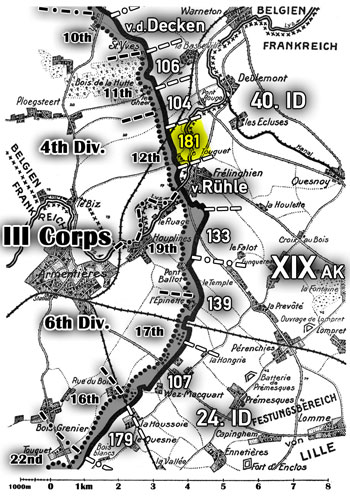
By 11th December the 2nd Essex were in the line, and reported direct contact with IR 181 in their battalion war diary:
This incident was not well received by Brigadier General Anley of 12th Brigade, who reiterated the corps orders against fraternisation and expressly forbid any continued communication with the Saxons. Nevertheless the Saxons seem to have felt that an understanding had been reached, as on Christmas Eve an envoy from IR 181 ended up being taken prisoner by the Lancashire Fusiliers. This was the sad result of a sentry's error in not blindfolding him before he was brought into the British trenches, and may well have been the reason for the apparently hostile attitude of IR 181. It may also be the source of the aforementioned reference in the published history of IR 104 to "trusting German soldiers" being deceived into captivity.
Nevertheless a report from Lieutenant-Colonel Cuthbertson of 2nd Monmouthshires (which admittedly contains a few plainly impossible unit identifications in addition to some plausible ones) claims that a few men from 10. / IR 181 were present at the burial truce in the IR 104 sector. 2nd Lancashire Fusiliers certainly fraternised, although this may have been with III. / IR 104 of 'Regiment von Rühle' immediately to the south of IR 181.
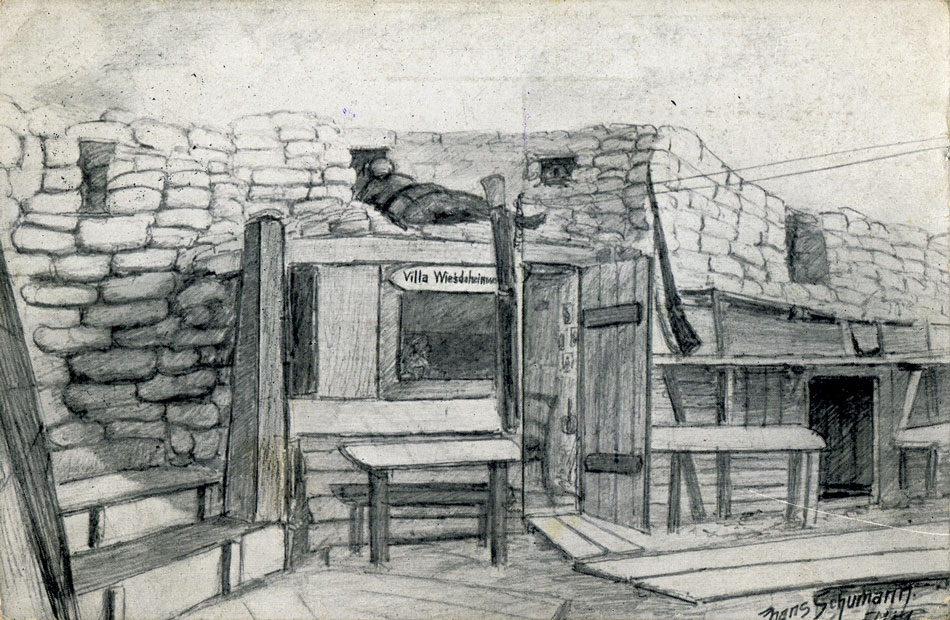
Above: Front-line position of IR 181, sketched by one Hans Schumann and printed as a picture postcard by a local firm in the regiment's garrison town of Chemnitz. The 'dugout' on the left, constructed in the homely style typical of the early months of trench warfare, is a trench HQ equipped with a telephone (note the overhead wires) and whimsically named "Villa wie's daheim war" ('Villa just like it was at home').