
9. KGL. SÄCHS. INFANTERIE-REGIMENT NR.133 (from somewhat south of Frelinghien to slightly north of Pont Ballot) held its relatively large sector presumably with I. / IR 133 and III. / IR 133 abreast; II. / IR 133 was with IR 106 at Ploegsteert Wood as previously noted. Opposite the regimental sector lay 2nd Argyll & Sutherland Highlanders, the territorial 1/5th Cameronians (Scottish Rifles) and possibly the left flank of the regular 1st Cameronians, all of 19th Brigade.
A published history of IR 133 did not appear until 1969, by which time its author Leutnant Johannes Niemann had already appeared in a BBC documentary on the Truce (Christmas Day Passed Quietly, 1968). This elderly officer was also apparently responsible for tracking down another eyewitness from his regiment, Soldat(?) Hugo Klemm, whose account he received in a letter in 1968.
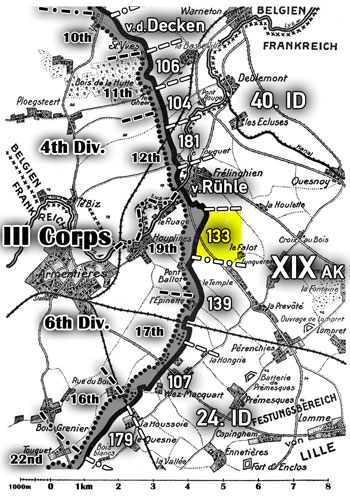
According to Niemann and Klemm, events on Christmas Eve only escalated to the point of a ceasefire and long-distance singing contest between the opposing trenches. Klemm notes that he and his comrades had been warned in advance by their company commander to be on their guard against any enemy attempt to take advantage of their relaxed mood. However according to the Argyll & Sutherland Highlanders, contact was established by envoys in No Man's Land that night. One such envoy was German-speaking Lieutenant Ian Stewart, who brought back a photo of the pre-war IR 133 football team from the exchange of gifts - indicating that the idea of football was already in the air here on Christmas Eve.
Whatever may have been agreed during the night, Klemm claims that in his part of the line an NCO of IR 133 'broke the ice' early on Christmas morning by carrying a tree out into No Man's Land and meeting a Tommy there. His platoon commander (one Leutnant Grosse, not yet fully identified) then met his counterpart between the lines to agree a burial truce. For his part, Niemann was informed about midday that mass fraternisation was underway and went out to investigate. His account of subsequent developments includes the most detailed (and perhaps most plausible) description of a Christmas Truce football match, during which the Saxons were greatly amused to discover that the Scotsmen really were wearing nothing underneath their kilts! Football is also mentioned in passing by Klemm. Supposedly the Saxons won 3-2, a score which recurs frequently in British references to Christmas football matches. Frequently reprinted, Niemann's account can be found in most books on the Truce and many places online - but often lacking his interesting description of how the fraternisation ended:
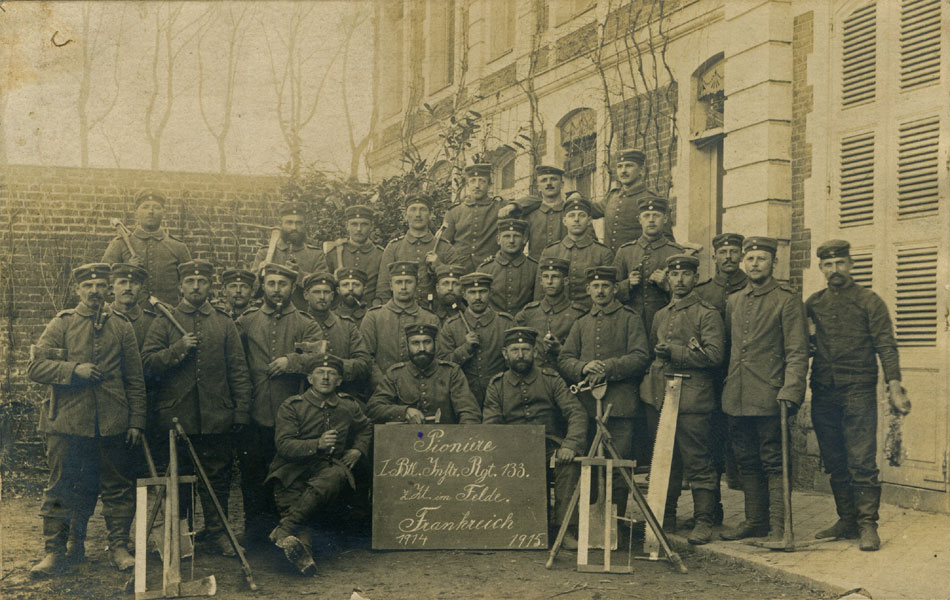
Above: Infanterie-Pioniere of I. Bataillon / IR 133 somewhere behind the front early in 1915 (the large beards seen here would disappear after the introduction of gas protection, due to the need to create a good seal on the face). Following the unprecedented demand for the services of the Pioniere (official combat engineers) during the first winter in the trenches, countless infantry regiments formed their own organic companies or smaller units of Infanterie-Pioniere, recruited from those of their men who possessed relevant skills and experience from their civilian trades.
Infanterie-Pioniere were trained and supervised by the overstretched official Pioniere, and undertook all manner of less technical construction and engineering tasks. Likewise Handgranatentrupps of the infantry took over the role of bombers (the hand grenade having originally been a specialist Pionier weapon) and Mineurtrupps or Mineurkommandos aided the Pioniere in the underground war.
To the south of the Argylls, 1st Cameronians took no part in the truce or fraternisation with either IR 133 or IR 139 - apparently under the illusion that they were opposite Prussians. The territorial 1/5th Cameronians however did fraternise on Christmas Day; it seems that their forward elements were on the left of those of the regular battalion (among other clues, their published history includes a photo of the Lutun Brewery taken from the front line). This instance of fraternisation came to a tragic end after 'a regular' (possibly a member of the 1st Cameronians?) fired at the Germans, and a return shot killed Corporal Walter Smith. Saxon protestations that 'a Prussian' was responsible are scarcely credible based on the known unit dispositions, unless referring to an individual Prussian subject serving with the Saxon army.
The Cameronians (including the 1/5th) were relieved by 1st East Yorkshires and the Argylls by 2nd Sherwood Foresters on Boxing Day; both relieving units belonged to 18th Brigade.